
ADHD Self-Motivation Steps for Creative Entrepreneurs
ADHD Self-Motivation Steps for Creative Entrepreneurs
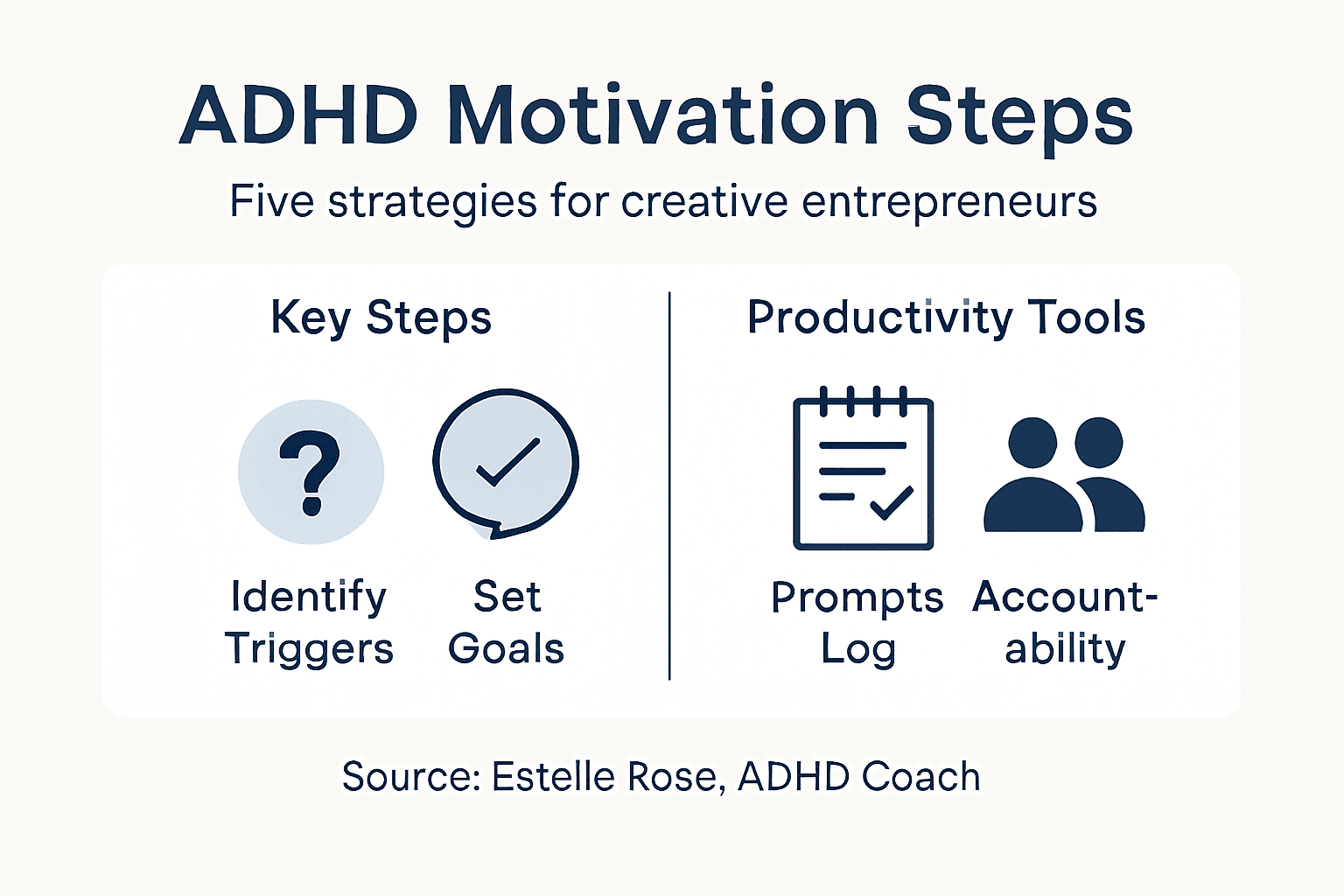
Balancing creativity and business demands as a British or American freelancer with newly diagnosed ADHD can feel overwhelming. Motivation often flickers between intense bursts and frustrating lulls, making burnout a real risk. By understanding your own unique dopamine responses, you can tailor self-motivation strategies that honor your neurodivergent strengths and help you manage everyday productivity hurdles. This guide delivers practical tools and ADHD-friendly frameworks that support your growth without sacrificing your creative energy.
Table of Contents
- Step 1: Clarify Your Personal Motivation Triggers
- Step 2: Design An ADHD-Friendly Goal System
- Step 3: Create Targeted Action Prompts For Tasks
- Step 4: Implement Flexible Accountability Tools
- Step 5: Review And Refine Your Motivation Methods
Quick Summary
| Key Point | Explanation |
|---|---|
| 1. Identify personal motivation triggers | Map out activities, emotions, environments, and rewards that energize you for tailored motivation strategies. |
| 2. Use a flexible goal system | Develop goals that align with your interests and allow for ongoing adjustments, encouraging sustainable progress. |
| 3. Create engaging action prompts | Design clear, motivating prompts that transform tasks into exciting challenges, helping tackle complex projects. |
| 4. Implement dynamic accountability tools | Set up a supportive accountability system that adapts to your needs, making tracking effortless and enjoyable. |
| 5. Continuously review motivation methods | Regularly assess your motivation strategies and be open to refining them, ensuring they meet your evolving needs. |
Step 1: Clarify your personal motivation triggers
Understanding what genuinely sparks your motivation is crucial for creative entrepreneurs with ADHD. People with ADHD experience unique dopamine responses that make traditional productivity strategies less effective.
To identify your personal motivation triggers, start by mapping out the activities and conditions that consistently energize you. This isn’t about generic productivity hacks - it’s about deeply understanding your neurological wiring. Consider tracking these key elements:
- Emotional resonance: Which tasks make you feel excited or purposeful?
- Time of day: When are you most naturally alert and engaged?
- Environment: What physical settings help you feel focused and inspired?
- Reward mechanisms: What types of recognition or outcomes genuinely motivate you?
The goal is creating a personalized motivation blueprint that works with your ADHD brain, not against it. Experiment with different approaches and pay attention to what consistently generates momentum.
Your motivation triggers are unique. What works for others might not work for you - and that’s perfectly okay.
Tracking is key. Use a simple journal or digital tool to document your energy levels, task engagement, and emotional responses. Look for patterns that reveal your most effective motivation strategies.
Pro tip: Design a motivation experiment where you intentionally try different work environments and tracking methods to discover your most energizing conditions.
Step 2: Design an ADHD-friendly goal system
Creative entrepreneurs with ADHD need a goal-setting approach that matches their unique neurological wiring. Traditional goal frameworks often fail because they don’t account for the neurodivergent brain’s motivation patterns.
Instead of rigid, linear goal structures, develop a flexible system that embraces your natural strengths. Consider implementing the PACT framework, which focuses on goals that are:
- Purposeful: Align goals with your core values and genuine interests
- Actionable: Break down complex objectives into immediate, manageable steps
- Continuous: Create ongoing processes instead of fixed endpoints
- Trackable: Use visual and dopamine-friendly tracking methods
Your goal system should feel more like a dynamic adventure than a restrictive checklist. This means building in frequent rewards, allowing spontaneous adjustments, and celebrating small wins along the way.
An ADHD-friendly goal system isn’t about perfection - it’s about sustainable progress and maintaining your enthusiasm.
Experimentation is crucial. No single approach works for everyone with ADHD, so treat your goal-setting method as an evolving experiment. Monitor what generates excitement and momentum, and be willing to quickly pivot when something isn’t working.

Pro tip: Create a visually engaging goal tracker with color-coded sections, stickers, or digital tools that provide instant dopamine hits when you make progress.
Step 3: Create targeted action prompts for tasks
Managing complex tasks with an ADHD brain requires strategic approaches that transform overwhelming projects into digestible, motivating steps. AI-powered task prompting techniques can serve as your personal executive function assistant, breaking down mental barriers and creating clear pathways to action.
Develop targeted action prompts by focusing on these critical elements:
- Specificity: Create ultra-clear, granular task descriptions
- Micro-Progression: Design prompts that feel like tiny, achievable missions
- Curiosity Triggers: Include elements that spark your intrinsic motivation
- Visual Cues: Incorporate visual or sensory descriptors that engage your attention
Your action prompts should feel less like a to-do list and more like an exciting challenge. Think of them as personal quest instructions that transform mundane tasks into engaging adventures.
Action prompts are not rigid commands - they’re flexible invitations to engage with your work in a way that feels authentic and energizing.
Experiment with prompt structures. Some entrepreneurs find success with question-based prompts, while others prefer command-style or narrative-driven approaches. The key is discovering what resonates with your unique cognitive style.
Pro tip: Record your most effective action prompts in a dedicated digital or physical notebook, creating a personalized toolkit of motivation strategies that you can reference and refine over time.
Step 4: Implement flexible accountability tools
Accountability for entrepreneurs with ADHD requires a nuanced approach that adapts to your unique cognitive style and energy fluctuations. The goal is creating a system that supports you without feeling restrictive or overwhelming.
Design your accountability framework around these key principles:
- Dynamic Tracking: Use tools that allow real-time adjustment and flexible progress monitoring
- Visual Engagement: Select methods with immediate visual feedback
- Low-Friction Logging: Choose systems that make tracking feel effortless
- Reward-Oriented Design: Incorporate built-in celebration mechanisms
Your accountability approach should feel more like a supportive companion than a harsh taskmaster. Think of it as a collaborative partner that understands your brain’s unique rhythms and challenges.
Accountability isn’t about punishment - it’s about creating a supportive structure that helps you succeed on your own terms.
Experiment constantly. What works this month might feel constraining next quarter. Stay open to reimagining your accountability tools as your skills and strategies evolve.
Pro tip: Create a quarterly accountability review where you assess and redesign your tracking systems, treating them as living documents that grow alongside your entrepreneurial journey.
Here’s a quick overview of how ADHD-tailored approaches differ from traditional methods:
| Aspect | Traditional Systems | ADHD-Friendly Systems |
|---|---|---|
| Motivation | External rewards, fixed routines | Intrinsic triggers, flexible strategies |
| Goal Structure | Linear, fixed endpoints | Adaptive, evolving checkpoints |
| Tracking | Rigid, scheduled reviews | Dynamic, frequent check-ins |
| Accountability | Formal reporting, strict rules | Supportive, collaborative tools |
Step 5: Review and refine your motivation methods
Navigating motivation with ADHD requires continuous adaptation and honest self-reflection. Understanding the deeper patterns of motivation challenges is crucial for developing sustainable strategies that actually work for your unique brain.
Refine your motivation methods through these strategic approaches:
- Radical Honesty: Track what genuinely energizes versus what feels like resistance
- Quarterly Assessment: Schedule regular check-ins to evaluate your current systems
- Data Collection: Document your productivity patterns without judgment
- Flexibility Mindset: Treat your motivation strategies as experiments, not fixed rules
Your motivation framework should be a living document that evolves with your entrepreneurial journey. Think of it as a personal operating system that requires occasional software updates.
Motivation isn’t about perfection - it’s about understanding your unique cognitive landscape and creating systems that support your natural rhythms.
Embrace iteration. What worked six months ago might feel completely different now. Your ADHD brain craves novelty and change, so build that understanding directly into your motivation review process.
Use this table to guide your motivation review process:
| Review Focus | What To Assess | Adjustment Strategy |
|---|---|---|
| Energy Patterns | Times of peak productivity | Shift key tasks to these periods |
| Resistance Points | Tasks you avoid or dread | Modify or break into smaller steps |
| Reward Responses | What motivates follow-through | Add more effective rewards |
| Progress Markers | How you track small wins | Update tools to be more visual |
Pro tip: Create a digital or physical motivation journal where you record your energy levels, successful strategies, and moments of resistance, treating it like a scientific study of your own cognitive patterns.
Unlock Your Unique Motivation with Expert ADHD Coaching
Struggling to harness your motivation as a creative entrepreneur with ADHD can feel overwhelming when traditional strategies just do not fit your brain’s unique needs. This article dives deep into how ADHD-friendly goal systems, personalized action prompts, and flexible accountability methods can transform your productivity and joy in work. If you find yourself battling inconsistent energy patterns or difficulty breaking down tasks, you are not alone.
Discover how tailored coaching and proven self-help techniques can empower your journey. At Estelle Rose, an ADHD coach and author specializing in adult ADHD, you will find guidance designed to align with your individual motivation triggers and creative strengths. Take control now and explore personalized strategies that help you build sustainable progress without burnout. Start your transformation today by visiting Estelle Rose Coaching and experience motivation solutions made just for you.
Frequently Asked Questions
How can I identify my personal motivation triggers as a creative entrepreneur with ADHD?
To identify your personal motivation triggers, start by tracking the activities and environments that energize you. Document what tasks excite you, when you feel most alert, and what settings help you focus; review this data across a few weeks to find consistent patterns.
What is the PACT framework for setting goals with ADHD?
The PACT framework focuses on creating goals that are Purposeful, Actionable, Continuous, and Trackable. To implement this, break down larger objectives into smaller, manageable steps that allow for ongoing adjustments and frequent rewards.
How can I create effective action prompts for complex tasks?
Design your action prompts to be specific, granular, and engaging by incorporating visual cues and curiosity triggers. For example, transform overwhelming projects into tiny missions that feel achievable, making them less intimidating and more motivating.
What are flexible accountability tools I can use to support my progress?
Utilize dynamic tracking methods that allow for real-time adjustments and low-friction logging. Make your accountability tools visually engaging, and include built-in celebration mechanisms to acknowledge small wins along the way.
How often should I review and refine my motivation methods?
Schedule a quarterly assessment to evaluate what motivates you and what does not. During these reviews, focus on your energy patterns and resistance points, and be ready to adapt your strategies based on your findings to maintain motivation and progress.
What should I document in my motivation journal for effective tracking?
In your motivation journal, record your energy levels, successful strategies, and tasks you find resistance toward. This ongoing documentation will help you identify patterns and adjust your motivation methods to work more efficiently within 30–60 days.

