
Why Adults With ADHD Seek Coaching: Real Solutions
Why Adults With ADHD Seek Coaching: Real Solutions
Struggling to keep your creative projects on track while deadlines loom can drain energy and leave you questioning your abilities. For many adults in the UK and USA, especially self-employed professionals and overworked executives with ADHD, daily demands rarely align with the brain’s wiring. Adult ADHD coaching offers support through tailored strategies and goal-focused sessions that help transform scattered efforts into practical action steps designed to fit individual strengths.
Table of Contents
- Adult ADHD Coaching: What It Is
- Types Of Coaching For ADHD Adults
- Coaching Process And Core Strategies
- Key Benefits Of ADHD Coaching
- Who Seeks Coaching And Why
- Comparing Coaching With Therapy
Key Takeaways
| Point | Details |
|---|---|
| Focus on Practical Skill Development | Adult ADHD coaching prioritizes actionable strategies to improve daily functioning and achieve personal goals. |
| Acceptance and Empowerment Philosophy | Coaching emphasizes recognizing individual strengths and fostering self-awareness to navigate ADHD challenges. |
| Diverse Coaching Approaches | Various coaching types, including practical skills and cognitive behavioral coaching, address the unique needs of adults with ADHD. |
| Difference from Traditional Therapy | Coaching is future-oriented and action-driven, contrasting with therapy’s focus on emotional exploration and past experiences. |
Adult ADHD Coaching: What It Is
Adult ADHD coaching is a specialized, goal-oriented support strategy designed specifically for individuals navigating the complex challenges of Attention Deficit Hyperactivity Disorder (ADHD). Unlike traditional therapy, coaching focuses on practical skill development to help adults improve daily functioning and achieve personal objectives.
This targeted approach emerged in the early 1990s as professionals recognized that adults with ADHD require unique interventions beyond medication and standard counseling. The core philosophy centers on leveraging individual strengths while developing strategies to manage executive functioning challenges.
Key characteristics of ADHD coaching include:
- Individualized support tailored to personal goals
- Collaborative partnership between coach and client
- Focus on skill-building and practical life management
- Emphasis on identifying and maximizing personal strengths
- Helping clients develop self-awareness and adaptive strategies
ADHD coaching operates on a fundamental principle of acceptance and empowerment. Coaches work closely with clients to break down complex tasks, create structured approaches, and build confidence in managing ADHD-related challenges.
ADHD coaching is not about fixing a person, but about helping them discover their unique potential and develop personalized strategies for success.
The coaching process typically involves regular sessions where clients and coaches collaborate on:
- Identifying specific life and career objectives
- Developing personalized organizational systems
- Creating accountability mechanisms
- Building executive functioning skills
- Improving time management and productivity
Pro tip: Start by finding an ADHD-certified coach who understands the nuanced challenges of adult ADHD and can provide targeted, compassionate support.
Types Of Coaching For ADHD Adults
Adults with ADHD have diverse coaching needs, requiring specialized approaches that address their unique challenges. Coaching strategies range from practical skill development to psychological interventions, ensuring comprehensive support for individuals managing ADHD symptoms.
Practical Skills Coaching focuses on tangible life management strategies. This approach helps adults develop concrete skills like:
- Time management techniques
- Organization systems
- Workplace productivity strategies
- Academic performance improvement
- Goal-setting and accountability mechanisms
Cognitive Behavioral Coaching takes a more psychological approach, addressing underlying thought patterns and emotional regulation. These coaches help clients:
- Reframe negative self-perceptions
- Develop emotional resilience
- Challenge unhelpful thinking patterns
- Build self-confidence
- Manage stress and anxiety related to ADHD
Not all coaching is created equal. The most effective approach combines practical skills training with psychological support.
Some specialized coaching types include:
- Career-focused ADHD coaching
- Educational performance coaching
- Relationship and social skills coaching
- Personal development coaching
- Executive functioning coaching
These targeted interventions recognize that ADHD impacts every aspect of an individual’s life, requiring nuanced, personalized support strategies.
Here’s a summary of specialized ADHD coaching types and their primary focus areas:
| Coaching Type | Main Focus Area | Typical Client Profile |
|---|---|---|
| Career-focused coaching | Professional advancement strategies | Entrepreneurs, mid-career professionals |
| Educational performance coaching | Academic improvement | Graduate students, academics |
| Relationship and social skills coaching | Building interpersonal skills | Creative industry workers |
| Personal development coaching | Self-growth and confidence building | Self-employed individuals |
| Executive functioning coaching | Enhancing task management | Tech professionals, startup founders |
Pro tip: Select a coach with specific ADHD certification and experience who understands the multifaceted challenges of adult ADHD.
Coaching Process And Core Strategies
Structured coaching interventions for adults with ADHD follow a systematic approach designed to address the unique challenges faced by individuals with executive functioning difficulties. The process begins with comprehensive assessment and personalized goal setting, ensuring a tailored strategy for each client.
Initial Assessment Phase involves several critical components:
- Detailed personal history evaluation
- Identification of specific ADHD-related challenges
- Assessment of current functioning in work, personal, and social domains
- Exploration of individual strengths and potential barriers
- Establishing baseline measurements for future progress tracking
Core Coaching Strategies are designed to address the multifaceted nature of ADHD. These include:
- Cognitive behavioral technique implementation
- Emotional regulation skill development
- Executive function enhancement
- Personalized organizational system creation
- Motivational interviewing approaches
The most effective ADHD coaching transforms challenges into opportunities for personal growth and self-discovery.
Typical coaching sessions follow a structured progression:
- Goal identification and prioritization
- Strategy development
- Skill-building interventions
- Regular progress monitoring
- Adaptive strategy refinement
The coaching relationship is dynamic, with strategies continuously adjusted to meet the client’s evolving needs and challenges. Coaches work collaboratively, empowering clients to develop sustainable skills and build self-confidence.

Pro tip: Approach ADHD coaching as a partnership, bringing your authentic self and commitment to personal growth to each session.
Key Benefits Of ADHD Coaching
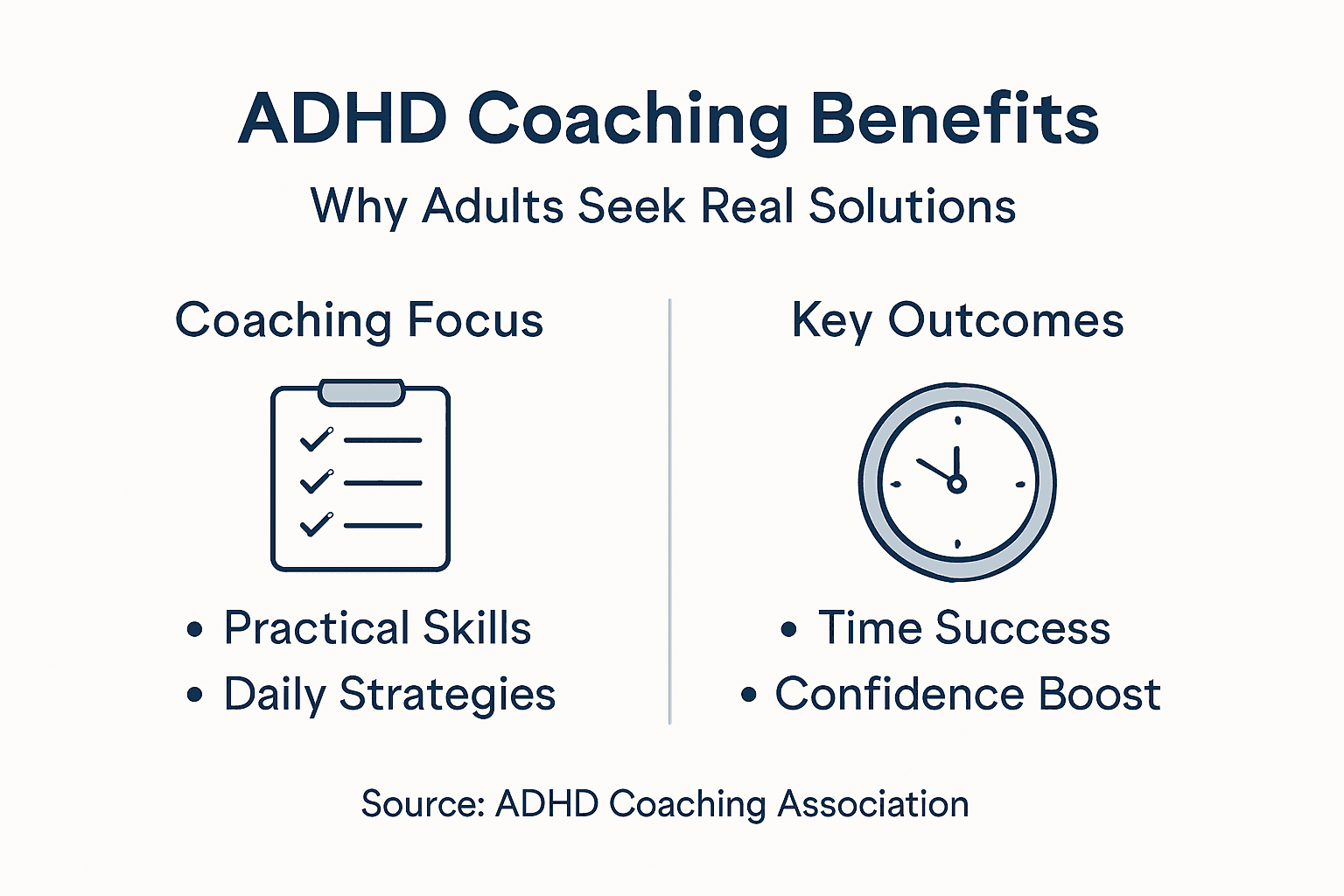
ADHD coaching offers transformative support for adults struggling with the complex challenges of neurodevelopmental differences. Unlike traditional therapy, coaching provides practical, action-oriented strategies that directly address the unique neurological patterns associated with ADHD.
Personal Empowerment Benefits include:
- Increased self-awareness and understanding of ADHD patterns
- Development of personalized coping mechanisms
- Enhanced emotional regulation skills
- Improved confidence and self-esteem
- Reduction of anxiety and stress related to ADHD challenges
Professional and Productivity Advantages encompass:
- Improved time management techniques
- More effective organizational strategies
- Better workplace performance and communication
- Enhanced goal-setting and achievement capabilities
- Reduced procrastination and increased task completion rates
ADHD coaching is not about fixing something broken, but about unlocking your unique potential and creating systems that work for your brain.
Specific areas of life transformation through ADHD coaching include:
- Career development and professional growth
- Personal relationship management
- Academic and educational performance
- Financial planning and management
- Mental health and emotional well-being
The holistic approach of ADHD coaching recognizes that neurodiversity is a strength, not a limitation. By providing tailored strategies and support, coaching helps individuals leverage their unique cognitive abilities while developing practical skills to navigate daily challenges.
Pro tip: Choose a coach who views ADHD as a difference to be understood and optimized, not a deficit to be corrected.
Who Seeks Coaching And Why
Adults with ADHD seek coaching as an alternative to traditional mental health approaches, recognizing the unique value of a strength-based, solution-focused strategy. These individuals are typically high-functioning professionals, creatives, and entrepreneurs who want practical support in managing their neurodivergent experiences.
Primary Demographics seeking ADHD coaching include:
- Self-employed professionals
- Creative industry workers
- Tech and startup entrepreneurs
- Graduate students and academics
- Mid-career professionals experiencing burnout
Motivational Drivers for seeking coaching often stem from:
- Persistent challenges with focus and productivity
- Desire for personalized performance optimization
- Need for strategic life management skills
- Feeling misunderstood by traditional therapeutic models
- Wanting to leverage ADHD as a potential strength
Coaching isn’t about fixing what’s wrong, but about amplifying what’s right.
Specific reasons individuals pursue ADHD coaching include:
- Career advancement strategies
- Relationship and communication improvement
- Personal development and self-understanding
- Stress management techniques
- Building sustainable life management systems
Many adults with ADHD have experienced traditional mental health interventions that felt disconnected from their lived experiences. Coaching offers a more dynamic, forward-looking approach that celebrates neurodiversity and individual potential.
Pro tip: Research coaches who specialize in ADHD and have personal or professional experience with neurodivergent thinking.
Comparing Coaching With Therapy
Adult ADHD interventions differ fundamentally between therapy and coaching, each addressing unique aspects of neurodevelopmental challenges. While both approaches aim to support individuals, their methodologies, goals, and underlying philosophies diverge significantly.
Key Differences between coaching and therapy include:
- Focus: Coaching targets future goals, therapy explores past experiences
- Approach: Coaching is action-oriented, therapy is insight-driven
- Duration: Coaching tends to be shorter-term, therapy can be long-term
- Methodology: Coaching provides practical strategies, therapy offers psychological exploration
- Professional boundaries: Therapists diagnose, coaches collaborate
Therapeutic Approaches typically involve:
- Diagnosing underlying mental health conditions
- Treating trauma and emotional regulation
- Addressing deep-rooted psychological patterns
- Exploring childhood experiences
- Managing comorbid mental health challenges
Coaching builds the bridge, while therapy helps understand the foundation.
Coaching strategies for adults with ADHD focus on:
- Immediate skill development
- Performance enhancement
- Goal achievement
- Practical life management
- Strengths-based personal growth
Both interventions are valuable, with therapy providing essential psychological support and coaching offering actionable, forward-looking strategies tailored to individual neurological differences.
Compare the most common adult ADHD intervention approaches:
| Aspect | Coaching for ADHD | Traditional Therapy |
|---|---|---|
| Primary Focus | Skill building, goal achievement | Emotional exploration, mental health diagnosis |
| Approach | Collaborative, action-oriented | Insight-driven, therapist led |
| Duration | Typically short to medium term | Often long term |
| Outcome | Improved life management | Emotional healing, coping skills |
| Professional Boundaries | No diagnosis, strengths-based | Diagnosis, mental health treatment |
Pro tip: Consider a holistic approach that combines coaching and therapeutic support for comprehensive ADHD management.
Discover Real Solutions for Adults With ADHD Seeking Coaching
Many adults with ADHD face ongoing challenges like difficulty focusing, managing time, and feeling misunderstood by traditional therapy models. These pain points often lead to frustration and stalled personal growth. As the article explains, coaching offers a strengths-based, solution-focused approach that empowers you to build practical skills and unlock your unique potential. Whether you struggle with productivity or want to improve relationships, the coaching process helps turn your ADHD from a challenge into a powerful advantage.

Ready to take control and experience the benefits of coaching designed specifically for adult ADHD? Visit Estelle Rose to explore expert guidance from an ADHD coach and author who understands your journey. Learn more about why adults with ADHD seek coaching and find personalized strategies that work. Don’t wait to start transforming your life with practical, compassionate support tailored to your needs. Visit Estelle Rose now and make your next move toward success.
Frequently Asked Questions
Why do adults with ADHD seek coaching?
Adults with ADHD often seek coaching for practical support in managing their symptoms, focusing on improving daily functioning, workplace productivity, and personal development.
What are the main benefits of ADHD coaching for adults?
ADHD coaching provides personalized strategies for better time management, emotional regulation, goal-setting, and enhanced self-awareness, leading to increased confidence and reduced stress.
How does ADHD coaching differ from traditional therapy?
ADHD coaching is action-oriented and focuses on future goals and skill-building, while traditional therapy often explores past experiences and emotional healing. Coaching is typically shorter-term and collaboration is emphasized.
What types of coaching are available for adults with ADHD?
Types of coaching for adults with ADHD include practical skills coaching, cognitive behavioral coaching, career-focused coaching, educational performance coaching, and relationship skills coaching, each targeting specific areas of need.

