
5 Benefits of ADHD Business Coaching for Creatives & Entrepreneurs (UK)
5 Benefits of ADHD Business Coaching for Creatives & Entrepreneurs (UK)
Yes, ADHD business coaching reliably helps entrepreneurs build steady momentum, systems that actually stick, faster decisions, and accountability that doesn’t feel like punishment. Clients report better emotional regulation and fewer shame spirals around unfinished work. Coaching complements medication and therapy rather than replacing them, and in the UK, work-related coaching support may be fundable through Access to Work. Keep reading for the specifics and how to pick the right coach.
TL;DR:
- Effective ADHD coaching builds systems that align with energy patterns, improve decision speed, and foster accountability without feeling punitive.
- Clients typically see early improvements within 2 to 4 weeks, with measurable business progress often appearing after 3 to 6 months of consistent work.
- Coaches use concrete tools like body doubling, task tracking, and micro-commitments to support execution, emphasizing externalized planning aligned with ADHD needs.
- Coaching complements medication and therapy but does not replace them, and clinical support is advised for severe depression or unmanaged comorbidities.
- Selecting a coach involves verifying ADHD-specific training, proven business results, and clear session structures, with trial sessions recommended before long-term commitments.
Table of Contents
- What Does an ADHD Business Coach Actually Do?
- What Are the Real Benefits of ADHD Business Coaching?
- Who Benefits Most From ADHD Business Coaching?
- How Long Does ADHD Business Coaching Take to Show Results?
- What Tools and Methods Do ADHD Coaches Use?
- Is Coaching a Replacement for Therapy or Medication?
- How Do You Choose the Right ADHD Business Coach?
- What Makes Estelle’s ADHD Coaching Approach Different?
- What Should You Expect in Your First Few Weeks of Coaching?
- Ready to Build Systems That Actually Fit Your Brain?
- Sources
What Does an ADHD Business Coach Actually Do?
An ADHD business coach isn’t a cheerleader with a whiteboard. The job is translating your brain’s wiring into workflows that don’t require you to fight yourself every Tuesday morning.
That looks like building 90-day plans structured around your actual energy patterns instead of an arbitrary Monday-to-Friday grid. It means being the person you talk through a decision with out loud, because ADHD brains often think better in speech than in silence. A good coach also shows up during execution, not just planning, offering body doubling or breaking a dreaded task into steps small enough that starting doesn’t feel like climbing a wall.
Here’s what that support typically covers:
- Designing brain-friendly quarterly plans instead of generic productivity templates
- Providing a sounding board for verbal processing and externalized decisions
- Offering completion support like body doubling and micro-step breakdowns
- Connecting the coaching to real business tasks: sales calls, hiring, cash flow tracking
This isn’t therapy dressed up in business language. It’s executive function support aimed directly at the parts of running a business that ADHD makes genuinely harder.
What Are the Real Benefits of ADHD Business Coaching?
The benefits show up in your bank account and your nervous system, not just your to-do list. Here’s what clients consistently report:
- Sustainable focus replaces adrenaline-chasing. Instead of white-knuckling through deadline panic every single time, you build momentum that doesn’t require a crisis to sustain it.
- Systems reduce daily overwhelm. A prospective coaching study found statistically significant improvements in executive functioning and daily impairment after just twelve sessions, with medium to large effect sizes.
- Decisions get faster and less agonizing. Second-guessing every choice is exhausting. Coaching builds the muscle for confident, quicker calls.
- Shame goes down, self-efficacy goes up. Learning your brain isn’t broken, just differently wired, changes how you talk to yourself after a rough day.
- Delegation actually happens. Clearer systems mean you can hand off work without it collapsing the moment you look away.
Pro Tip: Track one small win daily in a notes app for two weeks. ADHD brains forget progress fast; a visible list rebuilds the evidence that you’re capable, one entry at a time.
Who Benefits Most From ADHD Business Coaching?
Coaching works best for people with a viable business but inconsistent execution, not people starting from zero belief that things can change.
You’re likely a strong fit if:
- You’re self-employed, creative, or leading a team, and projects stall despite genuine skill
- Decision paralysis eats hours you don’t have
- You cycle between burnout sprints and total shutdown, with no steady middle
If you’re dealing with severe depression or unmanaged comorbidities, get clinical support first. Coaching works on execution, not crisis stabilization, and a coach worth hiring will tell you that directly rather than taking your money anyway.
How Long Does ADHD Business Coaching Take to Show Results?
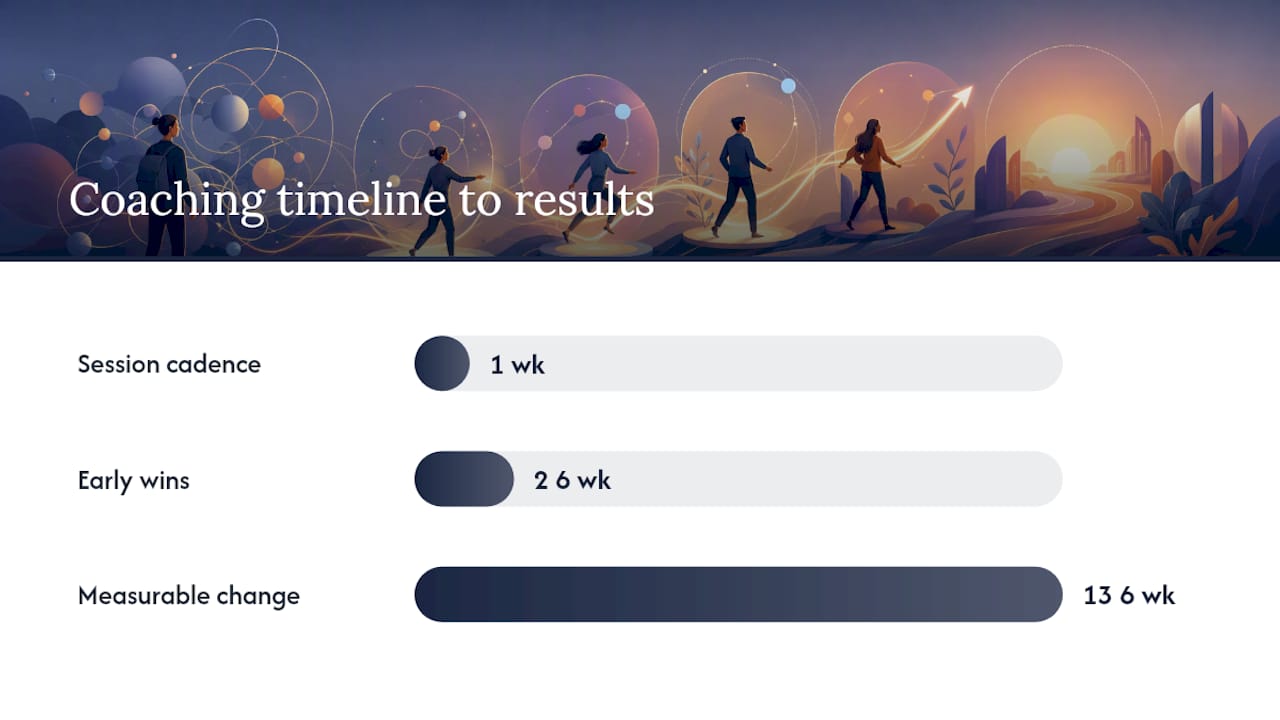
Most programs run on a weekly one-to-one cadence, sometimes paired with shorter micro-sprint sessions or group formats for accountability between full sessions.
Early wins tend to show up within 2 to 4 weeks, usually as small, specific things: an inbox that isn’t a horror show, a client email sent on the day you meant to send it. Measurable business change, the kind you’d notice in revenue or output, typically takes 3 to 6 months of consistent work.
Cost ranges vary widely depending on the coach’s experience and session length, and many self-employed clients in the UK claim coaching as a legitimate business expense. It’s also worth checking Access to Work eligibility if your ADHD affects your capacity to work, since it can fund practical job supports including coaching after an assessment.
Coaches commonly track:
- Task completion rates
- Time-to-decision on recurring choices
- Self-reported overwhelm or shame levels
What Tools and Methods Do ADHD Coaches Use?
Session content should feel concrete, not vague and inspirational. Ask a prospective coach what tools they’d actually put in front of you.
Common methods include:
- Body doubling and adapted Pomodoro or timeboxing, scheduled around your actual energy peaks rather than forced into a nine-to-five shape
- Externalized planning tools: visible 90-day maps, simplified task boards, low-friction trackers you’ll actually update
- Accountability structures like micro-commitments, short check-ins, and shared dashboards
- Simple emotional-regulation techniques, often CBT-adjacent, for the moments when a missed deadline spirals into a full identity crisis
Pro Tip: If a coach can’t name a specific tool they’d use in your first month, keep looking. Vague answers here predict vague sessions later. For organization support between sessions, resources like ADHD-friendly organization strategies can fill the gaps.
Is Coaching a Replacement for Therapy or Medication?
No, and any coach who implies otherwise is a red flag. Coaching is practical and forward-focused. Medication and therapy manage clinical symptoms; coaching builds the systems and habits that turn symptom improvement into actual business results.
Medical News Today frames coaching as complementary to medical and psychological treatment, not a substitute for either. The research base is still developing, and reviews note the evidence, while promising, remains varied in scale and design. If you’re on medication or in therapy, tell your GP you’re adding coaching, and share your business goals with your clinician so everyone’s working from the same page. If substance use has crept in as a coping mechanism, that’s a conversation for a clinician first; ADHD and substance use carries real clinical risk that coaching alone can’t address.
How Do You Choose the Right ADHD Business Coach?
Vetting a coach shouldn’t feel like a leap of faith. Run through this before you commit:
- Confirm ADHD-specific training and, ideally, lived experience with ADHD themselves
- Ask for a demonstrable track record with business owners, not just general life coaching
- Ask directly about session structure, what happens between sessions, and how they measure outcomes
- Request a trial session before signing anything longer-term
- Watch for red flags: one-size-fits-all plans, cure-sounding language, or reluctance to coordinate with your GP or therapist
- Get clear contract terms, including a trial period, milestone check-ins, and a cancellation clause you can actually use
If a coach dodges any of these questions, that’s information too.
What Makes Estelle’s ADHD Coaching Approach Different?
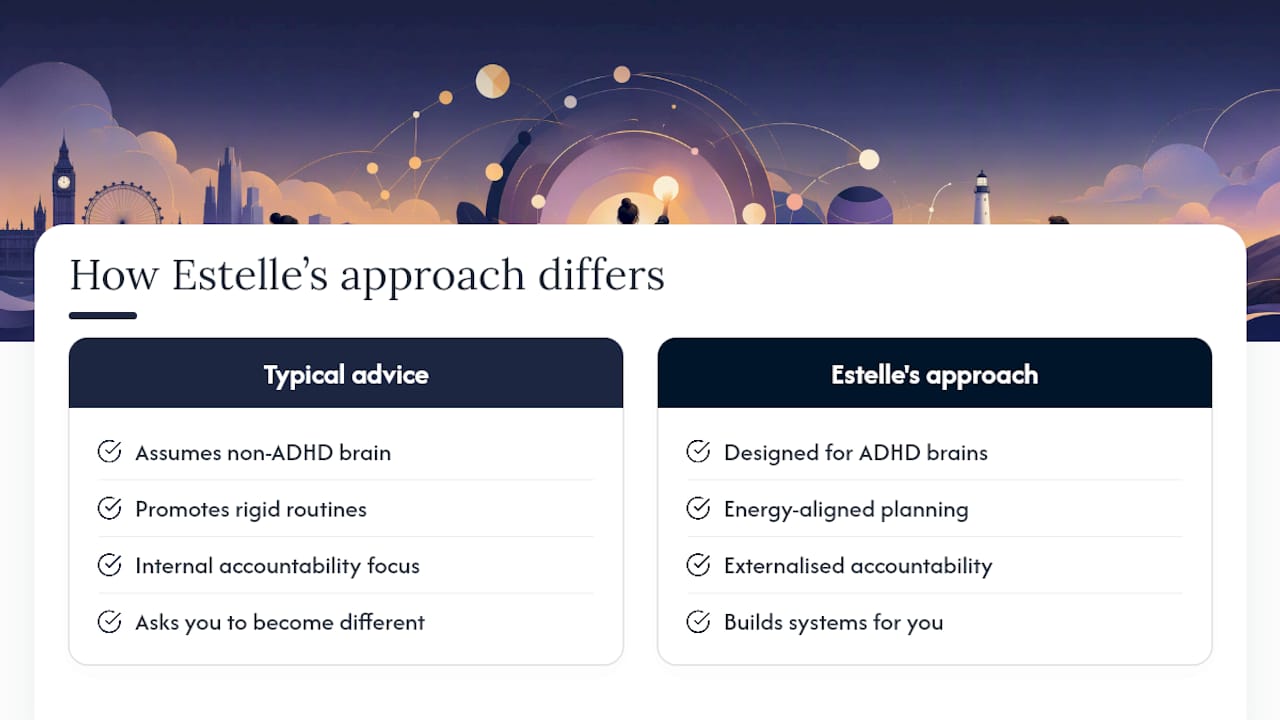
Estelle built her coaching practice around a simple observation: most productivity advice assumes a brain that doesn’t exist in people with ADHD. As an ADHD coach and author, she blends business strategy with executive-function tools designed for how ADHD brains actually operate, not how a productivity book assumes they should.
Her approach centers on energy-aligned planning rather than rigid routines, paired with the kind of externalized accountability that research on coaching outcomes links to measurable improvement in daily functioning.
Business coaching for ADHD works when it stops asking you to become a different kind of person and starts building systems for the person you already are.
Her book catalog extends that same framework into self-guided formats for readers who want structure between sessions or before committing to coaching at all.
What Should You Expect in Your First Few Weeks of Coaching?
Early wins are rarely dramatic. They’re a lighter chest walking into your inbox, a to-do list that finally feels honest, one priority instead of eleven competing ones. If you’re on the fence, start small: a single trial session costs less than another year of guessing. Look at the coaching options built for entrepreneurs and creatives, or grab a workbook to test the framework yourself first.
— Estelle
Ready to Build Systems That Actually Fit Your Brain?
Estelle-rose is the alternative to generic productivity coaching: instead of forcing you into someone else’s system, sessions are built around executive-function science and real business tasks, so the plan survives contact with an actual Tuesday. The core offering is one-to-one coaching for entrepreneurs and creatives working through inconsistent execution, paired with an executive-function program for founders who need structural rebuilding rather than a pep talk.
Founders juggling a growing team often do best with the Adult ADHD Executive Function program, while creatives who want a lower-commitment starting point tend to prefer the workbooks first. If you’re newly diagnosed or just tired of systems that only work for other people, book a session or browse the coaching packages for entrepreneurs and creatives to see what fits your situation and start this week.
Sources
For deeper context, see NHS guidance on adult ADHD, Access to Work funding details, and the prospective coaching outcomes study cited throughout this piece.

