
6 Steps to Build a Dopamine Menu for ADHD Backed by Coaches
6 Steps to Build a Dopamine Menu for ADHD Backed by Coaches
A dopamine menu is a pre-made list of quick, healthy activities you pick from when motivation collapses. It works by removing the decision itself, so instead of staring at your phone for twenty minutes trying to figure out what might feel good, you already have the answer. Pick a starter, set a timer, get moving.
TL;DR:
- Building a dopamine menu involves categorizing quick activities into starters, sides, mains, desserts, and specials based on time and effort, to match your current availability.
- Without proper planning, people often attempt to start with long activities during short time windows, leading to frustration and abandonment of the strategy.
- Menus should be placed where they are visible and paired with cues, and activities that are unlikely to be completed in the allotted time should be avoided to prevent discouragement.
- A one-week trial with timers and clear triggers helps identify which activities are effective, with adjustments needed for activities that are aspirational or too demanding.
- Coaching and accountability improve adherence, as personalized support helps tailor entries and guardrails, especially when facing setbacks or risky behaviors like substance use.
Table of Contents
- What Is a Dopamine Menu (And What Does It Actually Look Like)?
- Why Do Dopamine Menus Actually Help With ADHD?
- How to Build a Dopamine Menu in Under an Hour
- Dopamine Menu Examples You Can Copy Today
- When Your Dopamine Menu Stops Working
- How ADHD Coaching Turns This Into a Real System
- Setbacks Are Part of the Process, Not Proof It Failed
- Ready to Build a Menu That Actually Sticks?
- Sources
- FAQ
What Is a Dopamine Menu (And What Does It Actually Look Like)?
Restaurant menus organize food by course. A dopamine menu adhd strategy borrows that structure and applies it to stimulation, because your brain doesn’t need a philosophy lecture at 2 p.m. when you’re staring down a spreadsheet. It needs options, sorted by how much time and energy they cost.
The categories work like this:
- Starters (under 5 minutes): zero-setup, low-commitment actions. Splash cold water on your face, do 10 jumping jacks, step outside for two minutes.
- Sides (paired with a task): things you do while doing something boring. Music, a podcast, chewing gum, a fidget toy during a phone call.
- Mains (30+ minutes): a real activity you sink into. A workout, a creative project, a long walk with a friend.
- Desserts (high stimulation, needs guardrails): scrolling, video games, online shopping. Genuinely enjoyable, genuinely capable of eating your afternoon.
- Specials (occasional, high effort): a concert, a day trip, something you plan for and savor.
Here’s where most people mess it up: they reach for a main when they only have five minutes, get frustrated it “doesn’t work,” and give up on the whole idea. Dose matching is the entire game. If you have five minutes before a meeting, you need a starter, not a 45-minute hobby you’ll resent abandoning halfway through.
Why Do Dopamine Menus Actually Help With ADHD?
ADHD brains often show differences in how the reward system responds to routine tasks, which is part of why boring or effortful work feels disproportionately hard to start, according to the National Institute of Mental Health. Under-stimulation isn’t a character flaw. It’s a wiring issue that makes your brain go looking for a hit of novelty, movement, or sound wherever it can find one, sometimes at the worst possible moment.
That’s the biological piece. The behavioral piece is simpler and more useful day to day. Dopamine menus are, in essence, a rebranding of behavioral activation, a well-established technique for building small, specific actions that increase engagement rather than waiting for motivation to show up first. Mayo Clinic frames dopamenus this way too: a brief, purposeful reset, not an open invitation to disappear for an hour, according to Mayo Clinic News Network.
The menu also works because it moves the decision to a calm moment instead of a stressed one. That’s the same logic behind implementation intentions, the psychological research showing that deciding “when X happens, I’ll do Y” in advance makes the behavior far more likely to actually happen, per this overview of motivation and reward circuitry.
Be honest with yourself about the limits, though. No controlled trials have tested dopamine menus specifically, according to SimplyPsychology’s review of the practice. This is a coping tool, not treatment. If you’re dealing with persistent low motivation, a suspected but undiagnosed ADHD pattern, or symptoms that feel bigger than “I can’t start my inbox,” that’s worth a conversation with a clinician, not just a better list.
How to Build a Dopamine Menu in Under an Hour
You don’t need a color-coded system or a Pinterest board. You need six steps and a willingness to be honest about what actually works for you, not what sounds virtuous.
- Audit your reality for 3 to 7 days. Before you build anything, notice what you actually reach for when you’re stuck. Not what you think you should reach for. If it’s always your phone, write down exactly what app and why it pulls you in.
- Brainstorm without editing. Dump every activity that gives you a lift, big or small, onto a page. Nothing is too silly to write down.
- Sort into starters, sides, mains, desserts, and specials. This is where the list becomes usable instead of just a mood board.
- Prune the aspirational stuff. If “learn watercolor painting” has been on three vision boards and zero calendars, it’s not a starter. Cut anything you wouldn’t realistically do in the next ten minutes if it’s in that category.
- Prep for visibility. Print it. Set it as your lock screen. Write it on an index card and tape it to your monitor. A dopamine menu buried in a note app you never open is not a dopamine menu, it’s a digital junk drawer.
- Set guardrails and run a one-week test. Attach a timer to anything in the dessert category. Attach the menu itself to a trigger, like “when I sit down at my desk” or “when I finish a work block.” After a week, look at what you actually used and cut what you didn’t.
Pro Tip: Pair your menu with what’s sometimes called the 10-3 rule, a short-break heuristic where you take a brief, purposeful reset and set a timer to return to the task, rather than letting “just five minutes” quietly become forty-five.
This whole process takes less time than you’ve probably already spent this week trying to talk yourself into starting something. Run the one-week test before you judge whether it works. One bad Tuesday doesn’t mean the system failed. It means Tuesday was hard.
Dopamine Menu Examples You Can Copy Today
Steal these outright. Adjust for your own life, but don’t overthink the starting point.
Starters (under 5 minutes):
- Step outside barefoot for two minutes
- Splash cold water on your face and wrists
- Do one song’s worth of dancing, badly, alone
- Text one friend a voice memo instead of a text
- Stretch for 90 seconds
Sides (pair with a boring task):
- Put on a true crime podcast for paperwork
- Use a body-doubling app or call a friend to work “alongside” you
- Chew gum or use a fidget tool during phone calls
- Light a candle before starting your least favorite chore, something worth pairing with the organization strategies that make cleaning less miserable
Mains (30+ minutes):
- A full workout class, not just “exercise”
- An hour on a creative project with no deadline attached
- Cooking a real meal instead of assembling one, using foods that support steadier energy
- A long walk in a new neighborhood
- Deep-cleaning one room with music blasting
Specials (occasional, planned):
- A concert or live event booked weeks ahead
- A solo day trip somewhere you’ve never been
- A big cooking project for a dinner with people you love
Desserts (guardrails required): scrolling, gaming, online shopping. Set a 20 minute timer before you start, not after you notice you’ve lost track. Per CNN’s reporting on dopamine menus, the boundary matters more than the activity itself.
When Your Dopamine Menu Stops Working
Menus fail for predictable reasons, and almost all of them are fixable without starting over.
- You can’t see it. A menu in a drawer or a buried note is invisible, and invisible tools don’t get used.
- It’s full of aspirational items. If your “starter” secretly requires buying supplies first, it’s not a starter.
- You’re mismatching dose to time. Reaching for a 45-minute main during a 10-minute window sets you up to quit before you begin.
- Desserts have swallowed everything else. If every entry point leads back to your phone, the categories aren’t doing their job.
The fix is almost always the same: move the menu somewhere you’ll actually see it, pre-attach it to a transition (finishing lunch, sitting down at your desk, closing your laptop), and put a timer on anything with dessert-level pull. Social accountability helps too. Tell a friend you’re testing this and check in after a week.
One more thing worth naming plainly: if reaching for stimulation has started to look like using substances, gambling, or other higher-risk behaviors to fill the gap, that’s outside what a list of activities can address, and it’s worth talking to a professional who works specifically with ADHD and addiction overlap. A dopamine menu is a coping strategy. It was never built to carry that weight.
How ADHD Coaching Turns This Into a Real System
A list on paper is a start. A list someone helps you actually stick to is where the change happens, and that’s the gap ADHD coping strategies usually fall into: great in theory, abandoned by week two because nobody checked in.
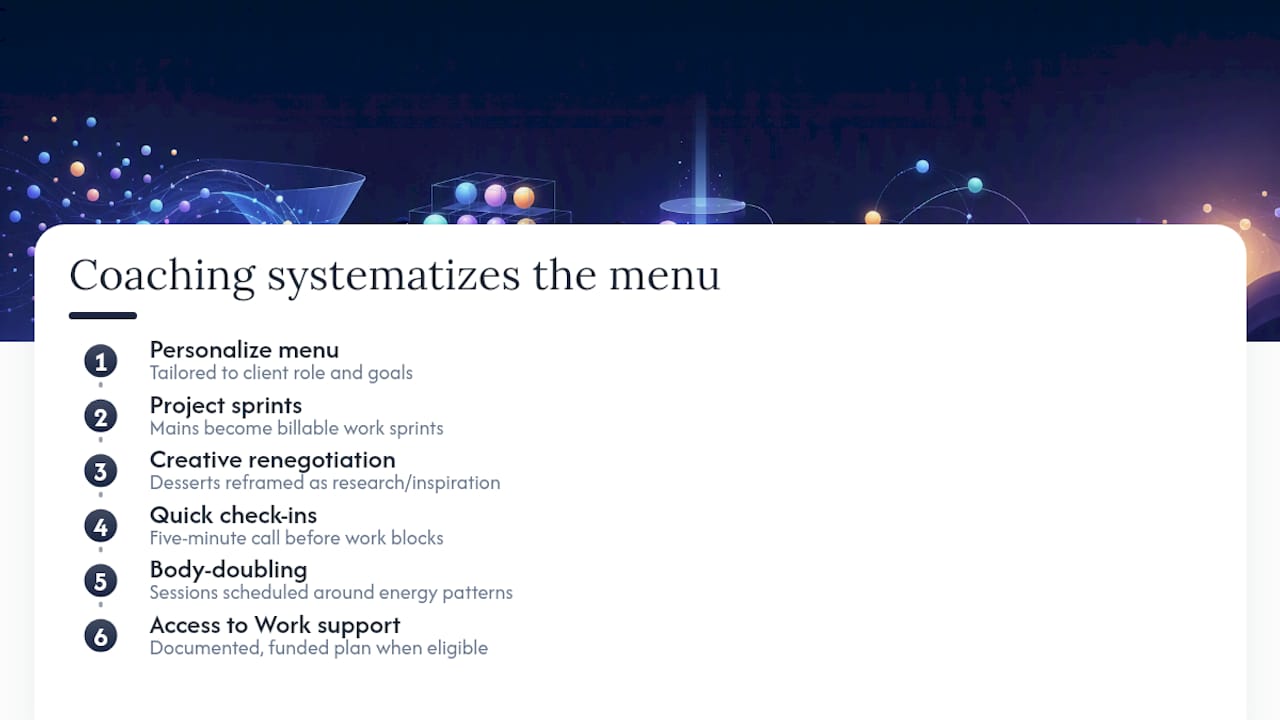
In coaching, dopamine menus get personalized fast. For a client running their own business, “mains” often become project-based work sprints instead of generic hobbies, because their real challenge isn’t finding stimulation, it’s channeling it into billable work. For creatives, desserts get renegotiated constantly, because the same behavior that derails one client (an hour on Instagram) is genuinely research and inspiration for another.
This is also where accountability check-ins earn their keep. A quick five-minute call before a work block, a body-doubling session scheduled around your actual energy patterns, a menu revisited monthly instead of set once and forgotten. For clients using Access to Work coaching support, this kind of structure often becomes part of a documented, funded plan rather than something you’re expected to white-knuckle alone.
Setbacks Are Part of the Process, Not Proof It Failed
Your first menu will have items that flop. You’ll set a timer and ignore it anyway on a Wednesday for no clear reason. That’s not evidence the whole idea is broken, it’s evidence you’re human and this is genuinely hard some days.
Iterate instead of abandoning. Swap the item, adjust the guardrail, and try again next week. And if you keep hitting the same wall alone, that’s not a personal failure either. It’s usually a sign you need a second set of eyes, a coach, or an accountability partner who won’t let you quietly disappear into “I’ll figure it out eventually.”
— Estelle
Ready to Build a Menu That Actually Sticks?
A list is only as good as the follow-through behind it, and that’s exactly where most self-help advice quietly runs out of road. Estelle-rose works with self-employed professionals, executives, and creatives who need more than a template. That means one-to-one coaching sessions built around your actual work patterns, not generic productivity advice that assumes a 9-to-5 schedule you don’t have.
Coaching sessions get hands-on with your menu: tailoring entries to your business rhythms, building real guardrails around your desserts, and setting up accountability check-ins so a good week isn’t just a fluke. For anyone navigating Access to Work coaching support, this structure can plug directly into that framework. If you’d rather start with a done-for-you resource, The Empowering ADHD Workbook for Women includes templates and exercises you can start using tonight. For the full coaching experience built around executive function, book a session and bring your half-finished menu. We’ll fix it together.
Sources
- Dopamine menus give your brain some space (Mayo Clinic News Network)
- The Dopamine Menu: A Better Way to Manage ADHD (SimplyPsychology)
- Attention-deficit/hyperactivity disorder (NIMH)
- In need of a dopamine hit? 5 things to know about creating a dopamine menu | CNN
This article is general information, not a substitute for advice from a qualified doctor. Consult a qualified healthcare professional about your own circumstances before acting on anything here.
FAQ
What Is a Dopamine Menu for ADHD?
It’s a pre-made, categorized list of stimulating activities you choose from when you’re stuck, sorted by time and effort so you can act instead of deliberating.
How Do You Trigger Dopamine With ADHD?
Short bursts of movement, novelty, sound, or social connection can offer a quick lift, and pre-committing to specific options through a dopamine menu makes reaching for them far more automatic than trying to decide in the moment.
Can You Give an Example of a Dopamine Menu?
A simple one includes a starter (two minutes outside), a side (music during chores), a main (a 30-minute workout), and a dessert (20 minutes of scrolling with a timer set beforehand).
What Is the 10-3 Rule for ADHD?
It’s an informal heuristic, not a clinical guideline, where you take a short, purposeful break and use a timer to return to your task rather than letting the break stretch indefinitely.
Is a Dopamine Menu a Substitute for ADHD Treatment?
No. It’s a behavioral coping tool that can sit alongside therapy, coaching, or medication, but it isn’t a replacement for a clinical assessment or treatment plan.

