
How to Break Down Tasks with ADHD: A Practical Guide
How to Break Down Tasks with ADHD: A Practical Guide
TL;DR:
- Breaking down tasks with ADHD involves creating specific, manageable steps to reduce activation energy and prevent overwhelm. Using external tools, visual checklists, and timeboxing helps maintain structure and momentum, increasing task initiation success. Consistent review and adjusting step sizes ensure continued progress and prevent common pitfalls like perfectionism or fatigue.
If you have ADHD, knowing how to break down tasks with ADHD is the difference between getting started and staring at a blank screen for two hours. Large, vague tasks do not just feel hard. They feel impossible. Your brain sees “write the report” and immediately looks for an exit. 56.59% of adults with ADHD specifically avoid important tasks because the mental cost of starting is too high. This guide walks you through exactly what to do instead, with specific methods that work with your brain, not against it.
Table of Contents
- Key takeaways
- Why ADHD brains struggle with big tasks
- How to break down tasks for ADHD, step by step
- Tools and strategies that make task breakdown stick
- Common pitfalls and how to fix them
- Tracking progress and adjusting your approach
- My honest take on task breakdown and ADHD
- Ready to take this further with ADHD coaching?
- FAQ
Key takeaways
| Point | Details |
|---|---|
| Micro-starts lower the barrier | Shrinking your first step to something tiny removes the activation cost that stops ADHD brains from starting. |
| Sequence beats a simple checklist | Structuring steps as an ordered pathway means you never have to re-decide what comes next. |
| Visual tools reduce decision fatigue | Externalizing your task list with apps or sticky notes frees up mental energy for the actual work. |
| Timeboxing creates structure | Pairing broken-down steps with 25-minute work blocks improves follow-through for adults with ADHD. |
| Progress tracking builds momentum | Celebrating small completions keeps dopamine levels working in your favor throughout the task. |
Why ADHD brains struggle with big tasks
ADHD is not a motivation problem. It is an executive function problem. Executive function covers the mental skills you use to plan, start, and follow through on tasks. When those systems are less reliable, a task like “prepare for the client meeting” does not register as a sequence of steps. It registers as one giant, shapeless thing that needs to happen.
The bigger and vaguer a task feels, the higher its activation cost. That is the mental energy required just to begin. For a neurotypical brain, that cost is low. For an ADHD brain, it can feel insurmountable. The result is avoidance, procrastination, and a lot of guilt that has nothing to do with laziness.
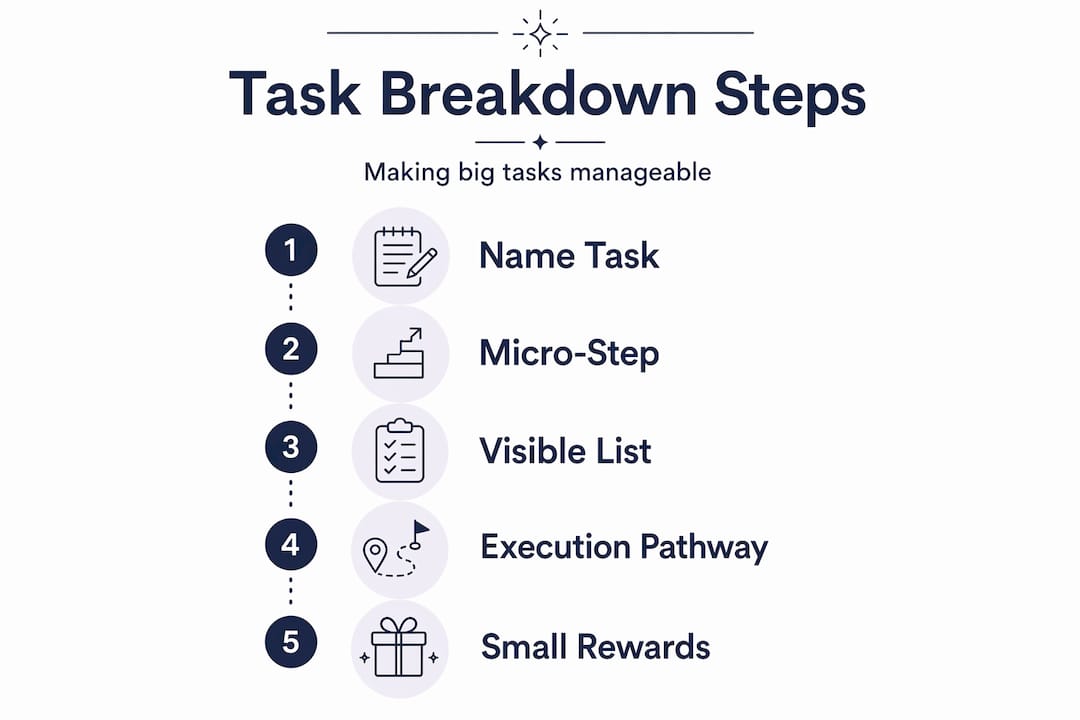
Reducing cognitive overload by breaking a large task into small, concrete, time-limited steps directly lowers that activation cost and reduces the shame that often follows. Understanding this is not just reassuring. It is the foundation for every strategy in this article.
Here is what typically happens when an ADHD brain faces a large task:
- The task feels undefined, so the brain cannot identify a starting point
- Decision fatigue sets in before any work begins
- Avoidance kicks in as a self-protection mechanism
- Time passes, pressure builds, and the task feels even bigger
“Task initiation is hardest when tasks feel overwhelming and uninteresting. Combining small steps with structured time commitments helps overcome this barrier.” — Effective U, University of Minnesota
The good news is that the ADHD brain responds extremely well to structure when that structure is simple, visible, and bite-sized. That is exactly what the next section covers.
How to break down tasks for ADHD, step by step
This is the core method. It is not complicated, but it requires specificity. Vague steps do not work for ADHD brains. Each step needs to be concrete, ordered, and short enough to feel completable.
-
Name the task clearly. Write down exactly what the outcome looks like. Not “deal with emails” but “reply to the three flagged emails from this week.” Specificity removes ambiguity before you start.
-
Break it into ordered subtasks. Write each subtask as its own line item. For example, “write the blog post” becomes: open the document, write the headline, write the intro paragraph, write one body section, add a conclusion, proofread. Ordered subtasks like these help your brain avoid overwhelm by focusing on one concrete action at a time.
-
Apply the micro-start principle. Look at your first step and shrink it again. Reducing a task to something as small as “put one mug in the sink” instead of “clean the kitchen” removes the activation barrier. Your only job is to begin, not to finish.
-
Use the two-minute and five-minute rules. If a step takes less than two minutes, do it now. If a step feels daunting, commit to just five minutes of work on it. These micro-start rules create quick wins that build momentum and reduce resistance.
-
Externalize your steps. Write them on sticky notes, a whiteboard, or an app. Do not keep them in your head. Keeping everything mental is exhausting. Getting it out of your head and onto a surface frees up cognitive space for the actual work.
-
Add timeboxing. Assign each step a time block. Pairing task breakdown with 25-minute work blocks and a visible timer improves focus and makes it harder to drift. If 25 minutes feels long, start with 10. There is no wrong answer here.
Pro Tip: Treat your task list as an execution pathway, not just a checklist. When each step flows into the next in a fixed order, you never have to decide what comes next. That decision fatigue is often what derails ADHD task organization mid-task.
Tools and strategies that make task breakdown stick
Breaking tasks into steps is one thing. Actually following through across a full day is another. The right tools make the system work without relying on willpower, which, let’s be honest, is not your most reliable resource when you have ADHD.
Digital apps with AI task breakdown. Tools like Goblin.tools use AI to break a vague task into smaller steps for you. AI-generated subtask lists work best as starting drafts that you refine, since the sequencing sometimes needs adjustment. But they dramatically reduce the upfront mental effort of structuring a task from scratch.
Visual checklists showing one step at a time. Showing only one step at a time reduces anxiety about the full scope of a task. Apps like Tiimo and Focusmate are built with this in mind.
Body doubling. Working alongside another person, in person or virtually, provides external structure. Body doubling reduces procrastination and makes starting noticeably easier for many adults with ADHD. It is one of the most underrated strategies in the ADHD toolkit.

Reward systems tied to dopamine. Build a small reward into your task sequence. Finish a step, get a coffee. Complete three steps, take a five-minute walk. The ADHD brain runs on novelty and reward, so building that in deliberately is not indulgent. It is neuroscience-based task management.
Here is a quick comparison of common tools to support ADHD task organization:
| Tool | Best for | Format |
|---|---|---|
| Goblin.tools | Auto-generating task breakdowns | AI-powered app |
| Tiimo | Visual scheduling and step sequencing | Mobile app |
| Focusmate | Body doubling and accountability | Virtual co-working |
| Physical sticky notes | Tactile, visible task tracking | Analog |
| Whiteboard | Large-scale project visualization | Physical tool |
Pro Tip: If you find yourself ignoring your digital app within a week, switch to physical sticky notes for a while. The act of writing by hand and moving notes creates a tactile feedback loop that many ADHD brains respond to better than screens.
For more tools and approaches to ADHD task organization, Estelle-rose covers both digital and physical methods in depth.
Common pitfalls and how to fix them
Even with a solid system, things go sideways. Here is what to watch for and how to course-correct without derailing entirely.
Steps that are still too big. If you sit down to work and feel that familiar freeze, your steps are probably still too large. Break them in half. Keep breaking until the next action feels genuinely easy to start.
Perfectionism that delays the start. If you are spending more time planning your task breakdown than doing the tasks, that is perfectionism wearing a productivity costume. A rough plan you execute beats a perfect plan you never start.
Fatigue that kills momentum. Flexible time blocks tuned to your personal energy levels work better than forcing yourself into a rigid 25-minute schedule. Some people work better with 10-minute blocks. Others use the length of a song as a natural work unit. Personalize the system.
Mid-task distraction. When you lose your place, your task list is your recovery tool. The moment you realize you have drifted, look at your list, find the current step, and re-enter there. No self-judgment needed.
Isolation and lack of accountability. Working alone with ADHD is hard. If you find yourself consistently avoiding tasks despite a good breakdown system, external support helps. An ADHD accountability partner or a structured coaching relationship provides the external scaffolding your executive function cannot always supply on its own.
Tracking progress and adjusting your approach
A task breakdown system that never gets updated stops working. Building in a short weekly review keeps your approach matched to what is actually happening in your life.
- Check your completion rate. At the end of the week, look at how many steps you completed versus planned. If you are consistently finishing less than half, your steps are too big or your time blocks are too long.
- Celebrate completed milestones. Write down what you finished, not just what is still pending. The ADHD brain tends to focus on the incomplete pile. Actively noting completions counteracts that bias.
- Adjust step size and block length. If your 25-minute blocks feel like torture, try 15. If your steps still feel large after breaking them down once, break them down again. This is not failure. It is calibration.
- Note what conditions helped. Did you get more done with music on? In the morning? After a walk? Tracking those patterns helps you replicate the conditions that work and stop wasting energy on setups that do not.
Pro Tip: Keep a “done list” alongside your to-do list. Every time you complete a step, write it on the done list. Seeing visible proof of progress is one of the most effective and most overlooked motivators for adults with ADHD.
My honest take on task breakdown and ADHD
In my years of working with adults with ADHD on executive function, the single biggest shift I see is not a new app or a better planner. It is the moment someone stops asking “why can’t I just do it?” and starts asking “what is the actual next physical step?”
That question changes everything. It removes the judgment and replaces it with a concrete answer. I have seen clients go from chronic procrastination to consistent output simply by learning to ask it every time they sit down to work.
What I have also learned is that the first step needs to be embarrassingly small. Not “start the project.” Not “open the document.” Something like “open the laptop.” That is not a joke. For many people, that specificity is the difference between starting and not starting.
The other thing I know for certain is that externalizing your task structure is not optional for most ADHD brains. Keeping it in your head and expecting to follow through is the same as hoping your brain will be different today than it was yesterday. Use the executive function tools that are available. Write things down. Make the invisible visible. That is not a workaround. That is the method.
Progress with ADHD is rarely linear, and that is fine. The goal is not perfection. The goal is one more step forward than yesterday.
— Estelle
Ready to take this further with ADHD coaching?
Breaking tasks into steps is a skill, and like any skill, it gets sharper with the right guidance. At Estelle-rose, the coaching work goes beyond general productivity tips. It is built specifically for adults with ADHD who are done with advice that sounds good on paper but falls apart by Tuesday. Whether you are an entrepreneur, a creative, or someone who just wants to get through the week without burning out, personalized support makes a measurable difference. Explore the ADHD executive function coaching programs to find what fits, or browse the ADHD books and workbooks for structured self-study that you can work through at your own pace.
FAQ
What is the best way to break down tasks with ADHD?
Start by naming the task as a specific outcome, then split it into ordered subtasks that each take 10 minutes or less. Apply the micro-start principle by shrinking your first step until it feels easy to begin.
How many steps should an ADHD task breakdown have?
There is no fixed number. If a step still triggers avoidance, it is too big. Keep breaking it down until the next action feels genuinely low-effort to start.
What tools help with ADHD task organization?
Apps like Tiimo and Goblin.tools help generate and visualize task breakdowns. AI-generated subtask lists serve as useful starting drafts, though they benefit from human refinement before use.
Does body doubling really help with task initiation?
Yes. Working alongside another person provides external accountability and structure that makes starting significantly easier for many adults with ADHD.
How do I stop breaking down tasks and actually start doing them?
Set a two-minute timer and commit to only the first step. Applying the five-minute rule and committing to just five minutes of work removes the mental resistance that comes from thinking about the whole task at once.

