
How to Delegate ADHD Tasks: 55% Less Overwhelm in 4 Weeks
How to Delegate ADHD Tasks: 55% Less Overwhelm in 4 Weeks
Delegation feels impossible when your brain constantly questions if you explained things clearly enough, worries about follow-up, or fears losing control entirely. For adults with ADHD, executive function challenges make delegation even harder because prioritizing, organizing instructions, and trusting others all strain the same cognitive systems already working overtime. This guide offers ADHD-specific strategies to break down tasks, use supportive tools, communicate clearly, and measure progress so you can reduce overwhelm and reclaim your time.
Table of Contents
- Understanding ADHD and Its Impact on Delegation
- Prerequisites: What You Need Before You Start Delegating
- Step 1: Breaking Down Tasks for Delegation
- Step 2: Leveraging ADHD-Friendly Tools and Supports
- Step 3: Establishing Clear Communication and Follow-Up
- Step 4: Managing Control, Trust, and Anxiety Around Delegation
- Common Mistakes and Troubleshooting
- Expected Results, Timelines, and Measuring Success
- Safety Considerations and Alternative Approaches
- Boost Your Delegation Success with Expert ADHD Support
- FAQ
Key Takeaways
| Point | Details |
|---|---|
| ADHD impacts delegation uniquely | Executive function deficits make prioritizing, organizing instructions, and trusting others challenging for 71% of adults with ADHD. |
| Preparation is essential | Understanding your ADHD profile, gathering visual tools, and building a trust mindset set you up for success. |
| Step-by-step process works | Breaking tasks into chunks, using ADHD-friendly apps, establishing clear communication, and managing control anxiety reduce overwhelm by 55% in 4 weeks. |
| Measure and adjust | Track metrics like task completion rates and stress levels; expect skill mastery in 3 to 6 weeks with consistent practice. |
Understanding ADHD and Its Impact on Delegation
ADHD disrupts the executive functions that make delegation possible. These include prioritizing which tasks to hand off, organizing clear instructions, and maintaining focus during follow-up conversations. Research shows that 71% of adults with ADHD experience daily executive function challenges affecting task management.
Impulse control issues can lead you to either delegate too quickly without adequate preparation or avoid delegation altogether because the setup feels overwhelming. Working memory deficits mean you might forget to follow up or lose track of what you delegated to whom. Approximately 40% of adults with ADHD report difficulty trusting others with their tasks, fearing mistakes or incomplete work.
“The hardest part isn’t finding someone to help. It’s letting go of the mental checklist long enough to explain what needs doing.”
Anxiety about losing control compounds these challenges. You might worry that explaining a task takes longer than doing it yourself, or that checking in repeatedly will annoy the person helping you. Recognizing these barriers allows you to design delegation systems that work with your ADHD brain rather than against it.
Key ADHD-related delegation barriers include:
- Difficulty breaking tasks into clear, sequential steps
- Forgetting to provide complete instructions upfront
- Struggling to assess which tasks are truly delegate-worthy
- Anxiety that prevents releasing control even after delegating
Prerequisites: What You Need Before You Start Delegating
Successful delegation starts before you hand off a single task. You need foundational knowledge about how ADHD affects your delegation style, the right tools to support your memory and attention, and a mindset shift around trust and communication.
First, understand your personal ADHD profile. Do you tend to over-explain because you fear being misunderstood, or under-explain because details slip your mind? Knowing your patterns helps you compensate. Studies indicate that 71% of adults with ADHD face daily challenges managing tasks, so accepting this reality reduces self-blame.
Second, gather ADHD-friendly tools before delegating. Visual timer apps, shared digital checklists, and reminder systems compensate for working memory limits. Having these ready means you will not abandon delegation mid-process because tracking feels too hard.
Third, develop a trust and communication mindset. Delegation requires believing others can complete tasks adequately, even if not exactly as you would. This mindset shift takes practice, especially when ADHD makes you hyper-aware of potential mistakes.
Essential prerequisites:
- Clear understanding of how executive function challenges impact your delegation
- Access to visual aids like timers, checklists, and reminder apps
- Willingness to communicate clearly and check in regularly
- Mental preparation to release control gradually
Pro Tip: Before delegating anything, write down three tasks you have successfully handed off in the past, even small ones. This reminds your ADHD brain that delegation is possible and that you have evidence of past success.
Step 1: Breaking Down Tasks for Delegation
Complex tasks overwhelm ADHD brains, making delegation feel impossible. Chunking breaks tasks into smaller, manageable pieces that are easier to explain and monitor. This step alone improves completion rates significantly.
Start by identifying the end goal. What does “done” look like for this task? Write it down in one clear sentence. Then work backward, listing every action needed to reach that outcome. For example, “organize the home office” becomes: sort papers into categories, file important documents, recycle junk mail, arrange desk supplies, and vacuum the floor.
Next, define observable outcomes for each subtask. Instead of “handle the mail,” specify “open all envelopes, separate bills from junk, and place bills in the red folder.” Concrete language prevents misunderstandings and gives you clear checkpoints.
Research demonstrates that chunking tasks improves completion rates by 45% among adults with ADHD. The strategy works because smaller steps require less working memory and feel less daunting.
Steps for effective task breakdown:
- Write the final outcome in one sentence
- List every action required to achieve that outcome
- Define what “complete” means for each action
- Assign a realistic time estimate per subtask
- Identify checkpoints where you will review progress
| Task Component | Breakdown Example | Observable Outcome |
|---|---|---|
| Organize office | Sort papers | Papers in labeled categories |
| Organize office | File documents | Documents in appropriate folders |
| Organize office | Arrange supplies | Supplies visible and accessible |
Pro Tip: Use task chunking methods to practice breaking down daily activities until it becomes automatic. The more you chunk, the easier delegation becomes.
Step 2: Leveraging ADHD-Friendly Tools and Supports
Your ADHD brain needs external supports to track delegated tasks and maintain accountability. The right tools act as a second brain, compensating for attention and memory challenges.

Visual timer apps help both you and the person you delegate to stay aware of time passing. Apps with progress bars or color-coded countdowns work especially well because they provide at-a-glance status updates. Shared digital checklists allow real-time tracking so you can see task completion without constant verbal check-ins.
Reminder systems prevent forgotten follow-ups. Set multiple reminders at strategic intervals: one when the task should start, another midway through, and a final one near the deadline. This structure keeps delegation on your radar without requiring you to remember independently.
Accountability partners boost success rates. Whether a friend, family member, or ADHD coach, having someone to report progress to increases follow-through. External accountability compensates for ADHD-related difficulty with self-monitoring.
Essential tools for ADHD delegation:
- Visual timer apps with progress indicators
- Shared checklists accessible on phones or computers
- Calendar apps with customizable reminder frequencies
- Voice memo apps for capturing quick delegation instructions
- Accountability partners for regular progress check-ins
These tools work together to create a delegation ecosystem that supports your executive function needs. The goal is making delegation easier to start and sustain, reducing the cognitive load that typically derails your efforts.
Step 3: Establishing Clear Communication and Follow-Up
Vague instructions doom delegation from the start. ADHD makes it easy to assume others understand what you mean, but clarity requires deliberate effort. Simple, specific language prevents misunderstandings and reduces the need for corrections later.
When delegating, use short sentences with concrete action verbs. Say “Place folded towels on the second shelf” instead of “Put the towels away.” Specificity eliminates guesswork and gives the other person confidence they are doing it correctly.
Schedule follow-up check-ins before you delegate. Decide together when you will review progress: after two hours, at the end of the day, or midway through a multi-day task. Pre-scheduled check-ins reduce your anxiety about micromanaging because you know a review is coming.
Provide written summaries after verbal instructions. Text, email, or shared notes confirm what you discussed and give both parties a reference point. Written records are especially helpful for ADHD because they compensate for working memory limits and prevent “I thought you said” conflicts.
Communication practices that support ADHD delegation:
- State the task using action verbs and observable outcomes
- Confirm understanding by asking the person to repeat the task back
- Provide written instructions in addition to verbal explanation
- Schedule specific follow-up times before the task begins
- Use the same communication method consistently for all delegated tasks
Consistent communication routines reduce the mental effort required to delegate. When you follow the same pattern every time, your ADHD brain does not have to reinvent the process for each new task.
Step 4: Managing Control, Trust, and Anxiety Around Delegation
Letting go feels terrifying when ADHD already makes you feel out of control. Approximately 35% of adults with ADHD report significant anxiety around delegating tasks, fearing others will not meet their standards or that mistakes will create more work.
Trust builds gradually through repeated positive experiences. Start by delegating low-stakes tasks where mistakes have minimal consequences. As the person demonstrates reliability, slowly increase task complexity and your comfort with less oversight.
Set clear boundaries and checkpoints together. Discuss what level of independence the person prefers and what oversight helps you feel secure. Joint agreements reduce friction because both parties understand expectations upfront.
Recognize that perfectionism often masks anxiety. Your ADHD brain might fixate on getting tasks done “the right way” as a control mechanism. Accepting “good enough” frees mental energy and makes delegation sustainable long term.
“Delegation does not mean abandoning standards. It means defining what truly matters and releasing control over the rest.”
Strategies to manage delegation anxiety:
- Start with tasks you care about least to practice releasing control
- Use graduated oversight, checking in frequently at first then reducing as trust grows
- Define which aspects of a task are non-negotiable versus flexible
- Remind yourself that time saved through delegation creates space for higher-priority work
- Celebrate successful delegations to reinforce positive associations
Building trust takes time, but each successful delegation strengthens your confidence and makes future handoffs easier.
Common Mistakes and Troubleshooting
Even with preparation, delegation can go wrong. Recognizing frequent pitfalls helps you correct course quickly and maintain momentum.
Vague instructions account for approximately 45% of delegation failures. When you say “clean the kitchen,” does that include wiping counters, washing dishes, sweeping the floor, or all three? Specify every component to eliminate confusion. Common mistakes often stem from assuming others interpret tasks the same way you do.
Lack of follow-up causes about 30% of delegation breakdowns. Without check-ins, tasks drift, deadlines pass, and resentment builds. Regular accountability prevents small issues from becoming major problems.
Poor task-to-person matching leads to 40% of failures. Delegating a detail-oriented task to someone who prefers big-picture work sets everyone up for frustration. Match tasks to individual strengths and availability.
| Mistake | Why It Happens | Solution |
|---|---|---|
| Vague instructions | ADHD makes details slip your mind | Write step-by-step instructions before delegating |
| No follow-up | Forgetting to check in | Set automatic reminders for progress reviews |
| Wrong person for task | Rushing delegation without considering fit | Assess skills and preferences before assigning |
| Over-complicating simple tasks | Anxiety about mistakes | Define minimum acceptable outcome, not perfection |
Pro Tip: When a delegation fails, conduct a brief post-mortem. Ask what went wrong, what you could have explained better, and what the other person needed that they did not receive. This analysis improves future attempts without assigning blame.
Expected Results, Timelines, and Measuring Success
Realistic expectations prevent discouragement. Delegation skills develop over weeks, not days, and progress varies based on task complexity and your ADHD symptom severity.
Most adults with ADHD see meaningful improvement within 3 to 6 weeks of consistent practice. Research indicates a 70% success rate in developing delegation skills during this timeframe when using structured approaches. Early weeks feel awkward as you learn to communicate clearly and trust others, but persistence pays off.
Studies show that consistent delegation practice reduces feelings of overwhelm by 55% within 4 weeks. This happens because successfully handing off even small tasks frees mental bandwidth, allowing your ADHD brain to focus on fewer things at once. Productivity typically increases by approximately 40% within 6 weeks as delegation becomes routine.
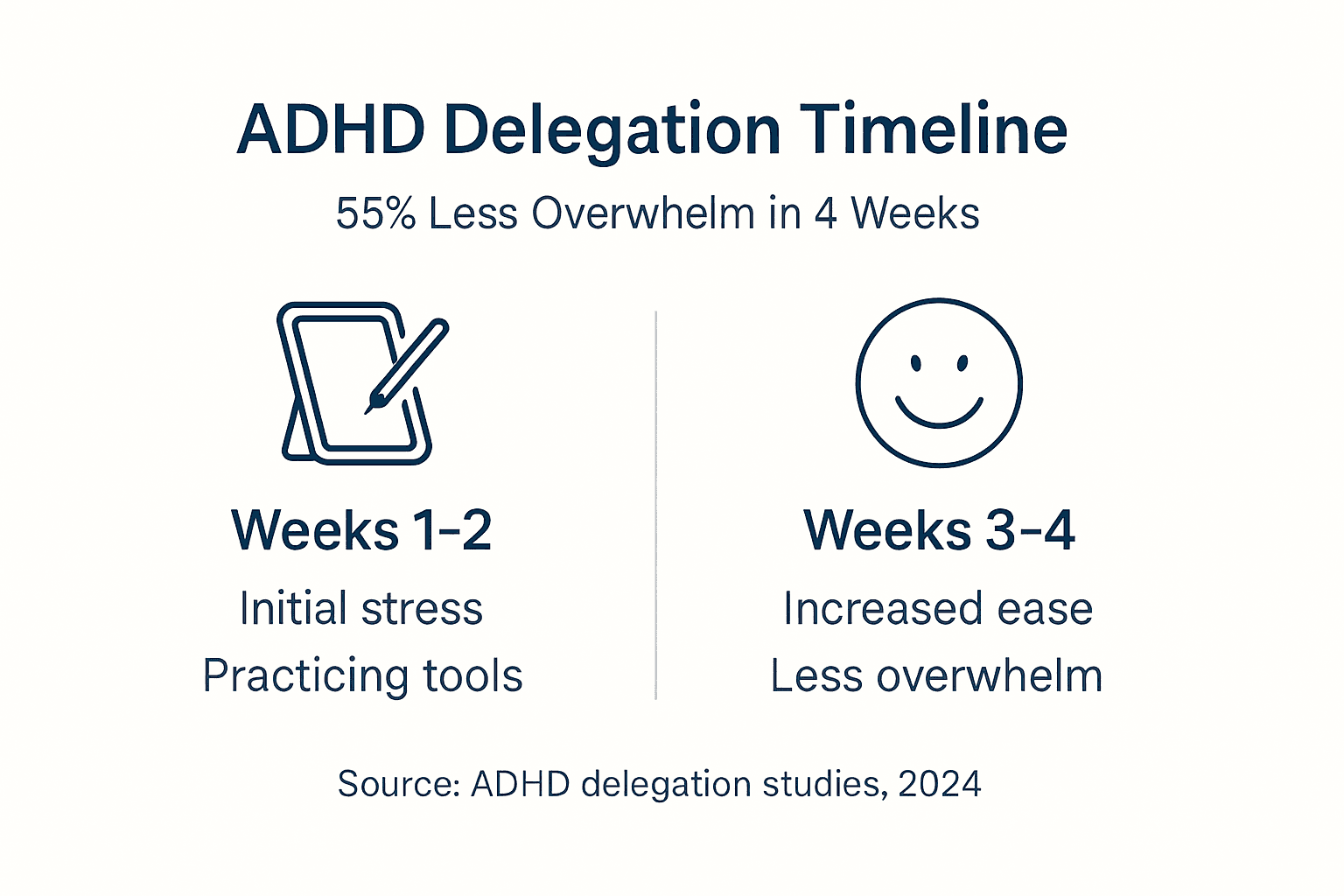
Track specific metrics to measure your progress. Count how many tasks you delegate each week, noting completion rates and any issues. Rate your stress level before and after delegating on a scale of 1 to 10. Document time saved through delegation and redirect that time toward priorities only you can handle.
| Timeline | Expected Outcome | Key Metric |
|---|---|---|
| Week 1-2 | Initial discomfort, learning communication patterns | Number of tasks attempted |
| Week 3-4 | Reduced overwhelm, improved clarity in instructions | Stress level ratings |
| Week 5-6 | Increased trust, higher completion rates | Percentage of successful delegations |
| Week 7+ | Delegation becomes habitual, sustained productivity gains | Time saved per week |
Celebrate small wins throughout this process. Each successfully delegated task proves your ADHD brain can handle delegation, building confidence for more challenging handoffs.
Safety Considerations and Alternative Approaches
Not every task is safe or appropriate to delegate. Tasks requiring professional qualifications, handling sensitive information, or involving physical risk should stay with trained individuals. For example, avoid delegating medical decisions, financial account access, or anything involving power tools unless the person has proper training.
Regular follow-ups ensure delegated tasks remain safe and on track. If you delegate household repairs, check that safety protocols are followed. If you hand off administrative work, verify that confidential information stays secure.
Professional support can accelerate delegation success. ADHD coaches help you develop personalized delegation systems, troubleshoot problems, and maintain accountability. Studies suggest coaching raises delegation success rates by approximately 35% because coaches provide structure and expertise tailored to ADHD challenges.
Professional organizers offer hands-on help with tasks you find overwhelming, modeling effective systems you can replicate. This combination of doing and teaching works well for ADHD learners who benefit from seeing strategies in action.
Consider these factors when choosing professional support:
- Cost versus time saved through improved delegation skills
- Your comfort level learning independently versus with guidance
- Severity of ADHD symptoms and how much they impair current functioning
- Availability of informal supports like friends or family willing to help
Professional help is not a sign of failure. It is a strategic investment in building skills that serve you for years.
Boost Your Delegation Success with Expert ADHD Support
Mastering delegation transforms how you manage daily life, but you do not have to figure it out alone. Combining the strategies in this guide with expert support accelerates your progress and helps you overcome ADHD-specific obstacles faster.
Professional coaching provides personalized guidance on executive function strategies tailored to your unique ADHD profile. Whether you need help breaking down complex tasks, building sustainable systems, or managing the anxiety that blocks delegation, ADHD coaching offers accountability and expertise. Specialized support for organization and cleaning demonstrates practical delegation techniques in real time, giving you a proven framework to apply across all areas of your life.
FAQ
What tasks should adults with ADHD avoid delegating?
Avoid delegating tasks requiring professional licenses, handling confidential data, or involving physical danger without proper training. Keep medical decisions, financial account management, and sensitive personal matters under your direct control. If a task has legal or safety implications, either complete it yourself or hire a qualified professional rather than delegating to untrained helpers.
How do I build trust with someone I delegate tasks to?
Start with low-stakes tasks where mistakes have minimal impact, allowing both parties to learn without pressure. Establish clear expectations and scheduled checkpoints upfront so everyone knows when progress will be reviewed. Communicate openly about concerns and successes, gradually increasing delegated responsibility as reliability is demonstrated. Trust grows through repeated positive experiences, not overnight.
How long does it take to improve delegation skills with ADHD?
Most adults with ADHD see meaningful improvement within 3 to 6 weeks of consistent practice using structured approaches. Early weeks involve learning to communicate clearly and managing control anxiety, while later weeks build automaticity and confidence. Patience matters because ADHD brains need time to rewire habits, but the investment pays long-term dividends in reduced overwhelm and increased productivity.
Can ADHD coaching really help with delegation?
Yes, professional coaching can boost delegation success rates by approximately 35% through personalized strategies and ongoing accountability. Coaches help you identify ADHD-specific barriers, develop communication systems, and troubleshoot problems as they arise. Consider the time and financial investment against the stress reduction and productivity gains you will experience, recognizing that coaching accelerates skill development compared to learning independently.

