
How to Prioritize Tasks with ADHD: A Practical Guide
How to Prioritize Tasks with ADHD: A Practical Guide
TL;DR:
- Prioritizing tasks with ADHD requires externalizing everything through a brain dump to reduce mental overload and understand your unique executive function style. Using the ABCD demand-horizon method, breaking tasks into small steps, and applying visual markers help manage urgency and focus effectively. Regular reviews, flexible planning, and emphasizing how tasks make you feel better support ongoing progress and reduce common obstacles like procrastivity and time blindness.
If you’ve ever stared at a to-do list and felt your brain short-circuit, you already know that learning how to prioritize tasks with ADHD is not as simple as “just write it down.” The ADHD brain doesn’t rank tasks by logic. It ranks them by urgency, interest, and emotional weight, often all at the same time. That’s not a character flaw. It’s executive function working differently. This guide gives you specific, tested methods to cut through that mental noise and start actually moving through your day.
Key Takeaways
| Point | Details |
|---|---|
| Externalize everything first | Do a brain dump before prioritizing so your working memory isn’t carrying the full load. |
| Use the “feel better” question | Ask which one task, when done, will make you feel better to reduce overwhelm and pick a clear starting point. |
| Apply the ABCD method | Sort tasks by time horizon: A (today), B (this week), C (next week), D (someday) to keep urgency visible. |
| Break tasks to their smallest step | Define the next physical action for every priority to lower the bar for starting. |
| Review and adjust regularly | Daily and weekly check-ins keep your system alive and prevent stale priorities from piling up. |
How to prioritize tasks with ADHD: the foundation
Before any system works, your brain needs one thing: less to hold. The ADHD executive function system was not built for juggling twelve open mental tabs. That’s not pessimism. That’s neuroscience.
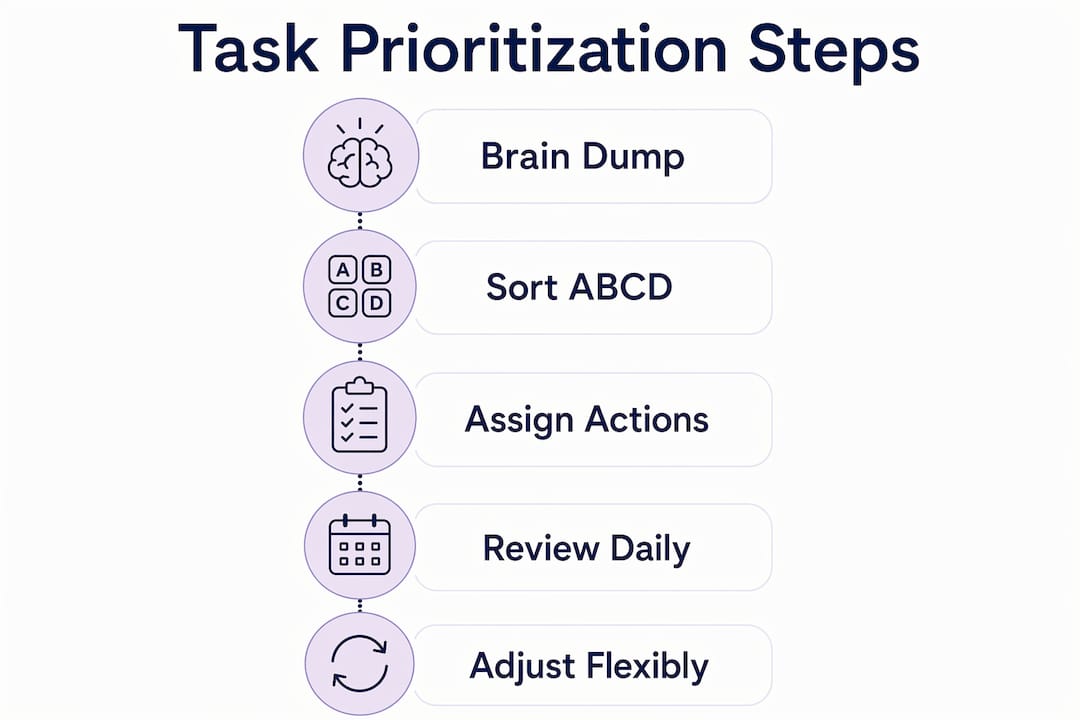
Start with a brain dump. Write every task, worry, and half-formed obligation onto paper or a digital note. No sorting yet. Just get it out. This single step reduces mental overload more than any planner you’ll ever buy.
Once everything is externalized, you can work with it. Here’s what to establish before you sort a single task:
- Accept your executive function style. Your brain resists starting, not finishing. Task initiation is often harder than continuation for adults with ADHD, so your prioritization system must make starting easier, not just planning cleaner.
- Use the “feel better” question. Clinician Terry Matlen recommends asking: “Which one task, when done, will make me feel better?” This cuts through the paralysis of trying to rank everything at once.
- Understand the ABCD demand-horizon method. This framework sorts tasks by urgency: A tasks need to happen within 24 hours, B tasks within 24 to 72 hours, C tasks within 3 to 7 days, and D tasks are future horizon items with no fixed deadline. You’ll use this structure throughout the day.
- Hold your priorities lightly. A prioritization process for ADHD must be flexible by design. If your energy crashes at 2pm, your morning A list should not become a guilt spiral. Adjust and continue.
Pro Tip: Keep your brain dump in one trusted place, whether that’s a notebook on your desk or a pinned note on your phone. Consistency in where you store tasks reduces the friction of starting your prioritization process.
Step-by-step ADHD task prioritization techniques
This is where the work becomes concrete. Effective task prioritization for ADHD works best when it combines an internal cue with an external structure. Neither alone is enough.
-
Start with the “feel better” question. Before sorting everything, pick the one task that will give you the most relief when complete. This is your anchor for the day. Prioritizing by emotional payoff reduces the internal shutdown that happens when every task feels equally urgent.
-
Sort your brain dump into ABCD categories. Go through your list and label each item. A tasks are non-negotiable today. B tasks are important but have a short window. C tasks matter but can wait a few days. D tasks are real but not pressing. Keep your A list short. Two to three items maximum. More than that and nothing gets done.
-
Schedule A and B tasks on a daily and weekly planner. Place A tasks in your morning or peak energy window. B tasks go into afternoon slots or tomorrow. Use a physical calendar or a digital tool you actually open. Organizing tasks with ADHD works better when the plan lives somewhere visible, not just in your head.
-
Add color coding or visual markers. Color-coded labels reduce the cognitive load of re-reading priorities every time you look at your list. Red for A, yellow for B, green for C works well for many people. Use whatever system your brain responds to visually.
-
Apply time-blocking with the Pomodoro technique. Typical Pomodoro sessions use 25-minute work blocks with 5-minute breaks, but ADHD brains often do better with flexible intervals. Try 20 minutes on and 10 minutes off to start. Set a timer externally so your brain doesn’t have to track it.
-
Break every A task into its smallest possible step. Don’t write “finish report.” Write “open document and type the first sentence.” CBT-informed approaches reduce priority paralysis by converting big decisions into the next physical action. When avoidance hits, you won’t have to re-decide how to start.
-
Set alarms and reminders with built-in buffers. ADHD and time blindness go together. Experts recommend adding 30-minute buffers between tasks and commitments to manage transitions. Set an alarm for when to start preparing, not just when to arrive.
| Technique | Best for | ADHD adaptation |
|---|---|---|
| ABCD sorting | Reducing decision overload | Keep A list to 2-3 items max |
| Pomodoro timer | Sustaining focus | Adjust intervals to your energy |
| Color coding | Visual task clarity | Use bold, distinct colors |
| Smallest step rule | Overcoming task initiation | Write the literal first physical action |
| Buffer alarms | Managing time blindness | Set three alarms: prep, start, deadline |
Pro Tip: Try framing your task names as verbs: “Email Sara” instead of “Sara email.” The brain responds to action-oriented language and starts faster when the task feels like a move, not a category.
Common obstacles and how to get unstuck
Even the best system hits walls. Here’s what those walls usually look like with ADHD, and what to do when you hit them.
Procrastivity is one of the sneakiest traps. It’s when you stay busy doing low-priority tasks, clearing emails, reorganizing your desk, or scrolling productivity articles, instead of the A task sitting at the top of your list. CBT techniques help reframe this by attaching “if X then Y” cues, such as “if I finish lunch, then I open the document,” to reduce the gap between intention and action.
- Priority paralysis happens when everything feels equally urgent. When that hits, go back to the “feel better” question. Pick one. The rest will still be there.
- Time blindness makes it impossible to judge how long tasks take. Use external anchors like timers and calendar blocks instead of relying on your internal clock.
- Low energy windows require a different task list, not a pep talk. Keep a B or C task ready for when your focus dips. Managing ADHD tasks well means working with your energy, not against it.
- Perfectionism stalls more ADHD adults than laziness ever could. Done at 80% today beats perfect someday. Give yourself permission to close the loop imperfectly.
- Rigid planning backfires with ADHD. If your plan falls apart by 10am, that’s not failure. That’s data. Adjust the list, pick the next anchor task, and keep moving.
“Progress with ADHD rarely looks like the neat checklist you imagined at 8am. It looks like recovering faster each time the plan breaks down.”
When nothing is working, step back and ask whether the obstacle is practical or emotional. Sometimes you need a shorter task. Sometimes you need a glass of water and five minutes outside. Both count as managing your day well.
Keeping your prioritization process dynamic
A system that works once isn’t a system. Here’s how to maintain one over time without burning out on the maintenance itself.
-
Do a daily review every morning. Spend five minutes checking your ABCD list. Move any B tasks that have aged into A territory. Drop anything that no longer matters. Daily re-assessment keeps your list current without requiring a full rebuild every day.
-
Anchor your review to an existing habit. Morning coffee, lunch, or a commute are natural anchors. Attaching your review to something you already do removes the need to remember to do it.
-
Do a weekly reset every Sunday or Monday. Look at the full week, move C and D items forward as needed, and set up your A and B list for the days ahead. This prevents backlog from quietly piling up.
-
Track capacity, not just completion. Log your energy levels alongside your task outcomes for a week. You’ll quickly see your peak hours and plan accordingly.
-
Include BACE activities in your schedule. Body, Achievement, Connection, and Enjoyment. These aren’t extras. They support the cognitive capacity that makes everything else on this list possible.
| Review type | Frequency | Purpose |
|---|---|---|
| Daily check-in | Every morning | Update ABCD, pick anchor task |
| Weekly reset | Sunday or Monday | Re-queue tasks, plan the week |
| Energy log | Ongoing for 1 week | Identify peak focus windows |
| BACE check | Daily | Maintain capacity and motivation |
Progress isn’t only tasks completed. Noticing when you’re procrastivating instead of doing it for three hours counts as a win. When the system starts to feel too heavy, simplify it, don’t abandon it. One brain dump and one anchor task is still a system.
My honest take on ADHD prioritization
What I’ve learned from working with adults with ADHD and writing about this topic is that most prioritization advice fails because it treats ADHD like a time management problem. It’s not. It’s an emotional regulation and initiation problem wearing time management clothing.
The systems that actually stick, and I’ve seen this over and over, are the ones that ask “what will make me feel better?” before “what is most important?” Those are not the same question. Importance is abstract. Feeling better is concrete. Your brain knows exactly what it means.
I’ve also watched people abandon perfectly good CBT-based methods because they expected the system to run on willpower. It doesn’t. It runs on structure, compassion, and the willingness to restart without drama. External tools are not a crutch. They’re a support system you deserve to use.
The biggest misconception I push back on is that thriving with ADHD means fixing how your brain works. It means building an environment where your brain can work as it actually does. The goal is not a perfect list. The goal is a day that moved forward.
— Estelle
Take your next step with Estelle-rose
If this guide gave you a clearer picture of how to manage your day, imagine having ongoing support built specifically around your ADHD brain.

Estelle-rose offers ADHD coaching for creatives and entrepreneurs who need more than generic productivity advice. Whether you’re working on executive function skills, building daily routines, or trying to get your environment to stop working against you, the resources here meet you where you are. There are also ADHD books and workbooks written specifically for adults who want to apply these strategies in their own lives. Take one step. The right support makes the next step easier.
FAQ
What is the easiest way to start prioritizing with ADHD?
Ask yourself which one task, when done, will make you feel better. This question, recommended by clinician Terry Matlen, cuts through decision overload and gives your brain a concrete starting point.
What is the ABCD method for ADHD task management?
The ABCD demand-horizon method sorts tasks by urgency: A tasks are due within 24 hours, B within 72 hours, C within a week, and D tasks are future items. Keeping the A list to two or three items prevents overwhelm.
How do you handle time blindness when prioritizing tasks?
Set multiple alarms with 30-minute buffers built in. Experts recommend alarms for when to start preparing, when to begin, and when the deadline hits, using external cues instead of relying on your internal sense of time.
Why does procrastivity happen with ADHD?
Procrastivity is the tendency to stay busy with low-priority tasks to avoid high-priority ones. CBT techniques help by converting vague tasks into specific next physical actions and using “if X then Y” prompts to reduce the gap between intention and starting.
How often should you review your ADHD task list?
A short daily review each morning and a full weekly reset on Sunday or Monday keeps your system current. Tying these reviews to existing habits, like morning coffee, reduces the effort needed to maintain the routine.

