
Manage Adult ADHD: 40% Fewer Missed Deadlines with Coaching
Manage Adult ADHD: 40% Fewer Missed Deadlines with Coaching
Adults with ADHD often struggle with deadlines and organization, leading to stress and reduced productivity. Using ADHD-specific reminder apps reduces missed deadlines by 40% for adults like you. This guide offers practical coaching and organization strategies for better work-life balance, helping you build consistent habits and regain control over your daily tasks.
Table of Contents
- Prerequisites Before Starting ADHD Management
- Core Coaching Techniques For Managing Adult ADHD
- Time Management Strategies
- Tools And Apps For Organization
- Common Mistakes And Troubleshooting
- Alternatives And Tradeoffs
- Expected Timeline And Measurable Outcomes
- Discover Expert ADHD Coaching To Transform Your Productivity
- Frequently Asked Questions
Key Takeaways
| Point | Details |
|---|---|
| Foundation First | Obtain a formal diagnosis and baseline assessment before starting management strategies. |
| Coaching Techniques | Use cognitive-behavioral methods to build routines and improve executive functions. |
| Time Management | Segment tasks into 10-15 minute blocks to increase focus by 25%. |
| Digital Tools | ADHD-friendly apps and planners reduce missed deadlines by 40%. |
| Avoid Pitfalls | Multitasking increases task failure rates by 50%; stick to single-task focus. |
Prerequisites Before Starting ADHD Management
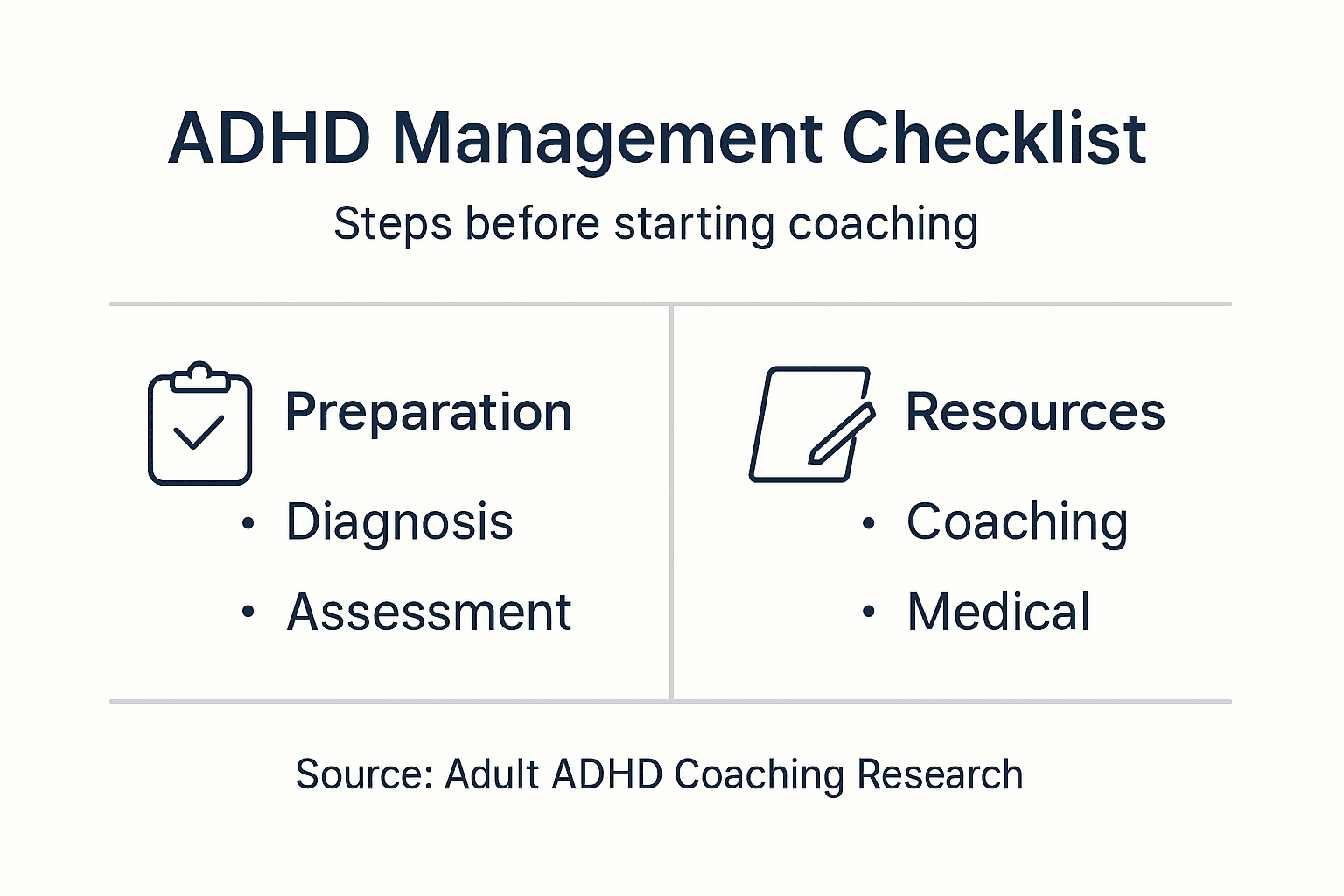
Before diving into coaching techniques, you need a solid foundation. Prerequisites before starting adult ADHD management include formal diagnosis, baseline symptom assessment, and setting realistic personal goals. Without these steps, you risk applying strategies that don’t match your specific needs.
Start with a formal ADHD diagnosis from a qualified professional. Self-diagnosis or assumptions can lead to ineffective management plans. Once diagnosed, complete a baseline assessment of your symptoms and executive function challenges.
Next, set specific and realistic goals related to work and life balance. Vague intentions like “be more organized” won’t drive change. Instead, aim for measurable outcomes such as completing daily priority tasks or reducing deadline misses by a specific percentage.
- Obtain a formal diagnosis from a psychiatrist or clinical psychologist
- Complete a baseline symptom and executive function assessment
- Set specific, measurable goals for work and personal productivity
- Research available coaching and medical resources in your area
Finally, familiarize yourself with coaching and medical resources available for adult ADHD. Knowing your options helps you make informed decisions about which approaches to combine for maximum benefit.
Core Coaching Techniques for Managing Adult ADHD
With your diagnosis and goals in place, tailored coaching methods effectively train your brain to manage ADHD symptoms. Cognitive-behavioral strategies improve executive functions like planning, impulse control, and memory, addressing the core challenges you face daily.
Breaking tasks into small, manageable chunks is essential. Your brain processes smaller units more effectively, reducing overwhelm and increasing completion rates. Instead of “write report,” break it into “outline main points,” “draft introduction,” and “review first section.”
Building consistent daily routines reduces executive dysfunction. When routines become automatic, you conserve mental energy for complex decisions. Start with morning and evening rituals that anchor your day.
Avoid multitasking at all costs. Research shows multitasking leads to 50% higher failure rates in task completion for adults with ADHD. Focus on one task at a time to improve both quality and completion rates. This contradicts the common misconception that multitasking boosts productivity.
- Use cognitive-behavioral strategies to strengthen planning and impulse control
- Break every large task into steps that take 15 minutes or less
- Establish morning, midday, and evening routines that become automatic
- Practice single-task focus to boost completion rates
- Review and adjust routines weekly based on what works
Pro Tip: Start your day with a prioritized to-do list and review it mid-day to adjust as needed. This simple habit keeps you aligned with your goals and prevents reactive task switching.
Explore impact-focused ADHD coaching to deepen these techniques with expert guidance. Professional coaching accelerates habit formation and provides accountability that self-management often lacks. For additional focus improvement methods, consider integrating evidence-based practices into your routine.
Time Management Strategies
Building on coaching methods, these specific time management tactics help you translate strategies into daily habit changes for measurable focus improvement. Breaking tasks into 10-15 minute segments increases focus duration by 25% among adults with ADHD.

Segment work into focused blocks of 10 to 15 minutes. This matches your natural attention span and prevents burnout. Use a timer to create clear boundaries between work and rest periods.
Prioritization tools like the Eisenhower matrix help you distinguish urgent from important tasks. Adapt this method by adding a third dimension: energy level required. Tackle high-energy tasks during your peak focus hours.
- Identify your top three priorities each morning before checking email or messages
- Assign each task to a 10-15 minute time block with a specific start time
- Set digital reminders 5 minutes before each block to transition smoothly
- Take a 3-5 minute break between blocks to reset focus
- Review completed tasks at day’s end and adjust tomorrow’s plan accordingly
Set up digital reminders and planners to keep deadlines on track. Syncing across devices ensures you receive alerts wherever you are. Choose tools with customizable notification settings to avoid alert fatigue.
Incorporate regular breaks to maintain mental energy. Your brain needs recovery time to sustain focus. Even a brief walk or stretching session recharges your attention reserves.
Adults with ADHD using task segmentation report a 25% increase in sustained focus duration compared to traditional time management methods.
Consistent application of these time management coaching strategies leads to measurable improvements within weeks. Track your focus duration and task completion rates to quantify progress and stay motivated.
Tools and Apps for Organization
After understanding time management strategies, adopting the right tools will solidify those habits and further reduce missed deadlines. Using reminder apps and digital planners specifically designed for ADHD reduces missed deadlines by 40% in adults.
Recommend ADHD-friendly apps for reminders and task planning. Look for features like recurring tasks, location-based alerts, and visual progress tracking. Apps designed for neurotypical users often lack the flexibility you need.
Sync schedules across all your devices for consistency. When your phone, tablet, and computer display the same information, you eliminate confusion and missed updates. Cloud-based tools ensure real-time synchronization.
- Choose apps with simple interfaces that don’t overwhelm with options
- Enable push notifications for time-sensitive tasks but limit non-urgent alerts
- Use widgets on your home screen for at-a-glance task visibility
- Regularly back up your data to prevent loss of important information
- Test apps for 1-2 weeks before fully committing to avoid tool overload
Regularly review and adjust your tools for best fit and to avoid overload. What works in month one may not suit your needs in month three. Stay flexible and willing to switch tools when necessary.
| App | Key Features | Primary Benefit |
|---|---|---|
| Todoist | Recurring tasks, priority levels, project organization | Reduces mental load by externalizing task memory |
| Habitica | Gamification, visual progress, social accountability | Increases motivation through reward systems |
| Structured | Time blocking, daily planner view, quick task entry | Provides clear daily structure and prevents overcommitment |
Pro Tip: Use color coding and sound alerts for important tasks. Assign red to urgent deadlines, yellow to medium priority, and green to low priority. Distinct sounds for different task types help you respond appropriately without checking your screen.
Integrate ADHD organization techniques beyond digital tools. Physical organization systems complement your apps and create a holistic management approach. Research on ADHD reminder apps confirms that consistent tool use dramatically improves deadline adherence.
Common Mistakes and Troubleshooting
With strategies and tools introduced, it’s crucial to recognize common mistakes that may derail your progress and how to troubleshoot them effectively. Avoid multitasking, which leads to 50% higher failure rates in task completion. Your brain cannot effectively process multiple complex tasks simultaneously.
Importance of establishing and maintaining consistent routines cannot be overstated. Inconsistent application of strategies yields inconsistent results. When routines break down, productivity plummets and anxiety rises.
Recognizing when coaching or tools aren’t working and adjusting accordingly shows self-awareness. Not every strategy fits every person. If a method doesn’t improve your metrics after four weeks, try a different approach.
- Stop trying to multitask; it destroys focus and increases errors dramatically
- Maintain daily routines even on weekends to prevent Monday restart struggles
- Review your progress weekly and adjust strategies that aren’t yielding results
- Avoid over-relying on tools without developing underlying executive function skills
- Don’t skip breaks; mental fatigue compounds ADHD symptoms and reduces effectiveness
Risks of relying solely on medication without behavioral coaching support include rebound symptoms and increased anxiety. Medication addresses neurochemical imbalances but doesn’t teach organizational skills or time management. Behavioral strategies build lasting habits that persist even when medication effects wear off.
Pro Tip: Keep a failure journal to identify patterns and improve strategies. When tasks fail or deadlines slip, write down what went wrong and what circumstances contributed. Patterns emerge quickly, revealing specific triggers or time periods that need extra support.
Troubleshooting requires honest self-assessment. If you consistently miss morning tasks, perhaps you’re not a morning person and should reschedule priorities. If digital reminders get ignored, try physical cues like sticky notes in high-traffic areas.
Alternatives and Tradeoffs
Understanding common pitfalls sets the stage for evaluating alternatives and tradeoffs to find the best personalized management plan. Adults using medication combined with coaching experience 20-30% greater improvement in productivity and symptom control compared to coaching alone.
Comparison of coaching alone, medication alone, and combined approaches reveals clear productivity gains. Coaching builds skills and habits but may take longer to show results. Medication provides faster symptom relief but doesn’t teach organizational strategies. Combined approaches leverage both benefits for optimal outcomes.
| Approach | Productivity Gain | Key Benefit | Primary Limitation |
|---|---|---|---|
| Coaching Only | 15-20% improvement | Builds lasting skills and habits | Slower initial results, requires high motivation |
| Medication Only | 20-25% improvement | Rapid symptom relief, improved focus | Doesn’t teach organizational skills, risk of rebound symptoms |
| Combined Approach | 35-45% improvement | Fastest results with lasting habit formation | Higher cost, requires coordination between providers |
Over-reliance on stimulant medication without behavioral strategies leads to rebound symptoms and increased anxiety in 35% of adults with ADHD. When medication wears off, untrained executive functions leave you struggling without chemical support. This creates dependency and prevents skill development.
Peer support groups and mindfulness meditation offer modest symptom relief but are less effective than structured coaching and medication for executive functioning improvements. These complementary approaches work best as supplements, not primary interventions. They provide emotional support and stress reduction but don’t directly address executive dysfunction.
Guidance on choosing approaches based on individual needs and symptom severity matters. Mild symptoms may respond well to coaching alone. Moderate to severe symptoms typically require combined medication and coaching for meaningful improvement. Consult with your healthcare provider to determine the right combination for your situation.
Review peer support and mindfulness as additions to your core treatment plan. These methods reduce stress and provide community connection but shouldn’t replace evidence-based interventions. Balance is key.
Expected Timeline and Measurable Outcomes
Having explored options and solutions, it’s important to set clear expectations about when and how you’ll notice progress from your efforts. Typical 8 to 12 week period to observe measurable improvements in productivity and symptom control is realistic for most adults starting ADHD management.
Trackable metrics such as increased task completion rate, reduced missed deadlines, and sustained focus times provide objective evidence of progress. Don’t rely solely on subjective feelings. Numbers reveal patterns that emotions can obscure.
Self-reported improvements in work-life balance and anxiety reduction often appear before objective metrics shift. You may feel less overwhelmed within weeks, even if completion rates take longer to increase. Both types of progress matter.
- Track daily task completion rates using your planner or app analytics
- Monitor the number of missed deadlines each week and watch for downward trends
- Measure focus duration by timing how long you sustain attention on single tasks
- Note changes in stress levels using a simple 1-10 scale each evening
- Record sleep quality and energy levels, as these impact ADHD symptom severity
Importance of regular progress review and adjusting strategies as necessary ensures continued improvement. Schedule weekly 15-minute reviews to analyze your metrics and identify what’s working. Adjust struggling areas before they become entrenched problems.
Most adults see initial improvements in 4 to 6 weeks, with substantial gains by week 12. Early wins include better morning routines and fewer forgotten tasks. Deeper changes like sustained focus and reduced anxiety emerge more slowly as neural pathways strengthen.
Plateau periods are normal. If progress stalls after initial gains, intensify one aspect of your plan rather than abandoning everything. Small tweaks often restart momentum without requiring complete overhauls.
Discover Expert ADHD Coaching to Transform Your Productivity
Ready to accelerate your progress beyond self-management? Professional coaching provides personalized strategies and accountability that dramatically improve outcomes. Adult ADHD executive function coaching addresses your specific challenges with evidence-based techniques tailored to your goals.
Whether you’re an entrepreneur juggling multiple projects or a creative professional struggling with deadlines, ADHD coaching for entrepreneurs and creatives offers specialized support. Expert guidance helps you implement the strategies covered in this guide while avoiding common pitfalls that derail self-directed efforts.
Transform chaos into clarity with proven ADHD organization strategies that work with your brain, not against it. Professional coaching shortens the timeline to measurable results and provides ongoing support as your needs evolve.
Frequently Asked Questions
How can I maintain focus when distractions are constant?
Use timed focus blocks of 10 to 15 minutes with scheduled breaks between sessions. Minimize external distractions by working in quiet spaces and turning off non-essential notifications. Employ ADHD-friendly reminder tools to keep tasks prioritized and visible throughout your day.
Is medication necessary to manage adult ADHD effectively?
Medication helps with symptom relief but should be combined with coaching for best results. Medication-only approaches risk rebound anxiety and reduced long-term benefits since they don’t build organizational skills. Many adults achieve significant improvements through coaching alone, especially with mild to moderate symptoms.
How long before I see real improvement after starting coaching?
Most adults see measurable gains in 8 to 12 weeks of consistent coaching application. Initial improvements like better routines appear within 4 to 6 weeks. Consistent application and regular review of strategies accelerate progress, while inconsistent efforts delay results significantly.
What tools are best for adults with ADHD to stay organized?
Use ADHD-specific reminder and planner apps that sync across all your devices for consistency. Apps like Todoist, Habitica, and Structured offer features designed for executive function challenges. Regularly update and customize tools to fit your evolving workflow and prevent tool overload from accumulating too many apps.

