
How Purpose Shapes ADHD Focus: 2026 Coaching Insights
How Purpose Shapes ADHD Focus: 2026 Coaching Insights
How purpose directly stabilizes attention in the ADHD brain
Purpose is not a motivational bonus for adults with ADHD. It is a neurological requirement. ADHD motivation is fundamentally meaning-based rather than reward-based, engaging dopamine systems selectively for intrinsically meaningful tasks. When a task connects to something you genuinely care about, your brain releases dopamine. When it does not, focus collapses, no matter how hard you try to push through.
The role of purpose in ADHD focus is not abstract. It is the difference between a brain that engages and one that shuts down. Coaches and clinicians consistently observe that adults with ADHD can sustain remarkable attention on tasks tied to personal values, curiosity, or a clear sense of why, while struggling intensely with tasks that feel arbitrary or disconnected from anything that matters to them.
Key effects of purpose on ADHD attention:
- Purpose triggers dopamine release, making sustained focus physiologically possible.
- Meaning-based tasks reduce the internal resistance that leads to procrastination.
- A clear personal “why” signals to the ADHD brain that a task is worth the effort.
- Meaning-based motivation is sustainable and responsive to engagement, rather than pressure or arbitrary rewards.
- Purpose-driven work increases follow-through, reducing the cycle of unfinished tasks.
Why your ADHD brain responds differently to meaningful work
The dominant neurobiological model of ADHD has long described it as a global deficit in the brain’s reward pathways. Recent research challenges that framing. A 2026 theoretical framework proposes that dopamine release in ADHD is differentially sensitive to alignment between an activity and intrinsic interests, and to perceived progress toward meaningful goals. The implication is significant: the ADHD brain is not broken. It is selective.
This selectivity explains hyperfocus. Hyperfocus in ADHD reflects intense dopamine release when tasks align with core values and curiosity. Far from a deficit, it demonstrates that the capacity for deep, sustained attention exists. The challenge is directing it.
| Task Type | Neurological Response in ADHD | Practical Outcome |
|---|---|---|
| Meaningful, interest-aligned | Elevated dopamine release, striatal activation | Sustained focus, hyperfocus possible |
| Externally imposed, low relevance | Reduced dopamine, low striatal engagement | Avoidance, procrastination, shutdown |
| Reward-based but not intrinsic | Temporary dopamine spike, not sustained | Short bursts, motivation fades quickly |
| Purpose-linked routine | Consistent dopamine engagement | Stable follow-through over time |
Pro Tip: When you notice you are avoiding a task, ask yourself whether it feels emotionally relevant to you. If the answer is no, that is a neurological signal, not a character flaw. Reconnecting the task to a value you hold can shift your brain’s response.
Why discipline alone rarely works for adults with ADHD
Telling yourself you “should” do something does not produce dopamine. Importance-based motivation is ineffective for ADHD because it lacks the emotional resonance needed to trigger dopamine release. The ADHD brain does not respond to pressure the way a neurotypical brain might. Willpower, guilt, and urgency are unreliable fuels.
Practitioners note that focus struggles in ADHD are often misread as laziness when the brain’s response to interest and meaning is actually the key driver. This misunderstanding causes real harm. Adults with ADHD internalize the narrative that they are failing when they cannot sustain effort through sheer discipline, leading to shame and burnout rather than solutions.
Reasons why discipline and importance alone fall short:
- The ADHD brain requires a clear “why” behind tasks to engage focus; without it, instructions register as meaningless.
- Punishment and pressure activate stress responses, not productive attention.
- “Must-do” framing without personal meaning increases avoidance, not compliance.
- Attempting to white-knuckle focus with willpower often fails due to neurological reward-system mismatch.
- External importance (deadlines, other people’s expectations) does not substitute for internal relevance.
Pro Tip: Try reframing a task you are avoiding by asking: “How does completing this connect to something I actually care about?” Linking a mundane task to a value or long-term goal you hold shifts the brain from “have-to” to “want-to,” and that shift is neurological, not just psychological.
Practical strategies to leverage purpose and improve your focus
The most effective motivational strategies for ADHD start with identifying your personal values and building a task-specific “why” before you begin. This is not a one-time exercise. It is a daily practice of connecting what you need to do with what genuinely matters to you.

Reframing mundane tasks by linking them to personal meaning stabilizes focus and reduces resistance. If you are filing paperwork, the task itself is not meaningful. But if filing paperwork means your business runs smoothly and you can spend more time on creative work you love, the connection is real. Your brain can work with that.
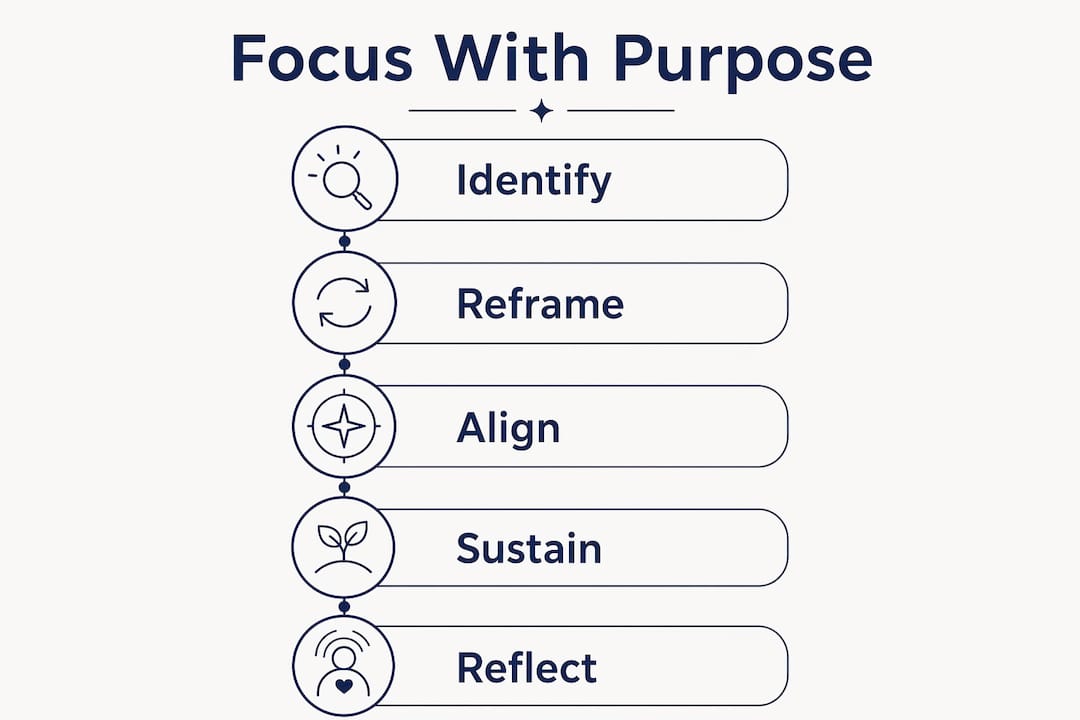
Coaches also recommend body doubling and the Pomodoro Technique as external structures that provide accountability and visible progress. These tools do not replace purpose. They support it by reducing the activation energy required to start. You can explore executive function strategies that combine these techniques with purpose-alignment work for a more complete approach.
Daily habits to build purpose-driven focus:
- Start each day by naming one task and its personal “why” before you open your inbox.
- Break large projects into smaller, purpose-driven steps to reduce overwhelm.
- Use body doubling for tasks with low intrinsic interest to borrow external momentum.
- Schedule purposeful breaks: short, physical, and time-limited, such as a walk around the block.
- Review your values list weekly and check whether your current projects still connect to them.
- Celebrate small completions. Progress recognition feeds the dopamine loop that keeps you going.
Pro Tip: Coaches recommend focusing on moment-to-moment meaning rather than searching for a grand life purpose. Ask “What matters about this next hour?” rather than “What is my life’s mission?” The smaller question is more useful and far less paralyzing.
For adults who want structured guidance on building these habits, proven focus strategies that emphasize task meaning and external supports offer a practical starting point alongside coaching work.
Discovering your personal sense of purpose does not require a retreat or a career overhaul. CHADD notes that for people with ADHD, what holds attention and interest contains the answers to what will sustain focus and produce genuine satisfaction. Start by noticing which tasks you lose track of time doing, which problems you find yourself thinking about unprompted, and which outcomes feel worth the discomfort of hard work.
What Estelle-rose’s coaching approach reveals about purpose and focus
Estelle-rose works with adults with ADHD who are often high-achieving, creative, and deeply frustrated by the gap between their potential and their daily output. The consistent pattern across clients is not a lack of intelligence or effort. It is a disconnect between what they are spending their time on and what actually engages their brain.
The coaching philosophy at Estelle-rose centers on purpose as a practical tool, not an inspirational concept. When a client cannot start a task, the first question is not “How can you be more disciplined?” It is “Does this task connect to anything you care about, and if not, how can we build that connection?” That reframe changes everything about how the brain approaches the work.
Adults with ADHD who align their work with personal values report not just better focus, but reduced shame around past struggles. Understanding that the brain was never broken, only misaligned, is a turning point. Estelle-rose’s ADHD books and workbooks are built around this principle, offering structured exercises to identify values, connect tasks to meaning, and build the kind of purposeful routines that the ADHD brain can actually sustain.
If you are ready to stop fighting your brain and start working with it, ADHD coaching with Estelle-rose offers a structured, empathetic path from chronic overwhelm to purposeful, consistent focus.
Key Takeaways
Purpose is the single most reliable activator of sustained focus for adults with ADHD because it directly engages the brain’s dopamine system in a way that discipline, pressure, and external rewards cannot replicate.
| Point | Details |
|---|---|
| Purpose triggers dopamine | Meaningful tasks engage dopamine pathways selectively, making focus physiologically possible for ADHD brains. |
| Discipline alone falls short | Importance-based motivation lacks the emotional resonance needed to trigger dopamine release in ADHD. |
| Reframing builds engagement | Linking mundane tasks to personal values shifts the brain from avoidance to active engagement. |
| External tools support purpose | Body doubling and the Pomodoro Technique reduce activation energy without replacing the need for meaning. |
| Moment-to-moment meaning works | Focusing on what matters in the next hour is more effective than searching for a grand life purpose. |

