
Motivational Interviewing for ADHD Teens: What It Is
Motivational Interviewing for ADHD Teens: What It Is
Motivational interviewing (MI) is a collaborative, evidence-based communication approach that helps adolescents with ADHD discover their own reasons for change, rather than responding to external pressure or directives. Unlike traditional directive therapy, MI treats the teen as the expert on their own life. The clinician or parent asks, listens, and reflects, rather than instructing. For teens with ADHD, whose motivation issues stem from neurological factors rather than willpower deficits, this distinction is clinically significant.
MI operates through four sequential stages: engagement, focusing, evocation, and planning. Within those stages, practitioners rely on the OARS framework, which stands for Open-ended questions, Affirmations, Reflective listening, and Summaries. Together, these tools reduce defensiveness, work around verbal working memory limitations, and help teens articulate goals they actually care about. The STAND program, developed by researcher Margaret H. Sibley, is a well-studied clinical application of MI for adolescents with ADHD in the United States, combining MI with structured behavior therapy in parent-teen sessions.
Key components of MI in ADHD treatment:
- Collaborative spirit: The clinician guides, not directs. The teen’s values and goals drive the conversation.
- Eliciting change talk: Practitioners draw out the teen’s own statements about wanting or planning to change, rather than making the case for them.
- OARS techniques: Open-ended questions, Affirmations, Reflective listening, and Summaries address ADHD-specific communication barriers.
- Four-stage process: Engagement, focusing, evocation, and planning provide a structured arc without rigidity.
- Autonomy support: MI explicitly protects the teen’s right to choose, which reduces the reactance common in ADHD adolescents.
- Partnership role: Parents and clinicians shift from authority figures to accountability partners.
What are the core principles and stages of MI in ADHD treatment?
MI’s four stages are not a rigid checklist. They describe a natural progression that a skilled practitioner moves through fluidly, sometimes cycling back when a teen’s motivation shifts.
Engagement comes first. The goal is simply to build a working relationship where the teen feels heard rather than managed. For adolescents with ADHD, who often arrive at therapy because an adult insisted, this stage can take longer than clinicians expect. Rushing past it is one of the most common errors in practice.

Focusing narrows the conversation toward a specific area of change. A teen might have concerns about school performance, friendships, or family conflict. The practitioner helps identify which issue the teen is most willing to explore, without imposing an agenda. This matters because ADHD teens often face pressure from multiple directions simultaneously, and diffuse pressure tends to produce paralysis rather than action.
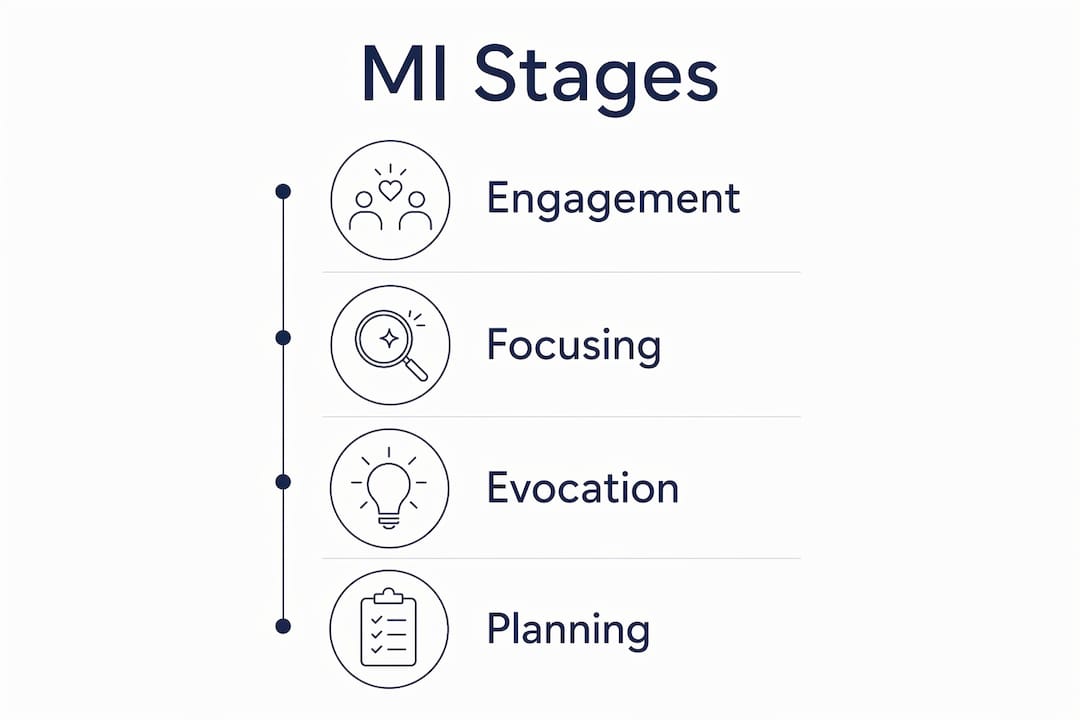
Evocation is where MI becomes most distinct from other approaches. Rather than presenting reasons for change, the practitioner elicits change talk from the teen. Questions like “What would be different if this changed?” or “What matters most to you about this?” pull out the teen’s own motivation rather than borrowing the clinician’s. This is particularly effective for ADHD because it bypasses the working memory and attention demands of processing someone else’s argument.
Planning translates motivation into concrete steps. Critically, the plan belongs to the teen. The practitioner helps make it specific and realistic, but the teen’s ownership of the plan is what determines whether it survives contact with Monday morning.
The OARS techniques operate across all four stages:
- Open-ended questions invite elaboration rather than yes/no answers, keeping the teen engaged and generating more material to work with.
- Affirmations acknowledge genuine strengths and efforts, not empty praise. For a teen who has heard mostly criticism about their ADHD behavior, a specific, earned affirmation lands differently.
- Reflective listening mirrors back what the teen said, sometimes with a slight reframe, which helps them hear their own thinking more clearly. This is especially useful when verbal working memory limitations make it hard for ADHD teens to track a long conversation.
- Summaries consolidate what has been said, reinforce change talk, and signal transitions between topics.
The non-confrontational spirit running through all of this is not just a stylistic preference. It is the mechanism. Confrontation activates defensiveness, and defensiveness in an ADHD teen with emotional dysregulation can derail a session entirely. MI’s collaborative structure keeps the door open.
What does the research say about MI effectiveness for adolescents with ADHD?
The clinical evidence base for MI in adolescent ADHD treatment has grown steadily, with the STAND program providing the most rigorous data available in the United States.

Parent-teen behavior therapy combined with MI, as structured in the STAND program, produced robust improvements in ADHD symptoms, organization skills, and parenting stress, with an 85% family engagement rate across trials. Benefits were partially maintained at six months post-treatment, which is a meaningful result given how difficult sustained change is for this population. Margaret H. Sibley’s work on STAND has been central to establishing MI as a credible adjunct to behavior therapy rather than a standalone intervention.
A separate nursing program applying MI with ADHD adolescents found improved medication adherence and reduced problematic behaviors at the individual level, extending MI’s utility beyond structured family therapy into clinical nursing contexts.
| Study / Program | Population | Key Outcomes | Maintenance |
|---|---|---|---|
| STAND (Sibley et al.) | Adolescents with ADHD + parents | Improved ADHD symptoms, organization skills, reduced parenting stress | — |
| MI-based nursing program | Adolescents with ADHD | Improved medication adherence, reduced ADHD behaviors | Not reported |
| MI + ADHD coaching integration | Youth with ADHD | Enhanced engagement, reduced resistance, autonomous goal-setting | Ongoing with MI support |
Research gaps remain. Most trials focus on the active treatment phase rather than long-term follow-up beyond six months. Studies on MI applied specifically to ADHD subgroups, such as girls or teens with co-occurring anxiety, are limited. The mechanisms by which MI produces change in ADHD populations, as distinct from other adolescent groups, also need more direct investigation.
Key findings from the current evidence base:
- MI combined with behavior therapy outperforms behavior therapy alone on engagement metrics.
- Family stress reduction is a consistent secondary benefit, not just a byproduct.
- Skill gains tend to plateau or decline after active treatment ends without continued motivational support.
- Clinician fidelity to MI principles, rather than session frequency, appears to drive outcomes.
- The STAND program’s structured format makes it replicable in community clinical settings.
How does MI address the specific challenges ADHD creates in treatment?
ADHD motivation problems are neurological, not attitudinal. The brain’s dopamine and norepinephrine systems regulate the experience of effort, reward, and future-orientation, and in ADHD those systems operate differently. A teen who “doesn’t care” about their grades is often experiencing a genuine deficit in the brain’s ability to make future consequences feel real and motivating right now. Telling them to try harder does not fix that. MI works with the brain’s emotional architecture instead of against it.
Emotional dysregulation is another layer. Many adolescents with ADHD experience intense, fast-moving emotional responses that can derail conversations before they start. A directive approach, where an adult presents a problem and expects a rational response, tends to trigger exactly the defensiveness and shutdown that makes ADHD treatment so frustrating for families. MI’s non-confrontational stance keeps emotional temperature low enough for real conversation to happen.
The shift from directive to partnership roles is one of the most clinically significant changes MI introduces. When a clinician or parent moves from “manager” to accountability partner, the teen’s experience of the interaction changes. They are no longer defending against an authority figure. They are thinking alongside someone who is genuinely curious about what they want. That shift reduces defensiveness and opens space for authentic goal exploration.
Common ADHD treatment pitfalls that MI helps avoid:
- Goal imposition: Setting targets the adult cares about, not the teen. MI keeps the teen’s values central.
- Lecture-heavy sessions: Extended explanations overload working memory. MI uses questions and reflections instead.
- Ignoring ambivalence: Most teens with ADHD feel genuinely conflicted about change. MI treats ambivalence as normal and works through it rather than around it.
- Skipping the maintenance phase: Skills gained in active treatment erode without ongoing motivational support. MI provides the framework for sustaining engagement when direct skills practice wanes.
Pro Tip: During skill maintenance phases, return explicitly to the teen’s original “change talk” from early sessions. Reviewing what they said they wanted, in their own words, is more motivating than reviewing what they have or haven’t done.
Adolescent autonomy is not a therapeutic obstacle. It is the resource MI is designed to activate. When teens feel their choices are genuinely respected, they invest more in the outcomes. For ADHD teens who have often experienced school and home as places where their autonomy is constantly overridden, that experience of being trusted is itself therapeutic.
How does MI integrate into parent-teen therapy and clinical ADHD programs?
The STAND program is the clearest model of how MI integrates with structured ADHD intervention. Developed by Margaret H. Sibley, STAND combines MI with behavior therapy targeting organization, time management, and planning (OTP) skills in structured parent-teen sessions. Parents learn monitoring strategies while teens work on specific skill deficits, and MI techniques run through both tracks to maintain engagement and reduce conflict.
The STAND program’s structure merges MI with behavior therapy targeting adolescent OTP skills and parent monitoring strategies, producing the high family engagement rate noted in clinical trials. That figure matters because family dropout is one of the primary reasons ADHD interventions fail in real-world settings. MI’s contribution to engagement is not incidental to the program’s success.
Clinician and parent strategies for effective MI use in ADHD contexts:
- Ask before advising: Check whether the teen wants information or a suggestion before offering it. This simple step dramatically reduces resistance.
- Reflect more than you direct: A ratio of roughly two reflections for every question keeps the teen talking and thinking rather than defending.
- Name ambivalence explicitly: “It sounds like part of you wants this to change, and part of you isn’t sure it’s worth the effort” normalizes the teen’s experience and keeps them engaged.
- Track progress in the teen’s language: Use the goals and phrases the teen generated, not clinical language, when reviewing progress.
- Involve parents as partners, not reporters: When parents shift from reporting problems to exploring solutions alongside the teen, session dynamics change quickly.
Training requirements for MI practitioners in ADHD contexts are not trivial. Basic MI competency typically involves formal training, supervised practice, and fidelity assessment using tools like the Motivational Interviewing Treatment Integrity (MITI) coding system. Working with ADHD adolescents adds complexity because the population’s emotional reactivity, attention variability, and history of negative feedback require practitioners to maintain MI spirit under pressure. A practitioner who defaults to directive language when a teen is dysregulated undermines the entire approach.
For parents applying MI principles at home, the learning curve is real but manageable. The core shift is from problem-solving mode to curiosity mode. Instead of “You need to do your homework,” the question becomes “What would make it easier to get started tonight?” That reframe does not always produce immediate compliance, but it builds the kind of relationship where compliance becomes more likely over time. Resources like ADHD executive function support can help parents understand the neurological basis for their teen’s behavior, which makes the MI stance easier to sustain.
What do MI sessions with ADHD adolescents actually look like?
Abstract principles are useful. Concrete examples are more useful. The following scenarios illustrate how MI techniques operate in practice with ADHD teens, drawing on the clinical frameworks established in the STAND program and related research.
The first session: building engagement without an agenda
A 15-year-old arrives at a first session because his parents insisted. He is not interested in being there. A directive therapist might open with a problem list. An MI-trained clinician opens with genuine curiosity: “What’s one thing going well for you right now, even if it’s not related to school?” The teen mentions a video game he’s been playing competitively. The clinician asks follow-up questions, not as a manipulation tactic, but because the answer genuinely matters. By the end of the session, the teen has talked for 40 minutes about what he cares about, and the clinician has a map of his values that will guide every subsequent conversation.
Evoking change talk around academic performance
A 16-year-old with ADHD knows her grades are slipping but feels no urgency about it. Rather than presenting consequences, the clinician asks: “If things stayed exactly as they are for the next two years, what would that mean for you?” The teen pauses. She mentions a design program she wants to apply to. The clinician reflects: “So getting into that program matters to you.” The teen says yes, and then, unprompted, begins connecting her current habits to that goal. That connection, made by the teen rather than the clinician, is change talk. It is more durable than any argument the clinician could have made.
Navigating ambivalence in a parent-teen session
A parent and teen are in session together. The parent wants the teen to use a planner. The teen finds planners pointless. An MI-trained clinician does not adjudicate. Instead, they ask the teen: “What would have to be true about a system for it to actually work for you?” The teen describes something flexible, visual, and low-effort. The parent, who has been listening rather than arguing, offers to look for something that fits that description. The session ends with the teen’s criteria driving the solution, not the parent’s preference. That outcome is more likely to produce actual behavior change than a negotiated compromise.
The maintenance phase: sustaining motivation after skills training
Six months after completing a structured ADHD program, a teen’s organization skills have slipped. A follow-up MI session does not review what went wrong. It returns to the teen’s original goals: “You told me back in the fall that getting your license was the thing you most wanted. Where does that stand?” The teen re-engages. The conversation moves from reviewing failures to reconnecting with motivation. This is precisely the function MI serves in the maintenance phase of ADHD treatment, where direct skills implementation wanes but the motivational foundation can be reactivated.
For clinicians working with ADHD teens in community settings, the anxiety and ADHD management overlap is worth addressing directly in MI sessions, since anxiety frequently co-occurs and can complicate the evocation stage. Teens who are anxious about change may produce change talk that sounds genuine but reflects compliance rather than authentic motivation. Skilled MI practitioners learn to distinguish the two through careful reflective listening.
One practical limitation worth naming: MI requires time and practitioner skill that not every clinical setting can provide. In high-volume school-based or community mental health contexts, session length and caseload pressures can make full MI fidelity difficult. Abbreviated MI approaches, sometimes called brief MI or adapted MI, have been studied in these contexts, though the evidence base for abbreviated versions with ADHD adolescents specifically is still developing. The role of psychiatrists in ADHD treatment increasingly includes coordinating with MI-trained therapists rather than delivering MI directly, which reflects a realistic division of labor in most clinical teams.
For parents who want to apply MI principles at home without formal training, Estelle-rose’s ADHD books offer accessible entry points into the communication frameworks that underpin MI, written specifically for the ADHD context rather than general therapy audiences.
Key Takeaways
Motivational interviewing works for ADHD adolescents because it aligns with how the ADHD brain actually processes motivation, using the teen’s own values and goals rather than external demands to drive change.
| Point | Details |
|---|---|
| MI targets intrinsic motivation | MI elicits change talk from the teen rather than imposing goals, reducing resistance and building genuine buy-in. |
| OARS addresses ADHD communication barriers | Open-ended questions, Affirmations, Reflective listening, and Summaries work around working memory and attention limitations. |
| STAND program shows 85% engagement | The STAND program achieved high family engagement—with 85% of families engaged across trials—and sustained benefits partially maintained at six months post-treatment. |
| Maintenance phase requires ongoing MI | Skill gains plateau without continued motivational support; MI reconnects teens to their original goals when adherence dips. |
| Practitioner role shift is central | Moving from directive authority to accountability partner reduces teen defensiveness and opens space for authentic goal exploration. |

