
Why ADHD Executives Need Recovery Plans to Lead Well
Why ADHD Executives Need Recovery Plans to Lead Well
ADHD executives need recovery plans because their brains face a specific, compounded form of burnout that generic rest strategies simply do not address. The combination of chronic executive dysfunction, dopamine depletion, and the invisible energy cost of masking neurotypical behavior creates a burnout profile that is neurologically distinct. Without a plan built around those realities, recovery stalls, and leadership performance deteriorates further.
This is not about working less hard. It is about understanding that an ADHD brain under sustained executive load depletes differently, and restores differently, than a neurotypical one.
Table of Contents
- Why ADHD executives need recovery plans: the core case
- What ADHD burnout actually looks and feels like
- The dual nature of ADHD leadership: strengths and vulnerabilities
- How to assess your own burnout risk before it becomes a crisis
- Recovery strategies that actually work for ADHD executives
- Coaching and workplace support that builds lasting resilience
- What recovery looks like in practice
- How ADHD recovery plans differ from standard executive burnout plans
- Long-term benefits of a structured recovery plan for ADHD leaders
- Estelle-rose: ADHD coaching built for executives who lead differently
- Key Takeaways
Why ADHD executives need recovery plans: the core case
ADHD executives carry a cognitive burden that most leadership frameworks never account for. Every meeting, every decision, and every social interaction requires not just the work itself, but a simultaneous layer of self-regulation, masking, and compensatory effort. That second layer is where burnout begins.
Licensed therapists and ADHD specialists consistently identify three compounding factors that make recovery plans non-negotiable for this group:
- Chronic executive dysfunction. The prefrontal cortex, already underactivated in ADHD, degrades further under sustained stress, making planning, prioritization, and emotional regulation progressively harder.
- Dopamine depletion. ADHD brains rely on dopamine-driven motivation. Prolonged overexertion depletes this system, leaving executives unable to initiate tasks they previously managed with ease.
- Masking load. The effort to appear neurotypical in high-stakes environments consumes significant cognitive energy, often invisibly, accelerating burnout faster than any single workload factor.
- Rejection sensitivity dysphoria (RSD). Heightened emotional reactivity to perceived criticism or failure amplifies stress responses, shortening the runway to full collapse.
- Sensory overload accumulation. Open offices, back-to-back video calls, and constant notifications create a sensory tax that neurotypical colleagues rarely register.
A recovery plan addresses each of these specifically. Generic advice to “take a vacation” or “set better boundaries” fails because boundary-setting itself requires the executive function that has already failed. The plan substitutes external structure for internal discipline, which is exactly what an ADHD brain needs during recovery.
An executive ADHD self-check, ideally reviewed with a licensed therapist or ADHD coaching specialist, gives you a baseline before designing any recovery protocol. Without that baseline, you are guessing.
What ADHD burnout actually looks and feels like
ADHD burnout is a physiological response to chronic executive over-exertion and dopamine depletion, not a character flaw or a sign of weakness. The symptoms are real, measurable, and distinct from the burnout patterns described in most mainstream leadership literature.

Physical symptoms include persistent fatigue that sleep does not fix, frequent illness as immune function drops, and a heavy, slowed quality to movement and speech. Cognitive symptoms are often the most alarming for executives: task paralysis on work that was previously automatic, inability to hold multiple variables in working memory, and a loss of the creative “edge” that often defines ADHD leadership at its best.
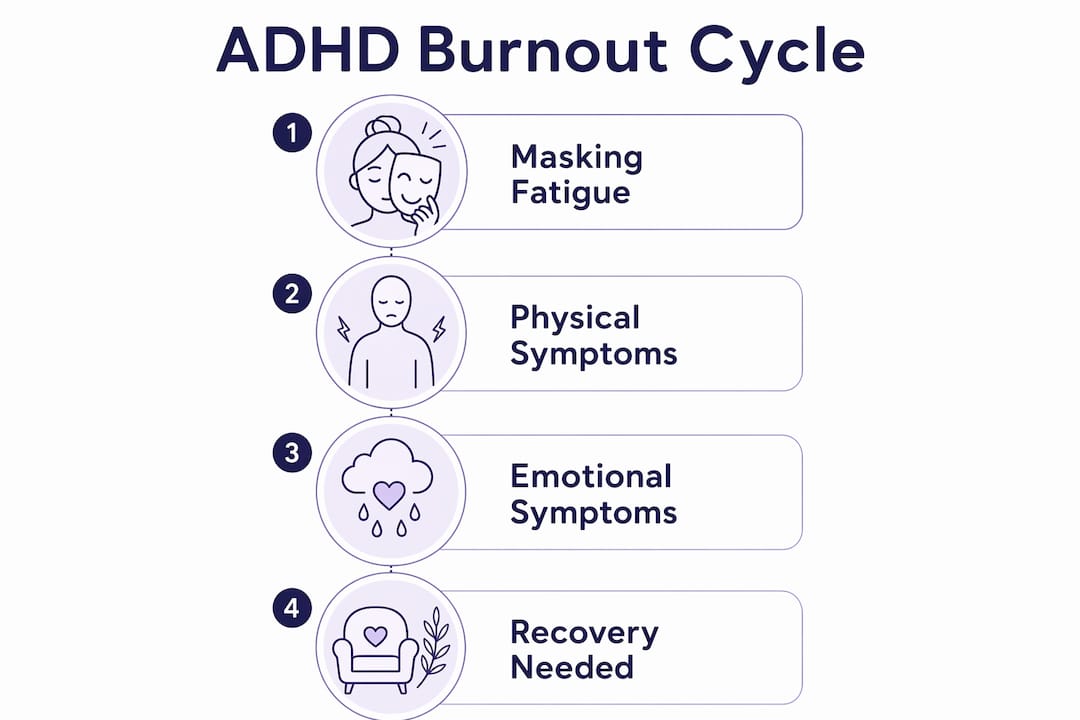
The burnout cycle in ADHD executives tends to follow a recognizable pattern. It starts with a masking fatigue phase, where the effort to appear organized and composed at work becomes exhausting. This progresses into dopamine depletion, where motivation collapses and even enjoyable tasks feel flat. The final phase is executive collapse: the inability to plan, initiate, or regulate emotions in any consistent way.
Emotional symptoms in this cycle include heightened irritability, reduced patience with colleagues, and a pervasive sense of shame. That shame is particularly damaging because it prevents executives from seeking support early, when intervention is most effective.
The dual nature of ADHD leadership: strengths and vulnerabilities
ADHD executives are not simply neurotypical leaders with a deficit. The same neurology that creates vulnerability to burnout also produces genuine leadership strengths.
Strengths that define ADHD leadership:
- Hyperfocus on high-interest problems, producing output that rivals entire teams
- Pattern recognition and creative problem-solving that cuts through conventional thinking
- High tolerance for ambiguity and rapid context-switching in crisis situations
- Authentic, energetic communication that builds team loyalty
Vulnerabilities that intensify burnout risk:
- Inconsistent energy output, with high-performance days followed by crashes
- Executive dysfunction under pressure, particularly with multi-step planning
- Sensory sensitivity that makes standard office environments chronically draining
- Perfectionism and identity fusion with work performance, making rest feel like failure
- Difficulty with transitions, meaning recovery periods are harder to enter and exit cleanly
The identity piece deserves particular attention. Many ADHD executives have built their professional identity around performing at a high level despite their neurology. When burnout strips away that capacity, the psychological impact goes beyond fatigue. It triggers a crisis of competence that standard burnout frameworks are not designed to address. A tailored recovery plan acknowledges this and builds in identity-level support alongside the practical tactics.
How to assess your own burnout risk before it becomes a crisis
Early detection changes outcomes. The warning signs of ADHD executive burnout are specific enough that a structured self-check, done honestly, can catch the trajectory before full collapse.
- Track your focus hours. Count the hours per day when you can genuinely concentrate. A drop from your personal baseline over two or more consecutive weeks is a reliable early signal.
- Monitor task initiation. Note how often you sit down to work and cannot start. Paralysis on familiar tasks is a stronger indicator than paralysis on new ones.
- Check your irritability baseline. Rate your patience with colleagues and family on a simple 1–10 scale each evening. A sustained downward trend matters more than any single bad day.
- Assess your masking effort. Ask yourself how much energy you spend managing how you appear at work versus actually doing the work. When masking effort exceeds task effort, burnout is close.
- Review your recovery quality. Are weekends and evenings actually restoring you, or do you arrive at Monday feeling no different from Friday? Diminishing returns on rest is a physiological signal.
- Note your emotional reactivity. Increased sensitivity to feedback, a shorter fuse with direct reports, or a sudden difficulty tolerating ambiguity all point toward RSD activation under stress.
- Gauge your creative output. ADHD executives often notice burnout first as a loss of their characteristic creative energy. If your ideas have dried up, that is worth taking seriously.
Pro Tip: Keep a simple weekly log using three numbers: focus hours, initiation failures, and irritability score. Reviewing four weeks of data gives you a pattern, not just a mood. That pattern is what you bring to a therapist or ADHD coach.
Licensed therapists who specialize in ADHD recommend using these self-checks as a structured conversation starter, not a self-diagnosis tool. The goal is to create objective data about your cognitive and emotional state so that decisions about recovery are grounded in evidence rather than willpower.
Recovery strategies that actually work for ADHD executives
Generic recovery advice fails ADHD executives because it assumes functional executive capacity. Boundary-setting is ineffective during burnout because it relies on the exact executive functions that have already failed. What works instead is external scaffolding that removes the need for internal discipline.
Phase 1: Physiological stabilization (weeks 1–4)
- Radical demand reduction: cut commitments by at least half, using pre-decided rules rather than case-by-case judgment
- Sleep repair as the first priority; consistent bedtimes and screen curfews restore cortisol rhythms and cognitive function faster than any other single intervention
- Delegated administration: remove all low-value decisions from your plate using pre-set systems
Phase 2: Cognitive restoration (weeks 5–12)
- Environmental modification: adjust lighting, reduce noise exposure, and schedule short “soft fascination” breaks such as brief outdoor walks or low-demand creative tasks
- Dopamine rehabilitation through low-friction novelty: new music, short creative projects, or physical movement that does not feel like exercise
- Micro-recovery protocols between meetings: two-minute resets using breathing or brief movement prevent cognitive depletion from compounding across the day
Phase 3: Sustainable reintegration (months 3–6+)
- Gradual reintroduction of complex responsibilities with built-in buffer days
- Energy tracking using biometrics like sleep quality and heart rate variability as performance inputs, not afterthoughts
- Masking load audit: identify which environments and relationships require the most masking and restructure access to them
Pro Tip: Treat your vitality metrics the same way you treat cash flow. Track them weekly. When the numbers drop, you adjust before the crisis, not after.
| Recovery phase | Primary focus | Key tactics |
|---|---|---|
| Phase 1 (weeks 1–4) | Physiological stabilization | Demand reduction, sleep repair, delegated admin |
| Phase 2 (weeks 5–12) | Cognitive restoration | Environmental modification, dopamine rehab, micro-recovery |
| Phase 3 (months 3–6+) | Sustainable reintegration | Energy tracking, masking audit, buffer days |
Coaching and workplace support that builds lasting resilience
Sustainable recovery does not happen in isolation. ADHD executives need structured external support that compensates for the executive function gaps that burnout exposes and that recovery has not yet fully restored.
- ADHD business coaching provides consistent accountability and neurodivergent-friendly organization techniques that replace the internal discipline that burnout has depleted. Specialized ADHD business coaching addresses executive function challenges directly, rather than applying generic productivity frameworks that assume a neurotypical baseline.
- Access to Work coaching offers funded, practical support for ADHD professionals in the UK, covering workplace accommodations, assistive technology, and coaching tailored to neurodivergent needs.
- Accountability partners trained in ADHD provide the external structure that makes task initiation and follow-through possible during recovery, without the shame spiral that self-imposed deadlines often trigger.
- Environmental modifications at the workplace level, such as quiet spaces, flexible scheduling, and reduced meeting loads, reduce the daily sensory and cognitive tax that accelerates burnout. Guidance on ADHD organization strategies can help executives restructure their physical and digital environments to lower cognitive load.
- Consistent coaching routines matter more than intensive one-off sessions. Regular, shorter check-ins build the habit scaffolding that ADHD brains need to maintain recovery gains over time.
A tailored recovery treatment plan that incorporates these supports is structurally different from a standard wellness program. It is built around the specific deficits burnout creates in an ADHD brain, not around the deficits a neurotypical brain experiences.
What recovery looks like in practice
Consider a senior executive who has spent years compensating for ADHD through sheer effort: arriving early, staying late, over-preparing for every meeting, and masking disorganization behind a polished exterior. The masking works, until it does not. The first sign is usually a loss of creative output, followed by task paralysis on routine work, then emotional dysregulation that damages team relationships.

A recovery plan for this person does not start with a two-week vacation. It starts with a masking audit: identifying every environment and interaction that requires neurotypical performance and systematically reducing exposure. It continues with sleep repair, demand reduction, and the introduction of an ADHD coach who provides accountability without judgment. Over three to six months, cognitive capacity returns, but only if the structural changes hold.
The key distinction from a generic burnout recovery is the masking audit. Neurotypical executives do not carry that load. Removing it is not optional for ADHD recovery; it is the foundation everything else is built on. Recovery is also understood as a lifelong process of ongoing adjustment, not a one-time reset.
How ADHD recovery plans differ from standard executive burnout plans
Standard executive burnout recovery typically focuses on workload reduction, improved delegation, and rest. Those elements matter for ADHD executives too, but they are insufficient on their own.
The critical differences are:
- Masking load reduction is a required step in ADHD recovery and has no equivalent in neurotypical burnout plans.
- External scaffolding replaces internal discipline during recovery. Neurotypical executives can often use willpower-based strategies like boundary-setting. ADHD executives cannot, because those strategies require the executive function that burnout has depleted.
- Dopamine system rehabilitation is specific to ADHD. Recovery must actively rebuild dopamine-driven motivation through low-friction novelty and physical movement, not just passive rest.
- Timeline expectations differ. Because burnout in ADHD executives involves neurological changes including prefrontal cortex thinning and amygdala dysregulation, recovery typically requires a multi-month commitment rather than a few weeks of rest.
- Identity work is built in. ADHD executives often need support separating their sense of competence from their current performance capacity, which is a layer of recovery that standard burnout frameworks rarely address.
Long-term benefits of a structured recovery plan for ADHD leaders
Executives who implement structured, ADHD-specific recovery plans report outcomes that go beyond simply feeling better. The long-term benefits operate at both the neurological and organizational level.
Cognitively, sustained recovery allows the prefrontal cortex to restore function, improving decision-making quality, working memory, and emotional regulation. These are not soft benefits. They directly affect the quality of strategic thinking and people management that define executive performance.
Organizationally, leaders who recover well tend to build more resilient teams. The self-awareness developed through a recovery process, including the masking audit and energy tracking, translates into better understanding of team members’ cognitive needs. ADHD executives who have navigated their own recovery often become more effective advocates for neurodivergent colleagues.
The Energy Equation approach frames vitality metrics as performance inputs, treating recovery as an operating discipline rather than a luxury. Executives who adopt this framing shift from reactive crisis management to proactive capacity maintenance, which is the structural change that prevents the next burnout cycle before it starts. Understanding executive function challenges at a neurological level is what makes that shift possible.
Estelle-rose: ADHD coaching built for executives who lead differently
Estelle-rose offers ADHD coaching and self-help resources specifically designed for adults navigating executive function challenges in high-demand roles. The coaching approach addresses the exact gaps that standard burnout recovery misses: masking load, dopamine rehabilitation, external scaffolding, and the identity work that comes with building a sustainable leadership practice as a neurodivergent professional.
For executives who want structured, personalized support, Estelle-rose provides ADHD coaching for entrepreneurs and creatives that combines accountability, practical organization strategies, and a deep understanding of how ADHD brains actually work under pressure. The self-help books and workbooks, including resources specifically for women with ADHD, offer a starting point for those who want to build their recovery framework independently before engaging coaching support.
The next step is straightforward: visit the adult ADHD executive function page to understand what tailored support looks like, and book a coaching conversation to build a recovery plan that fits your specific neurocognitive profile and leadership demands.
Key Takeaways
ADHD executives need recovery plans that address masking load, dopamine depletion, and external scaffolding because standard burnout strategies assume executive function capacity that burnout has already depleted.
| Point | Details |
|---|---|
| Burnout is physiological | ADHD burnout involves dopamine depletion and prefrontal cortex changes, requiring multi-month structured recovery. |
| Masking load is the hidden driver | Reducing masking effort is a required step in ADHD recovery with no equivalent in neurotypical burnout plans. |
| External scaffolding replaces willpower | Pre-decided systems and environmental controls substitute for internal discipline during recovery. |
| Energy tracking prevents relapse | Monitoring sleep quality and HRV as performance inputs shifts recovery from reactive to proactive. |
| Estelle-rose provides tailored support | ADHD coaching and self-help resources from Estelle-rose address executive function, masking, and sustainable leadership directly. |

