
Why organization skills matter in ADHD: Boost productivity
Why organization skills matter in ADHD: Boost productivity
Many people assume adults with ADHD simply lack discipline or motivation to stay organized. This misconception overlooks the real neurological challenge: executive dysfunction. Executive dysfunction affects your brain’s ability to plan, prioritize, and manage tasks effectively. For adults recently diagnosed with ADHD, understanding this connection is transformative. You’re not lazy or careless. Your brain processes organization differently, and with the right strategies, you can build systems that work with your ADHD, not against it. This guide explains why organization matters for your productivity and well-being, and shows you practical approaches to develop these essential skills.
Table of Contents
- Understanding Executive Dysfunction And Its Impact On Organization In ADHD
- How ADHD Organizational Challenges Affect Productivity And Well-Being
- Effective Organizational Strategies Tailored For Adults With ADHD
- Combining Treatments And Proactive Habits To Enhance Executive Function And Productivity
- Support Your Journey With Expert ADHD Coaching And Resources
Key takeaways
| Point | Details |
|---|---|
| Executive dysfunction drives organizational challenges | Executive dysfunction is a core feature of ADHD affecting planning, prioritizing, and sustaining effort, making traditional organization methods ineffective. |
| Poor organization significantly impacts work and emotions | Higher ADHD symptoms predict lower work engagement and reduced quality of life, creating cycles of frustration and shame. |
| External strategies compensate for executive deficits | Time blocking and visual systems create structure that bypasses working memory limitations and improves task completion. |
| Combined treatments provide optimal improvement | Medication paired with psychosocial interventions improves organizational skills by 20-25% more than either approach alone. |
| Personalization accelerates progress | Tailoring organizational methods to your specific ADHD symptoms and preferences creates sustainable habits rather than temporary fixes. |
Understanding executive dysfunction and its impact on organization in ADHD
Executive dysfunction describes impairments in the mental processes that help you plan, focus attention, remember instructions, and juggle multiple tasks. For adults with ADHD, these cognitive control systems don’t function at typical levels. Executive dysfunction is a core feature of ADHD impacting planning, prioritizing, and sustaining effort. This isn’t about intelligence or capability. Your brain’s executive control center processes information differently, creating specific challenges with organization.
These deficits show up in predictable ways. You might struggle to start tasks even when you know they’re important. Breaking large projects into manageable steps feels overwhelming. Keeping track of deadlines, appointments, and commitments becomes a constant battle. Your working memory, the mental workspace that holds information temporarily, doesn’t retain details as reliably as neurotypical brains. This makes following through on plans exceptionally difficult.
Research confirms how widespread these challenges are. Studies indicate 60% of adults with ADHD experience significant impairment in executive functions affecting organization. You’re far from alone in these struggles. The organizational difficulties you face stem from measurable differences in how your brain’s prefrontal cortex regulates attention and behavior.
Specific organizational challenges caused by executive dysfunction include:
- Difficulty estimating how long tasks will take, leading to chronic lateness and missed deadlines
- Trouble maintaining focus on boring but necessary organizational tasks like filing or sorting
- Challenges with working memory that make it hard to remember multi-step processes
- Problems with task initiation, where you know what needs doing but can’t get started
- Difficulty sustaining effort on long-term projects without immediate rewards or pressure
Understanding executive dysfunction in ADHD helps you recognize that your organizational struggles aren’t character flaws. They’re neurological differences requiring specific strategies. When you stop blaming yourself and start addressing the actual executive function deficits, you can build systems that genuinely support your brain’s needs. This shift from shame to strategy makes all the difference in developing sustainable organizational skills.
Experts emphasize this neurological foundation:
Executive function deficits in ADHD aren’t about trying harder. They require compensatory strategies that work around the brain’s natural limitations in planning and organization.
Recognizing these patterns in your own life is the first step. The challenges with adult ADHD executive function you experience have explanations rooted in brain science, not personal failure.
How ADHD organizational challenges affect productivity and well-being
Organizational deficits don’t just create minor inconveniences. They fundamentally impact your ability to perform at work and maintain emotional health. Research shows that higher daily ADHD symptoms predict lower work engagement, creating a direct link between organizational struggles and professional success. When you can’t manage tasks effectively, productivity drops by 30 to 40 percent compared to neurotypical peers. This gap isn’t about working less hard. It reflects the extra cognitive load required to compensate for executive dysfunction.
The emotional toll compounds these practical challenges. Missing deadlines triggers anxiety about job security. Forgetting important commitments damages relationships with colleagues and supervisors. The constant effort to appear organized while internally struggling creates exhausting cognitive dissonance. You might experience shame about needing more time or different systems than others. This emotional burden affects your mental health as much as the organizational challenges themselves.
Quality of life suffers across multiple domains. Adults with ADHD report significantly lower quality of life than neurotypical peers, particularly in areas requiring consistent organization and time management. Social relationships strain when you frequently cancel plans or arrive late. Financial management becomes stressful when bills go unpaid or important documents get lost. The cumulative effect creates a sense of being perpetually behind, never quite catching up.
Emotional reactions to disorganization common in adults with ADHD:
- Frustration when simple organizational tasks take excessive time and mental energy
- Shame about visible signs of disorganization like cluttered workspaces or missed appointments
- Anxiety about forgetting important commitments or losing track of essential information
- Overwhelm when facing multiple organizational demands simultaneously
- Depression stemming from repeated failures to maintain systems that work for others
These emotional responses aren’t overreactions. They’re natural responses to genuine struggles. The gap between what you know you should do and what your brain allows you to do consistently creates real distress. Understanding this connection helps you address both the practical organizational challenges and the emotional impact they create.
The workplace presents particular challenges. You might excel at creative problem solving or crisis management but struggle with routine administrative tasks. Colleagues may not understand why someone intelligent and capable can’t simply keep a tidy desk or remember to file reports on time. This disconnect between your strengths and organizational weaknesses can feel isolating.
Recognizing these impacts helps you prioritize organizational skill development. The empowered women with ADHD resources available can provide targeted support for managing both the practical and emotional dimensions of these challenges. Improving organization isn’t just about productivity. It’s about reducing daily stress, protecting your emotional well-being, and creating space for your strengths to shine.
Effective organizational strategies tailored for adults with ADHD
Traditional organizational advice rarely works for ADHD brains. You need strategies designed specifically for executive dysfunction. Time blocking stands out as particularly effective. This technique involves assigning specific time slots to particular tasks or categories of work. Time blocking improves task completion rates by 30 to 40 percent and reduces procrastination by creating external structure your brain can follow.

Time blocking works because it removes decision making from the moment. Instead of constantly asking “what should I do now,” you follow a predetermined schedule. This bypasses working memory limitations and reduces the cognitive load of task switching. Your brain doesn’t have to hold multiple competing priorities in mind simultaneously.
Other practical organizational tools complement time blocking:
- Digital calendars with multiple reminders set for important deadlines and appointments
- Visual task boards that make your to-do list concrete and manipulable
- Automated bill payment systems that remove the need to remember due dates
- Designated spaces for frequently lost items like keys, wallet, and phone
- Body doubling, where working alongside someone else provides external accountability
These tools share a common principle: they create external structures that help manage executive function deficits effectively. Instead of relying solely on internal mental processes, you build environmental supports that compensate for executive dysfunction.
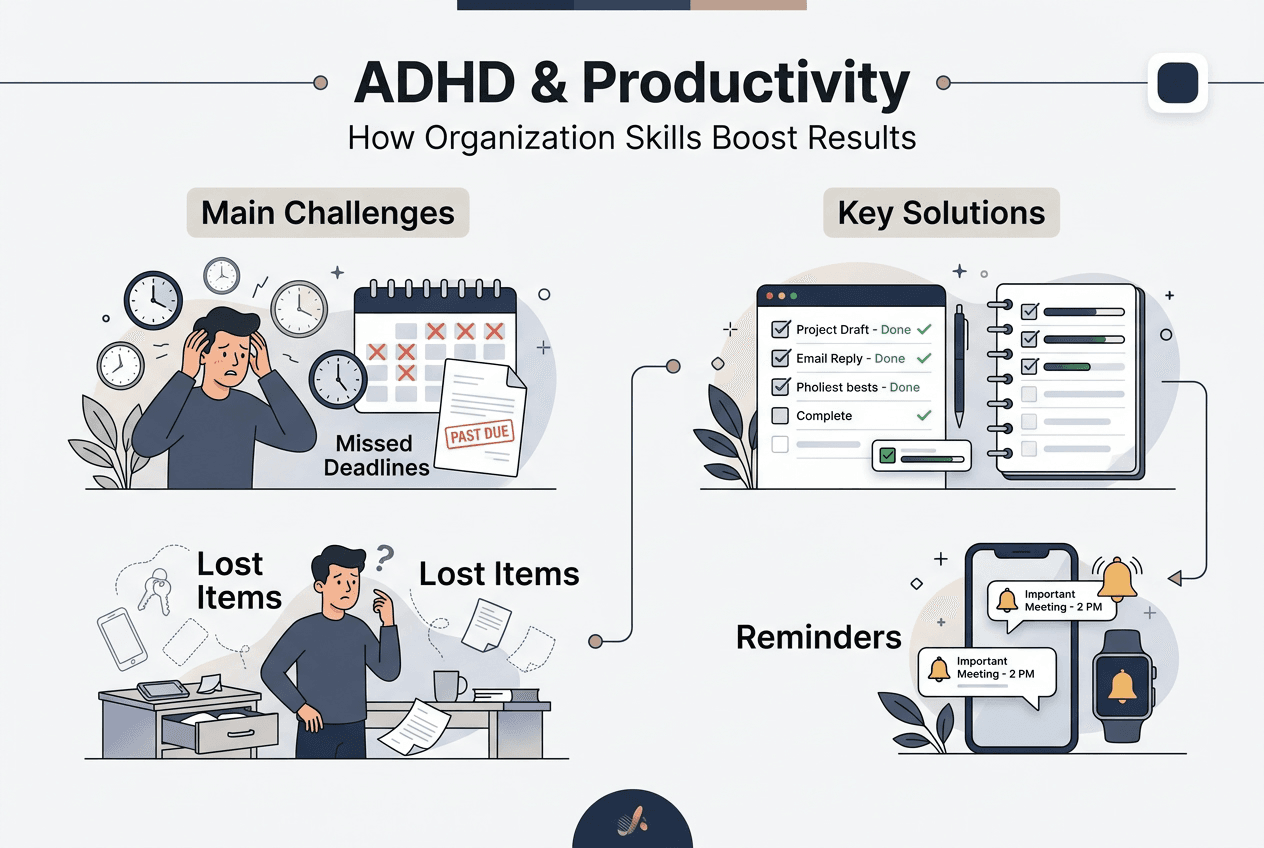
| Organizational Tool | Primary Benefit | Best Used For |
|---|---|---|
| Time blocking | Creates predictable structure | Managing daily schedules and reducing decision fatigue |
| Visual task boards | Makes abstract tasks concrete | Tracking project progress and maintaining motivation |
| Digital reminders | Compensates for working memory | Remembering appointments and deadlines |
| Designated item locations | Reduces search time | Preventing lost items and morning chaos |
| Automated systems | Removes reliance on memory | Bill payment and routine administrative tasks |
Implementing time blocking effectively:
- Start by tracking how you currently spend time for three to five days to identify patterns and time wasters.
- Block out non-negotiable commitments first, including work hours, meals, and sleep.
- Assign specific time blocks to categories like focused work, administrative tasks, and breaks.
- Build in buffer time between blocks to accommodate the ADHD tendency to underestimate task duration.
- Use different colors or labels for different activity types to create visual clarity.
- Review and adjust your blocks weekly based on what actually worked versus what you planned.
- Start with larger blocks and gradually increase specificity as the system becomes habitual.
Pro Tip: No single organizational system works for everyone with ADHD. Experiment with different approaches and combinations to discover what fits your specific symptoms, work style, and preferences. What works brilliantly for someone else might feel impossible for you, and that’s completely normal.
The key is consistency without rigidity. Your organizational system should provide structure while allowing flexibility for the natural variability in ADHD symptoms. Some days you’ll have better focus and can tackle complex organizational tasks. Other days require simpler systems and more external support. Building this adaptability into your approach prevents the all-or-nothing thinking that often derails organizational efforts.
Explore ADHD organization and cleaning strategies for additional practical methods. The right combination of tools creates a personalized organizational ecosystem that supports your executive function rather than fighting against it.
Combining treatments and proactive habits to enhance executive function and productivity
Organizational strategies work better when supported by appropriate treatment. Combined medication and psychosocial treatments improve organizational skills by 20 to 25 percent compared to either intervention alone. Medication helps regulate the neurochemical imbalances affecting executive function, while psychosocial interventions teach specific skills and strategies. Together, they create synergistic improvements.
Medication, typically stimulants or non-stimulants, enhances your brain’s ability to regulate attention and impulse control. This neurological support makes it easier to implement and maintain organizational systems. You can focus long enough to complete filing tasks. You remember to check your calendar. The cognitive bandwidth needed for organization becomes more readily available.
Psychosocial treatments include cognitive behavioral therapy, ADHD coaching, and skills training. These approaches teach you how to work with your ADHD brain rather than against it. You learn to recognize executive function challenges as they arise and apply compensatory strategies. The combination addresses both the neurological foundation and the practical skill development needed for sustainable organization.
Proactive workplace strategies that improve engagement despite ADHD symptoms:
- Requesting accommodations like flexible scheduling or quiet workspaces that reduce environmental distractions
- Building structural resources such as regular check-ins with supervisors or project management software
- Creating accountability partnerships with colleagues who understand your ADHD challenges
- Designing your role to emphasize strengths like creativity or problem solving while minimizing repetitive administrative tasks
- Establishing routines that reduce daily decision making and conserve executive function for important tasks
Research shows that proactive strategies that increase challenges and structural resources reduce negative ADHD symptom impact on work engagement. This might seem counterintuitive. Adding challenges sounds like making things harder. But the right kind of challenge, matched with appropriate support, actually improves engagement and performance.
For example, taking on a complex project that genuinely interests you can increase motivation and focus. The key is ensuring you have structural supports in place, like regular deadlines, accountability partners, or project management tools. The challenge engages your brain while the structure prevents you from getting lost in the complexity.
Habits to enhance structural support and reduce hindering demands:
- Morning routines that prepare your brain for focused work through exercise, medication, and planning
- Weekly reviews where you assess what organizational strategies worked and what needs adjustment
- Environmental design that removes distractions and makes organized behavior the path of least resistance
- Energy management that schedules demanding organizational tasks during your peak focus times
- Self-compassion practices that reduce the emotional toll of inevitable organizational setbacks
Pro Tip: View organization as a skill you’re developing, not a personality trait you either have or lack. Skills improve with practice, feedback, and appropriate support. Every small improvement in your organizational systems represents real progress, even if you’re not yet where you want to be.
The journey to better organization isn’t linear. You’ll have periods of improvement followed by setbacks. ADHD symptoms fluctuate based on stress, sleep, life changes, and countless other factors. Building organizational skills means creating systems flexible enough to accommodate this variability while maintaining enough structure to prevent complete chaos.
Combining treatment approaches with practical strategies creates the most robust foundation for lasting improvement. Neither medication nor skills training alone provides complete solutions. Together, they address both the neurological and behavioral dimensions of ADHD organizational challenges.
Support your journey with expert ADHD coaching and resources
Developing organizational skills with ADHD requires more than generic productivity advice. You need strategies designed specifically for executive dysfunction, delivered by professionals who understand the ADHD brain. Specialized ADHD coaching combines evidence-based organizational techniques with personalized support that adapts to your unique challenges and strengths.
Working with an ADHD executive function coach accelerates your progress by helping you identify which strategies match your specific symptoms and lifestyle. Instead of trying every organizational system and hoping something sticks, you get targeted guidance based on what actually works for ADHD brains. Coaches help you troubleshoot when systems break down, adjust approaches as your needs change, and maintain motivation through the inevitable setbacks.
Whether you’re an entrepreneur managing multiple projects or a creative professional juggling deadlines, ADHD coaching provides the accountability and structure your executive function needs. You’ll learn to build organizational systems that feel natural rather than forced, creating sustainable habits instead of temporary fixes.
Explore comprehensive organization and cleaning support designed specifically for adults with ADHD. These resources address the full spectrum of organizational challenges, from managing physical spaces to coordinating complex schedules.
FAQ
What are the most effective organizational strategies for adults with ADHD?
Time blocking, external visual systems, and digital reminders prove most effective because they compensate for executive dysfunction rather than relying on willpower alone. These strategies create environmental structure that your brain can follow without depending on working memory. Personalizing these approaches to match your specific ADHD symptoms and preferences significantly increases success rates.
Can adults with ADHD improve their organizational skills naturally?
Yes, organizational skills can improve with consistent practice and appropriate external supports, though the process requires patience and self-compassion. Natural improvement happens when you build systems that work with your ADHD brain rather than fighting against it. Combining behavioral strategies with environmental modifications creates sustainable progress without necessarily requiring medication.
How does executive dysfunction affect daily life for those with ADHD?
Executive dysfunction disrupts planning, time management, task initiation, and emotional regulation throughout daily activities. You might struggle to start important tasks, underestimate how long things take, forget commitments despite good intentions, or feel overwhelmed by decisions others find simple. These challenges create cascading effects on work performance, relationships, and emotional well-being that extend far beyond simple disorganization.
Is combined medication and psychosocial treatment necessary to improve organization?
Combined approaches yield 20 to 25 percent better improvement than either medication or psychosocial treatment alone, though individual needs vary significantly. Some adults achieve meaningful progress through behavioral strategies and coaching without medication. Others find medication essential for creating the neurological foundation needed to implement organizational systems. Consult with ADHD specialists to develop a personalized treatment plan that addresses your specific challenges and goals.

