
Workflow for ADHD Coaching Sessions: Your Structured Guide
Workflow for ADHD Coaching Sessions: Your Structured Guide
TL;DR:
- A structured workflow for ADHD coaching sessions provides a repeatable system that supports clients in overcoming executive dysfunction and making consistent progress. It includes clear session agendas, ethical intake, detailed documentation, and external accountability tools that replace unreliable internal motivation. This framework is flexible, client-centered, and evolves over time to align with individual growth and needs.
A structured workflow for ADHD coaching sessions is defined as a repeatable sequence of intake, session design, documentation, and between-session accountability steps that compensates for executive dysfunction and keeps clients moving forward. Without this structure, sessions drift into unfocused conversation and clients leave without clear next steps. Estelle-rose has worked with adults across the UK and beyond, and the pattern is consistent: the right workflow does not restrict the coaching relationship. It protects it. This guide covers every component, from the first intake form to the habit tracker your client checks on a Tuesday morning, so you get the most from every session.
What does a workflow for ADHD coaching sessions actually look like?
A workflow for ADHD coaching sessions is built from five core components: a structured session agenda, an ADHD-friendly intake process, consistent documentation, between-session accountability, and ethical agreements that keep the relationship clear. Each component addresses a specific executive function challenge. Together, they function as an external system that replaces the internal organization most ADHD brains struggle to sustain.

The coach as external support acts as an externalized prefrontal cortex, helping clients build internal capacity over time. This framing matters because it shifts the goal from “getting through the session” to building a system the client eventually internalizes. That distinction changes how you design every part of the workflow.
Estelle-rose recommends thinking of the workflow in three time zones: before the session (intake and preparation), during the session (agenda and intervention), and after the session (documentation and follow-up). Each zone has its own tools and its own failure points. Knowing where things break down is the first step toward fixing them.
How to structure ADHD coaching sessions for adult clients
Shorter sessions of 30 to 40 minutes improve focus compared to 60-minute formats, with a 10-minute break recommended if a full hour is needed. This matters because ADHD attention does not degrade linearly. It drops off a cliff. A 35-minute session with a clear agenda outperforms a 60-minute session that meanders.
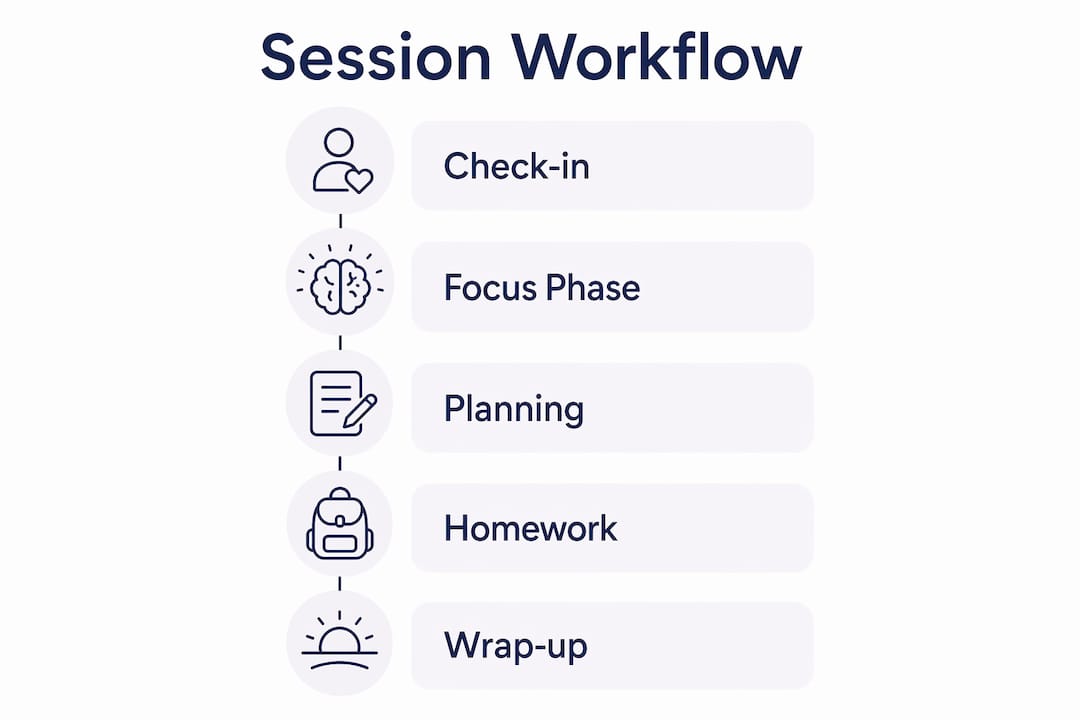
A reliable session agenda follows this sequence:
- Check-in (5 minutes): Mood, energy level, and one win from the past week
- Homework review (10 minutes): What got done, what did not, and why
- Focused intervention (15 minutes): One targeted skill, obstacle, or decision
- Planning (5 minutes): Specific, time-bound action items for the coming week
- Wrap-up (5 minutes): Summary, next session date, and one closing reflection
| Session phase | Time | Purpose |
|---|---|---|
| Check-in | 5 min | Regulate and orient the client |
| Homework review | 10 min | Reinforce accountability and learning |
| Focused intervention | 15 min | Address one concrete challenge or skill |
| Planning | 5 min | Set specific, measurable next steps |
| Wrap-up | 5 min | Consolidate and confirm next session |
Specific, measurable action items are far more effective than vague goals for ADHD clients. “Send the invoice by Thursday at 10am” works. “Work on finances this week” does not. The specificity is not pedantic. It removes the decision-making burden that causes ADHD clients to stall before they even start.
Pro Tip: Use time-boxing during the focused intervention phase. Set a visible timer for 15 minutes and tell your client the timer is running. The mild time pressure activates focus without triggering anxiety, and it keeps the session from expanding into every topic at once.
Allowing flexibility within a core agenda helps ADHD clients explore without losing direction. The agenda is a container, not a script. If the client needs to process something unexpected, you can flex the intervention phase. What you do not flex is the planning and wrap-up. Those two phases are where the session converts into real-world action.
Designing an ADHD-friendly intake and consent workflow
An ADHD-friendly intake flow includes predictable, consent-forward steps with sensory-inclusive supports such as voice notes and simple form questions focused on client values and rhythms. The intake is the first test of your workflow. If it overwhelms a new client, you have already created an obstacle before the first session begins.
A well-designed intake reduces executive function load at every step. That means short forms, clear instructions, and no surprises. Consider offering a therapy intake overview as a reference point for clients who are new to structured coaching or therapy processes.
The intake sequence Estelle-rose recommends covers these steps:
- Send a one-page welcome document explaining what coaching is and is not
- Provide a short intake form (under 10 questions) focused on goals, rhythms, and current challenges
- Offer voice note or video options for clients who struggle with written responses
- Schedule a 20-minute discovery call before the first full session
- Send the coaching agreement at least 48 hours before the call for review
Ethical coaching requires explicit agreements on coaching scope, confidentiality, boundaries, and referral pathways. These agreements are not bureaucratic formalities. They are the foundation of trust, and for ADHD clients who have often felt misunderstood or let down by systems, that trust is the product. A 5-move ethical checklist helps structure this relationship sustainably from day one.
Mapping a 90-day coaching rhythm with small, manageable experiments aligns with ADHD executive function needs. Rather than setting a 12-month goal that feels abstract, you map the first 90 days as a series of low-stakes experiments. This framing reduces perfectionism and increases follow-through.
What documentation practices support ADHD coaching workflows?
Structured coaching note templates organized by client ID, session objectives, detailed notes, action items, and follow-up plans improve documentation consistency and coaching quality. Good notes are not just a record. They are an accountability tool that both coach and client can reference between sessions.
A reliable note template covers five elements:
| Note element | Outcome it supports |
|---|---|
| Client ID and session date | Continuity and legal compliance |
| Session objectives | Focus and drift prevention |
| Key discussion points | Memory externalization for client |
| Action items with deadlines | Specific accountability between sessions |
| Follow-up plan and next date | Momentum and preparation |
Post-session written summaries covering discussion points, action items, and follow-up timing are critical to compensate for ADHD-related memory challenges. Send the summary within 24 hours of the session. A summary sent three days later loses its value because the client’s working memory has already moved on.
Pro Tip: Avoid coaching drift by reviewing the previous session’s action items at the start of every new session. If you skip this step, sessions become disconnected conversations rather than a cumulative coaching process. The agenda and the notes work together to keep the work on track.
Technology tools like Google Calendar, Notion, and Todoist support reminders and accountability between sessions. Including resource links and the next session date directly in the notes removes one more decision from the client’s plate. The goal is to make the right next step the obvious next step.
Between-session workflows: sustaining momentum for ADHD clients
Weekly sessions outperform bi-weekly formats for maintaining momentum and accountability with ADHD clients. Two weeks is a long time for an ADHD brain to hold a commitment without reinforcement. If weekly sessions are not possible, a brief mid-week check-in by text or voice note fills the gap.
External structures replace unreliable internal motivation with visual tools and accountability mechanisms. This is the core principle behind between-session design. You are not asking the client to remember. You are building a system that reminds them.
Recommended external supports for between-session accountability:
- Calendars: Google Calendar or Apple Calendar with session reminders set 24 hours and 1 hour before
- Habit trackers: Habitica, Streaks, or a simple paper tracker for daily actions
- Accountability partners: A peer or colleague who checks in on one specific task per week
- Implementation intentions: “When X happens, I will do Y” formatted action items that link behavior to a trigger
- Reward systems: Small, immediate rewards tied to task completion, not outcome achievement
An ADHD accountability partner is one of the most effective external structures available. The partner does not need to be a coach. They need to be consistent, non-judgmental, and willing to send a short message on a set day. That single touchpoint can be the difference between a completed task and a missed one.
Body doubling, where a client works alongside another person (in person or via video), activates focus during tasks that would otherwise stall. Apps like Focusmate formalize this practice for clients who do not have a natural body-doubling partner. Pair body doubling with time-boxed work blocks and you have a between-session system that mirrors the structure of the coaching session itself.
Key takeaways
A structured workflow for ADHD coaching sessions requires a clear session agenda, ethical intake, consistent documentation, and external accountability systems to produce reliable client progress.
| Point | Details |
|---|---|
| Session length matters | Use 30 to 40 minute sessions or add a break at 30 minutes in a 60-minute format. |
| Intake reduces friction | Short forms, voice note options, and a 90-day rhythm map lower executive function load from day one. |
| Documentation drives accountability | Send structured session summaries within 24 hours to externalize memory and prevent drift. |
| Between-session systems sustain momentum | Weekly check-ins, habit trackers, and accountability partners replace unreliable internal motivation. |
| Ethical agreements build trust | Explicit scope, confidentiality, and boundary agreements are non-negotiable in every ADHD coaching workflow. |
Why structure is the most compassionate thing you can offer
I have worked with enough adults with ADHD to know that the word “structure” can feel like a threat. It carries the weight of every planner they abandoned, every system that worked for two weeks and then collapsed. So I want to say this directly: the structure in a good coaching workflow is not there to control you. It is there to carry you.
The biggest mistake I see in ADHD coaching, including in my own early practice, is treating flexibility and structure as opposites. They are not. A flexible session that has no agenda is just a conversation. A structured session that has no room to breathe is an interrogation. The goal is a container that holds the work without suffocating it.
What I have found is that clients relax when they know what is coming. The check-in, the review, the planning phase. Predictability reduces the cognitive load of the session itself, which means more mental energy is available for the actual work. That is not a small thing for an ADHD brain that arrives at the session already depleted.
The documentation piece is where most coaches underinvest. I used to think a quick mental note was enough. It is not. The written summary sent after the session is often the most useful tool a client has all week. It is the thing they pull up on Wednesday when they cannot remember what they agreed to do. Externalization is not a workaround. It is the intervention.
Evolve the workflow as the client grows. What works in month one will not work in month six. The intake rhythm, the session length, the accountability structures. All of it should be reviewed at the 90-day mark and adjusted based on what the client has actually built. The workflow serves the client, not the other way around.
— Estelle
Explore professional ADHD coaching with Estelle-rose
Adults with ADHD get the most from coaching when the process is designed around how their brain actually works, not how a generic productivity system assumes it should. Estelle-rose offers executive function coaching built specifically for adults navigating ADHD in work, creative projects, and daily life.
Whether you are looking for one-to-one coaching, practical tools, or ADHD self-help books that translate research into real strategies, Estelle-rose has resources designed for your brain. The coaching process follows the structured workflow outlined in this guide, with intake, session design, and between-session accountability built in from day one. Explore what is available and take the first step toward a coaching process that actually fits.
FAQ
How long should an ADHD coaching session be?
30 to 40 minutes is the recommended session length for ADHD clients, with a 10-minute break added if a 60-minute format is used. Shorter sessions match ADHD attention patterns and reduce cognitive fatigue.
What is the most important part of an ADHD coaching workflow?
Between-session accountability is the component most likely to determine whether a client makes progress. External structures like calendars and habit trackers replace internal motivation systems that ADHD brains cannot consistently access.
How often should ADHD coaching sessions happen?
Weekly sessions are more effective than bi-weekly for ADHD clients because two weeks is too long a gap to sustain momentum without reinforcement. A brief mid-week check-in by text or voice note strengthens the weekly format further.
What should an ADHD coaching intake include?
An ADHD-friendly intake includes a short form under 10 questions, voice note options, a 90-day rhythm map, and explicit ethical agreements covering scope, confidentiality, and boundaries. The intake should reduce executive function load, not add to it.
How do you prevent coaching sessions from losing focus?
Review the previous session’s action items at the start of every new session and follow a fixed agenda structure. Maintaining a core session agenda while allowing flexibility within it keeps sessions productive without becoming rigid.

