
Accountability Methods for ADHD: What Actually Works
Accountability Methods for ADHD: What Actually Works
TL;DR:
- External support systems like body doubling, visual timers, and process-focused check-ins significantly improve ADHD productivity and motivation. Rotating accountability formats every two to three weeks and keeping routines simple help sustain engagement and prevent system failure. Incorporating external tools and focusing on effort rather than outcomes creates low-shame, high-structure systems tailored to ADHD brains.
Accountability methods for ADHD are external support systems designed to compensate for executive function differences, specifically the gaps in task initiation, time awareness, and follow-through that medication alone rarely fixes. Research confirms that accountability doubles behavioral change success rates. Tools like body doubling via Focusmate, visual timers like Time Timer, and task apps like Todoist or Notion give your brain the external scaffolding it needs. The key distinction most people miss: process-focused accountability reduces shame and sticks longer than outcome-focused systems that punish you for what you didn’t finish.
What are the best accountability methods for ADHD?
Body doubling is the single most effective accountability method for ADHD adults. It works through social facilitation, a well-documented phenomenon where the presence of another person activates attention circuits that ADHD brains struggle to engage alone. A 2026 BMJ review of over 200 meta-analyses confirmed body doubling as a highly effective intervention for ADHD. That finding matters because it moves body doubling from “productivity hack” into evidence-based territory.
You have three practical formats to choose from:
- In-person co-working: Work alongside a friend, colleague, or family member in the same room. No conversation required. Presence alone is the mechanism.
- Virtual sessions: Platforms like Focusmate match you with a stranger for a 25, 50, or 75-minute focused work session over video. Discord servers also host open “study with me” rooms around the clock.
- Async co-working: Some shared document tools let you work in a live doc while others are present, creating a lightweight version of social facilitation.
Setting up a body doubling session takes less than two minutes on Focusmate. Book a slot the night before so your morning brain doesn’t have to make the decision. Consistency matters more than duration. Three 25-minute sessions per week outperform one long session you keep skipping.
Pro Tip: Combine body doubling with the Pomodoro technique. Work for 25 minutes during the session, take a 5-minute break, then decide whether to book another slot. This keeps sessions low-commitment and your dopamine engaged.

How do timing tools improve ADHD focus and follow-through?
Task initiation is where most ADHD productivity systems collapse. The first 120 seconds are the hardest. Experts recommend setting a timer for just 2 minutes to push past the activation barrier. Most people keep working once they start. That 2-minute commitment is not a trick. It is a direct workaround for the ADHD brain’s impaired task-launch mechanism.
Once you’re in motion, structured sessions maintain focus. Pomodoro intervals of 25–45 minutes with short breaks match the natural attention arc of most ADHD adults. Longer blocks without breaks produce diminishing returns fast.
Here is a comparison of the most practical timing tools:
| Tool | Format | Best For |
|---|---|---|
| Time Timer | Visual analog countdown | Time blindness, visual learners |
| Forest App | Gamified phone timer | Reducing phone distraction |
| Pomofocus.io | Browser Pomodoro timer | Desk-based work sessions |
| Google Clock | Simple interval timer | Flexible session lengths |
| Focusmate | Live accountability timer | Combining timing with body doubling |
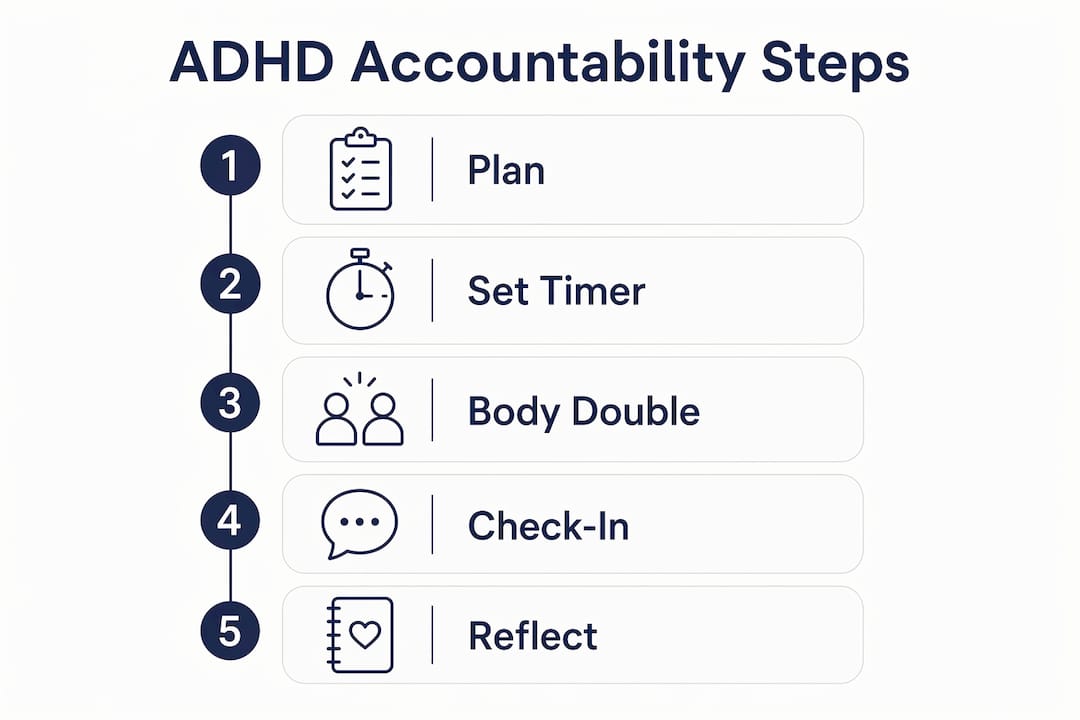
External time anchors like visual timers and printed calendars directly improve ADHD time awareness. ADHD brains have impaired internal time perception, meaning you genuinely cannot feel how long 30 minutes is without an external reference. A Time Timer sitting on your desk makes time visible, not just audible. That single change reduces time blindness more reliably than any app notification.
Pro Tip: Place your timer where you can see it without looking for it. Out of sight means out of mind for ADHD brains. A visible countdown removes one more decision from your day.
What accountability system design avoids shame and builds motivation?
Process-focused accountability is more sustainable than outcome-focused accountability for ADHD adults. Outcome-based systems ask “what did you finish?” Process-based systems ask “what did you work on?” That shift sounds small. The emotional difference is significant.
Here is why outcome focus backfires:
- It triggers shame when tasks are incomplete. ADHD adults already carry disproportionate shame around productivity. A system that reinforces failure creates avoidance, not motivation.
- It ignores effort and learning. You might spend 90 minutes untangling a problem without producing a visible output. Outcome systems count that as zero. Process systems count it as work.
- Detailed reporting activates perfectionism. Minimal reporting such as presence plus one sentence produces more consistent output than elaborate progress updates that trigger emotional dysregulation.
- Novelty decay hits harder with rigid formats. When the format never changes, dopamine drops and the system feels like a chore.
The fix is to rotate your accountability format every two to three weeks. Swap a shared Google Doc check-in for a voice memo. Replace a weekly video call with a co-working session. Rotating formats maintain dopamine-driven engagement and prevent the collapse that hits most ADHD accountability systems by week three.
Pro Tip: Keep your accountability reporting to one sentence. “I worked on the proposal for 40 minutes and got stuck on the budget section” is enough. Anything longer invites perfectionism and delays the next session.
What tools and routines build strong ADHD self-management?
Fragmented systems are the enemy of ADHD self-management. Consolidating all tasks, reminders, and notes into one app reduces cognitive overload. Todoist, TickTick, and Notion each work well. The specific tool matters less than the rule: one system, used consistently.
A 10-minute daily prep routine is the highest-return habit you can build. Daily prep focused on setting priorities and reviewing tasks reduces overwhelm and builds consistent accountability habits. Ten minutes in the morning to review your top three tasks removes the decision fatigue that derails ADHD adults before 9 a.m.
Here is a practical daily structure:
- Morning (10 minutes): Open your task app, pick three priorities, set your first timer, and book a body doubling session if needed.
- Midday (5 minutes): Voice memo update on what you worked on. No judgment, just a record.
- End of day (5 minutes): Move incomplete tasks forward, note one win, and close your tabs.
External supports like calendars, alarms, and Pomodoro timers are critical because ADHD brains cannot be expected to hold schedules in working memory. Google Calendar with time-blocked appointments and recurring alarms acts as an external prefrontal cortex. Pair it with a visible analog clock and you have covered both digital and physical time anchoring.
Voice memos deserve a special mention. ADHD brains generate ideas in bursts, often at inconvenient times. A 15-second voice memo captured on your phone beats a sticky note you’ll lose and a mental note you’ll forget. Apps like Apple Voice Memos or Otter.ai transcribe automatically, turning idea bursts into searchable text.
How do you sustain ADHD accountability systems long-term?
Most ADHD accountability systems fail around week three. This is the novelty-decay cycle. The dopamine hit of a new system fades, and the brain starts treating it as background noise. Knowing this in advance changes how you build your system.
The most common reasons ADHD accountability systems collapse:
- The setup takes too long each day. Successful systems focus on very small steps and avoid complex machinery needing excessive daily work. If your system requires more than 5–10 minutes of daily prep, it will fail.
- The format never changes. Rotating every two to three weeks is not optional for ADHD brains. It is maintenance.
- Shame spirals after missed sessions. One skipped day is not a failed system. It is Tuesday.
- Reporting feels like homework. Keep it minimal. Presence plus one sentence is the standard.
The goal is not a perfect system. The goal is a system you return to after you’ve abandoned it.
Self-compassion is not soft advice here. Research on behavior change consistently shows that self-criticism after lapses predicts longer gaps before returning to a habit. Treat a missed session as data, not evidence of failure. Adjust the format, reduce the friction, and start again.
Key takeaways
The most effective accountability methods for ADHD combine social facilitation, external time anchors, and process-focused check-ins to build systems that are low-friction and shame-resistant.
| Point | Details |
|---|---|
| Body doubling works | Social presence activates ADHD attention circuits; use Focusmate or in-person co-working consistently. |
| Start with 2 minutes | The first 120 seconds overcome task initiation; set a timer and commit to just starting. |
| Focus on process, not outcomes | Ask what you worked on, not what you finished, to reduce shame and sustain motivation. |
| Rotate formats every 2–3 weeks | Novelty decay hits around week three; switching formats keeps dopamine engaged. |
| Keep systems low-friction | Any daily setup over 10 minutes will fail; one app, one routine, one sentence of reporting. |
What i’ve learned after years of building accountability systems
I spent a long time believing accountability meant discipline. It doesn’t. For ADHD brains, accountability is infrastructure. It is the external scaffolding that does the job your executive function can’t always do alone.
Body doubling changed my work life more than any planner or productivity app. The first time I used Focusmate, I finished a task I had avoided for three weeks. Not because I suddenly had willpower. Because someone else was on the screen. That’s social facilitation in action, and it’s not cheating. It’s using your brain’s actual wiring.
The shame piece took me longer to unlearn. I used to track outcomes obsessively: finished, not finished, failed again. Switching to process-focused check-ins felt uncomfortably low-stakes at first. Then I noticed I was actually showing up more. Less dread, more consistency.
The hardest truth I share with clients is this: the system that works is the one you’ll actually use, not the one that looks best in a productivity video. Ugly, minimal, and consistent beats beautiful, complex, and abandoned every time. If you’re an ADHD accountability partner for yourself, be the kind of partner who shows up with encouragement, not a clipboard.
— Estelle
Ready to build an accountability system that actually fits your brain?
Estelle-rose works with adults with ADHD to build practical, personalized accountability systems grounded in executive function research. If you’ve tried every planner and app and still feel stuck, the issue is rarely effort. It’s usually structure.
Estelle-rose’s executive function coaching helps you identify which accountability methods match your specific ADHD profile, whether that’s body doubling, process-focused check-ins, or a combination of timing tools and daily routines. Coaching is available for creatives, entrepreneurs, and impact-focused adults who need systems that flex with their energy, not against it. If you want support that goes beyond tips and into real skill-building, explore the ADHD coaching for creatives page to find the right fit.
FAQ
What is the most effective accountability method for ADHD?
Body doubling is the most evidence-based accountability method for ADHD. A 2026 BMJ review of over 200 meta-analyses confirmed its effectiveness by leveraging social facilitation to activate attention circuits.
How do i stop my ADHD accountability system from failing?
Rotate your format every two to three weeks to prevent novelty decay, and keep daily setup under 10 minutes. Systems that require complex daily effort consistently fail for ADHD adults.
Is process-focused or outcome-focused accountability better for ADHD?
Process-focused accountability is more sustainable. Asking “what did I work on?” instead of “what did I finish?” reduces shame spirals and produces more consistent output over time.
What apps support ADHD accountability and self-management?
Todoist, TickTick, Notion, and Focusmate are the most practical tools. Pair one task app with a visual timer like Time Timer and Google Calendar for a complete external scaffolding system.
How long does it take to build an ADHD accountability habit?
Most ADHD accountability systems show results within the first two weeks, but face a novelty-decay risk around week three. Rotating formats and keeping reporting minimal are the two factors that determine long-term success.

