
Adaptive planning for ADHD: why rigid plans fail adults
Adaptive planning for ADHD: why rigid plans fail adults
Adults with ADHD often struggle with traditional planning systems that promise organization but deliver frustration. Adaptive planning supports adults with ADHD by compensating for executive dysfunction, improving follow-through on tasks through flexible adaptation of routines. This article explains how adaptive planning addresses ADHD-specific cognitive challenges and provides actionable strategies for newly diagnosed adults seeking better daily functioning and accountability.
Table of Contents
- Understanding Adaptive Planning In Adult ADHD
- Executive Function And ADHD Challenges
- Principles Of Effective Adaptive Planning For ADHD
- Therapeutic And Clinical Supports In Adaptive Planning
- Enhancing Accountability In ADHD Adaptive Planning
- Common Misconceptions And Planning Pitfalls
- Putting Adaptive Planning Into Practice: Next Steps For Adults With ADHD
- Explore Expert Support To Enhance Your Adaptive Planning
- Frequently Asked Questions
Key takeaways
| Point | Details |
|---|---|
| Adaptive planning compensates for executive dysfunction | It offers flexibility and personalization to manage ADHD-related challenges in organization, time management, and follow-through. |
| Executive function deficits hinder traditional planning | Time management, organization, emotional regulation, and motivation difficulties make rigid plans ineffective for adults with ADHD. |
| Therapeutic supports enhance planning success | Adapted CBT and occupational therapy improve skill development and adherence to adaptive planning routines. |
| Accountability mechanisms improve outcomes | Coaching and peer support increase motivation, reduce procrastination, and sustain planning efforts. |
| Rigid planning myths must be debunked | Success requires ongoing adjustment, personalized approaches, and professional support rather than one-size-fits-all methods. |
Understanding adaptive planning in adult ADHD
Adaptive planning is a flexible, evolving approach tailored to individual cognitive profiles rather than rigid schedules. Unlike traditional planning that assumes consistent executive function capacity, adaptive planning acknowledges that adults with ADHD experience fluctuating attention, working memory, and task initiation abilities.
Executive function deficits typical in adult ADHD executive function create specific barriers to conventional planning success. These impairments affect attention control, working memory storage, and the ability to start tasks without external prompts. Traditional rigid plans fail because they demand cognitive consistency that ADHD brains cannot reliably provide, leading to frustration and plan abandonment.
Adaptive planning compensates for these difficulties through several key mechanisms:
- Personalized routines that match current energy levels and cognitive capacity
- Flexible time blocks that adjust when unexpected challenges arise
- Task breakdown strategies that accommodate working memory limitations
- Environmental modifications that reduce executive function demands
- Real-time adjustments based on daily cognitive performance
This approach supports better daily functioning by accepting and working with ADHD cognitive patterns rather than fighting against them. The UK Adult ADHD Network consensus emphasizes that occupational therapy interventions using adaptive strategies produce measurable improvements in task completion and daily routine adherence.
Executive function and ADHD challenges
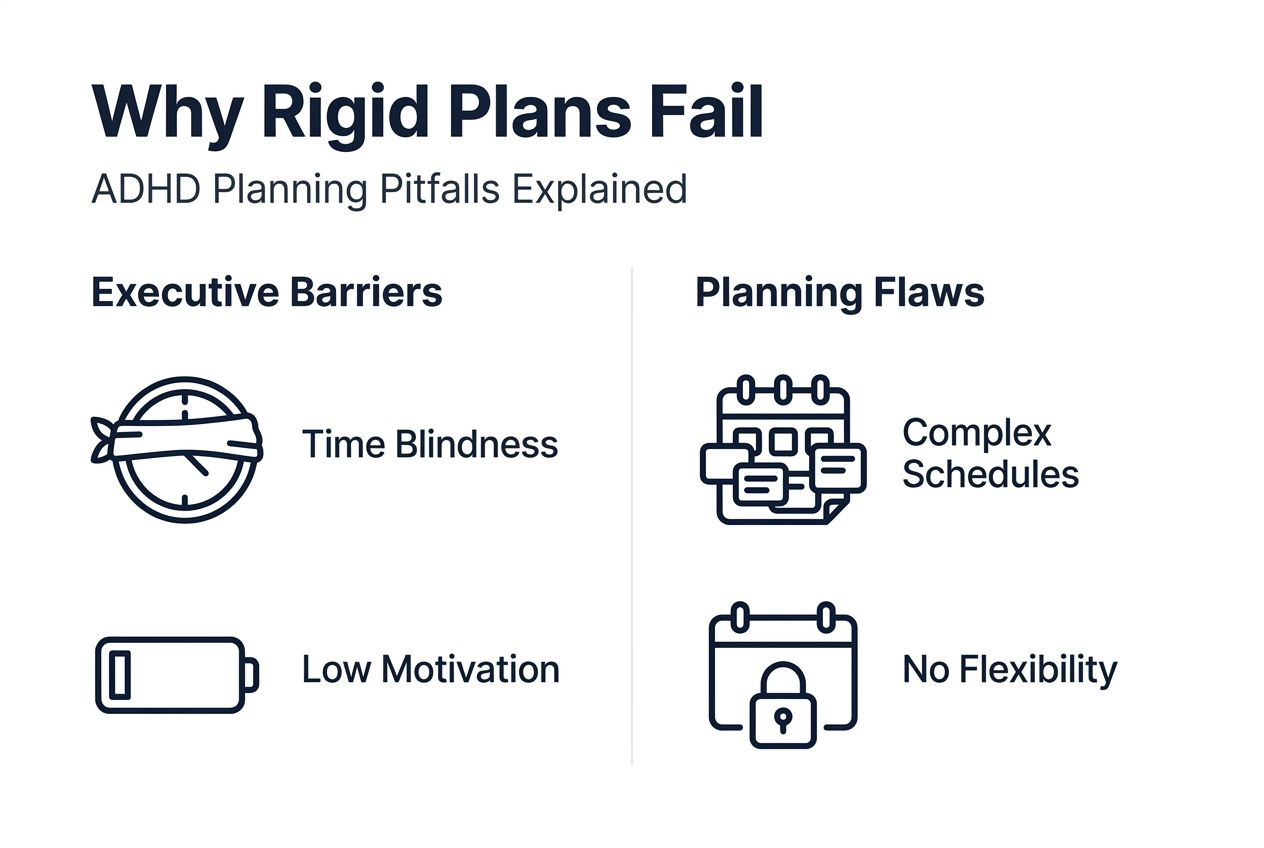
Adults with ADHD face specific executive function deficits that create persistent planning barriers. Time management, organization, emotional regulation, and motivation difficulties can be addressed through adaptive planning, but first require clear understanding.
Time blindness represents a core challenge where hours feel like minutes or minutes feel like hours. This distorted time perception makes estimating task duration nearly impossible, causing chronic lateness and missed deadlines. Adults with ADHD often underestimate how long activities take, leading to overpacked schedules and constant rushing.
Organization difficulties extend beyond messy desks to systemic problems maintaining order across life domains. Physical clutter accumulates because categorization and storage decisions overwhelm working memory. Digital chaos mirrors physical disorganization as emails pile up and files scatter across folders without clear systems.
Emotional regulation challenges amplify planning difficulties when frustration, anxiety, or disappointment derail carefully constructed routines. Small setbacks trigger disproportionate emotional responses that consume cognitive resources needed for task execution. This emotional volatility makes maintaining consistent planning habits extremely difficult without adaptive flexibility.
Motivation deficits in ADHD relate to dopamine regulation rather than laziness or lack of willpower. Tasks lacking immediate rewards or novelty fail to activate the brain’s motivation circuits, creating paralysis around important but boring responsibilities. Traditional planning ignores this neurobiological reality, assuming willpower alone drives task completion.
These interconnected deficits explain why conventional one-size-fits-all planning methods consistently fail adults with ADHD. Understanding these specific challenges is critical to designing plans that work with ADHD brains rather than against them. The Cleveland Clinic executive function overview details how these impairments interact to create complex planning obstacles requiring specialized adaptive approaches.
Principles of effective adaptive planning for ADHD
Effective adaptive planning for adults with ADHD prioritizes flexibility over rigidity at every level. Plans must accommodate fluctuating energy, motivation, and external demands rather than imposing static schedules that ignore cognitive variability. This flexibility prevents the shame spiral that occurs when rigid plans inevitably fail.
Iterative adjustments based on actual performance replace the illusion of perfect planning. You review what worked and what didn’t each week, then modify approaches accordingly. This experimentation mindset transforms planning from a test you pass or fail into an ongoing optimization process.

Personalization aligns planning methods with your specific executive function profile and lifestyle constraints. Some adults with ADHD thrive with visual schedules while others need auditory reminders. Your adaptive plan reflects your unique cognitive strengths rather than generic productivity advice.
Real-time adaptations allow you to cope with disruptions without abandoning your entire system. When unexpected events derail your morning routine, you adjust afternoon priorities rather than declaring the day lost. This resilience prevents all-or-nothing thinking that sabotages long-term consistency.
Key principles for building adaptive plans include:
- Start with minimum viable routines containing only essential tasks
- Build buffer time between activities to accommodate transitions
- Create backup plans for high-priority tasks before problems arise
- Design environmental cues that trigger desired behaviors automatically
- Schedule regular plan reviews to capture lessons and adjust strategies
Pro Tip: Begin with just one small flexible goal for two weeks before adding complexity. Mastering a single adaptive routine builds confidence and provides a foundation for expanding your planning system without overwhelming your executive function capacity.
Therapeutic and clinical supports in adaptive planning
Adapted CBT for adult ADHD is essential to facilitate adaptive planning by teaching organizational and time management skills suited to ADHD brain traits. Standard CBT protocols designed for neurotypical populations often miss ADHD-specific cognitive patterns, making adaptation crucial for effectiveness.
Adapted CBT builds executive function skills through structured practice targeting time management, organization, and planning. Therapists help you develop personalized strategies that account for attention variability and working memory limitations. This tailored approach produces better outcomes than generic cognitive therapy because it addresses root causes of planning difficulties.
Occupational therapy provides complementary support by enhancing sensory regulation and task management capabilities. Occupational therapy interventions emphasizing adaptive strategies improve skills like sensory regulation and task management critical in adaptive planning. Occupational therapists assess how sensory processing affects your daily functioning and design environmental modifications that reduce executive function demands.
Integrating these therapeutic approaches creates synergistic benefits for planning maintenance and resilience. CBT provides cognitive restructuring and skill-building while occupational therapy addresses physical environment and sensory factors. Together they support sustainable improvements rather than temporary fixes.
Benefits of combining therapeutic supports with adaptive planning:
- Professional guidance accelerates identification of effective personal strategies
- Structured accountability through regular therapy sessions improves consistency
- Objective feedback helps distinguish helpful adjustments from avoidance behaviors
- Crisis support prevents minor setbacks from cascading into system abandonment
- Evidence-based techniques replace trial-and-error experimentation
These clinical supports transform adaptive planning from a solo struggle into a professionally guided development process with measurably better outcomes.
Enhancing accountability in ADHD adaptive planning
Accountability provides the external motivation structure that adults with ADHD need to sustain planning efforts over time. Adaptive planning incorporating accountability through social support improves follow-through and reduces procrastination in adults with ADHD by creating regular check-in points and progress reviews.
Why accountability works for ADHD brains relates to dopamine and external deadlines. Tasks with social consequences activate motivation circuits more reliably than internal commitments alone. Knowing someone will ask about your progress creates the urgency needed to overcome executive dysfunction paralysis.
Common accountability mechanisms that enhance adaptive planning include:
- Professional ADHD coaching with weekly sessions reviewing goals and obstacles
- Peer support groups where members share progress and strategies
- Accountability partners who exchange regular check-ins on specific commitments
- Public commitment through social media or community forums
- Body doubling sessions where you work alongside others virtually or in person
Building sustainable accountability requires matching the support level to your current needs. New habits need more frequent check-ins while established routines may only need monthly reviews. The key is creating enough structure to maintain momentum without making accountability itself feel burdensome.
Effective ADHD organization strategies often combine multiple accountability layers to prevent gaps when one support temporarily unavailable. You might have a weekly coach session, daily partner check-ins, and a monthly peer group to create redundant motivation sources.
Pro Tip: Seek professional ADHD coaching or establish trusted accountability partnerships before motivation naturally wanes. Waiting until you’re struggling makes it harder to implement support systems when executive function is already compromised. Preventive accountability maintains planning consistency through inevitable difficult periods.
Common misconceptions and planning pitfalls
Rigid planning myths persist despite overwhelming evidence they harm adults with ADHD. Failure to adapt planning to unique cognitive profiles leads to poor outcomes and plan abandonment in 80% of adults with ADHD. Understanding these misconceptions helps you avoid predictable pitfalls.
The most damaging myth claims that discipline and willpower can overcome executive dysfunction. This belief leads to self-blame when rigid plans fail rather than recognizing the planning method itself was flawed. Adults with ADHD internalize failure messages that make future planning attempts feel hopeless.
Another common misconception treats planning as a one-time setup rather than ongoing adjustment process. You create an elaborate system, expect it to work indefinitely, then abandon everything when life changes render it obsolete. Sustainable planning requires regular reviews and modifications as circumstances evolve.
The assumption that more detailed planning produces better results often backfires for adults with ADHD. Overly complex systems overwhelm working memory and create so much planning overhead that execution becomes impossible. Simpler adaptive approaches consistently outperform elaborate rigid frameworks.
Research shows 70% of adults with ADHD abandon rigid planning methods within three months due to stress and poor cognitive fit. This high abandonment rate reflects systemic problems with conventional planning approaches rather than individual failures.
| Rigid Planning | Adaptive Planning |
|---|---|
| Fixed schedules regardless of energy levels | Flexible time blocks adjusted to current capacity |
| All-or-nothing adherence expectations | Partial completion celebrated as progress |
| No accommodation for executive function variability | Built-in contingencies for cognitive fluctuations |
| Shame when plans fail | Learning opportunity when adjustments needed |
| Static systems that become obsolete | Evolving approaches that improve over time |
Common pitfalls and recommended fixes:
- Overcommitting in planning phase: Start with minimal commitments and add gradually
- Ignoring energy patterns: Track when executive function peaks and schedule accordingly
- Planning in isolation: Include accountability and support from start
- Forgetting review cycles: Set recurring calendar blocks for plan assessment
- Treating setbacks as failures: Reframe obstacles as data for system improvement
Avoiding these myths about ADHD planning positions you for sustainable success rather than predictable frustration and abandonment.
Putting adaptive planning into practice: next steps for adults with ADHD
Starting or refining your adaptive planning system begins with small, achievable goals that build confidence rather than overwhelm executive function. Focus on establishing one flexible routine before adding complexity. This foundation prevents the common mistake of creating elaborate systems that collapse under their own weight.
Incorporate reminders, cues, and environmental supports to reduce reliance on working memory. Visual schedules posted where you see them, phone alarms for transitions, and physical environment modifications all decrease executive function demands. These external supports compensate for internal cognitive limitations.
Professional ADHD coaching options provide accountability and plan customization that dramatically improve success rates. Coaches help you identify patterns, troubleshoot obstacles, and maintain motivation during difficult periods. This guided approach accelerates progress compared to solo trial and error.
Sequential steps to begin adaptive planning effectively:
- Assess your current executive function challenges using specific examples from recent weeks
- Identify one high-impact area where better planning would improve daily functioning
- Design a minimal viable routine for that area with built-in flexibility
- Implement the routine for two weeks while tracking what works and what doesn’t
- Review results and adjust the approach based on actual performance data
- Add accountability support through coaching, partners, or peer groups
- Gradually expand to additional areas once the first routine feels sustainable
- Schedule monthly reviews to ensure your system evolves with changing needs
Maintain a growth mindset that treats planning as an ongoing skill development rather than a fixed system to implement perfectly. Every adjustment teaches you something valuable about your cognitive patterns and effective strategies. Support for women with ADHD and other specialized resources can provide community and guidance throughout this iterative process.
The workbook for ADHD planning offers structured exercises for developing your personalized adaptive planning system. These guided activities help translate general principles into concrete practices tailored to your situation. Additional insights from ADHD clinical insights can deepen understanding of underlying cognitive factors.
Remember that adaptive planning success comes from consistent small improvements rather than dramatic transformations. Be patient with yourself as you develop new skills and discover what works for your unique brain.
Explore expert support to enhance your adaptive planning
Transforming your understanding of adaptive planning into consistent daily practice becomes easier with professional guidance tailored to ADHD cognitive patterns. Specialized adult ADHD executive function support addresses the specific challenges that make traditional planning ineffective for your brain.
Personalized ADHD coaching programs provide the accountability, strategy customization, and motivation that sustain adaptive planning efforts over time. Professional coaches help you navigate obstacles, celebrate progress, and adjust approaches based on your evolving needs. This expert partnership accelerates skill development while preventing the isolation that often derails solo planning attempts.
Targeted support for ADHD organization support combines adaptive planning principles with practical implementation assistance. You gain access to proven frameworks, personalized feedback, and community connections that transform planning from a solitary struggle into a supported growth process. Explore these resources to enhance your adaptive planning success and build sustainable routines that work with your ADHD brain.
Frequently asked questions
What is adaptive planning in ADHD?
Adaptive planning is a flexible, personalized approach to organizing tasks and time that compensates for ADHD-related executive function deficits. It emphasizes ongoing adjustments based on actual performance rather than rigid adherence to static schedules. This method helps adults with ADHD manage daily responsibilities more effectively by accommodating cognitive variability and changing circumstances.
Why do traditional planning methods often fail adults with ADHD?
Traditional plans are usually too rigid and not tailored to the executive function challenges of adult ADHD like time blindness and motivation deficits. This mismatch between planning demands and cognitive capacity causes frustration, overwhelm, and high rates of plan abandonment. Conventional methods assume consistent executive function that ADHD brains cannot reliably provide.
How can accountability improve planning success for adults with ADHD?
Accountability provides external motivation and structure that enhance follow-through and reduce procrastination for adults with ADHD. Regular check-ins with coaches, partners, or support groups create social consequences that activate motivation circuits more reliably than internal commitments alone. This external structure compensates for inconsistent internal motivation typical in ADHD.
What are common mistakes to avoid when planning with ADHD?
Avoid overly rigid plans that do not adapt to changing needs, energy levels, and cognitive styles specific to your ADHD brain. Recognize that planning is one tool among many requiring ongoing support, flexibility, and professional guidance for sustained success. Don’t create elaborate systems that overwhelm your working memory or treat initial setbacks as personal failures rather than learning opportunities.
What is the first step to start adaptive planning after an adult ADHD diagnosis?
Begin by identifying your unique executive function challenges affecting planning through concrete recent examples of difficulties. Start with one small, flexible goal in a high-impact area rather than trying to overhaul your entire life at once. Consider seeking professional ADHD coaching to guide this process and provide accountability as you develop new adaptive planning skills.

