
ADHD Talking to Self: Why You Do It and How to Use It
ADHD Talking to Self: Why You Do It and How to Use It
TL;DR:
- Talking to yourself helps adults with ADHD externalize working memory and improve focus.
- While usually adaptive, persistent or distressing self-talk may signal underlying emotional or cognitive issues.
Yes, talking to yourself is common in adults with ADHD, and it usually functions as a practical cognitive tool rather than a warning sign. A peer-reviewed study by Ellie Benfield and Geoff G. Cole found a robust association between ADHD-like traits and self-directed speech across three experiments, covering both overt (out-loud) speech and covert (inner) speech. ADDitude Magazine frames it plainly: self-talk is often a coping strategy, not a sign of something wrong.
- What it usually does: Externalizes working memory so you can hold a thought long enough to act on it.
- When it’s helpful: Task sequencing, focus recovery, emotional regulation, and motivational prompting.
- When to get help: If self-talk is intrusive, uncontrollable, accompanied by distressing voices, or worsening anxiety or depression, consult a clinician.
Table of Contents
- What “talking to yourself” actually means for ADHD brains
- What the research actually says about self-talk and ADHD
- How self-talk helps you day to day
- When self-talk becomes a problem worth addressing
- Practical strategies to put self-talk to work
- How to choose between a coach, a therapist, and a prescriber
- A coaching perspective on using self-talk as a real tool
- Key Takeaways
- Self-talk is something worth working with, not against
- Ready to turn self-talk into a real executive-function habit?
- Useful sources for further reading
What “talking to yourself” actually means for ADHD brains
Self-directed speech is the umbrella term researchers use. It covers two main forms. Overt self-talk is audible, the muttering you do while packing a bag or narrating a grocery run. Covert self-talk is inner speech, the silent internal monologue running in the background. Both show up more frequently in adults with ADHD-like traits, per Benfield and Cole’s research.
Within those two categories, the content varies a lot. Task-directed speech (“okay, first I open the file, then I save a copy”) is purposeful and performance-linked. Ruminative self-talk loops on the same worry without resolution. Vocal stimming, which overlaps with self-talk in neurodivergent populations, is repetitive vocalization that serves a regulatory function rather than a communicative one. Knowing which type you’re doing matters, because each calls for a different response.
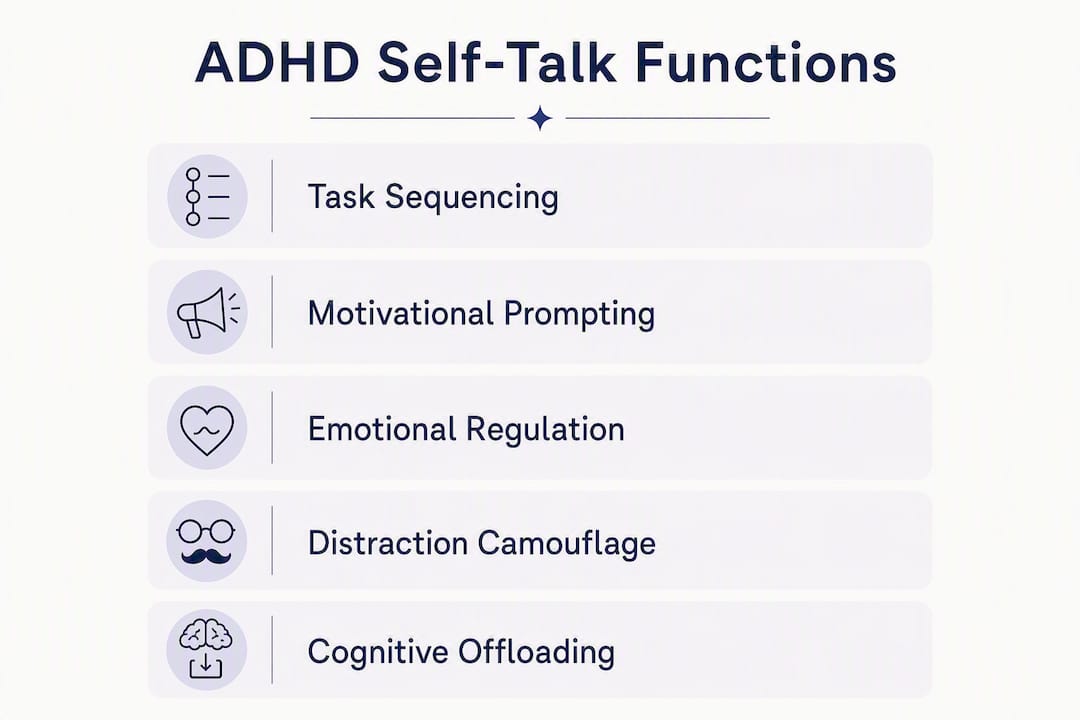
The cognitive mechanism behind the helpful kind is straightforward. Talking out loud offloads temporary information from fragile internal working memory into the environment via the auditory loop, freeing attention for execution rather than maintenance. Think of it as a spoken sticky note. The ADHD brain’s working memory is unreliable, so externalizing a thought, saying it aloud, turns a fleeting mental note into a real-world anchor.
Benfield and Cole also suggest self-talk can operate as a camouflage or displacement activity. In social settings where talking aloud would be inappropriate, the impulse gets redirected inward. This can happen automatically, without any conscious decision to do it.
Pro Tip: If you catch yourself narrating tasks or muttering steps, don’t fight it. That’s your brain building an external scaffold. The goal isn’t silence; it’s making the scaffold work better.
What the research actually says about self-talk and ADHD
The Benfield and Cole study, published in the British Journal of Psychology and indexed on PubMed, ran three experiments. Participants completed the Adult ADHD Self-Report Scale (ASRS-v1.1) alongside either the Self-Talk Scale or the Varieties of Inner Speech Questionnaire. The core finding: adults who scored higher on ADHD-like behavior measures reported significantly more self-directed speech, and the effect held for both overt and covert forms.
Convergent evidence from developmental and laboratory studies adds weight to this. Task-relevant private speech consistently improves executive task performance, a pattern observed in children and replicated in adult populations with ADHD profiles.
The limits of the evidence are worth stating clearly. Sample sizes in individual experiments are modest. Lab conditions don’t perfectly mirror the messy reality of a workday. Correlational designs can’t confirm that self-talk causes better performance, only that the two travel together. Distinguishing helpful self-talk from harmful rumination is also difficult in survey-based research.
| Research dimension | What the evidence shows | Confidence level |
|---|---|---|
| Prevalence in ADHD | Higher self-directed speech in adults with ADHD-like traits | Strong (replicated across experiments) |
| Overt vs. covert speech | Both forms elevated, not just audible speech | Moderate (consistent across measures) |
| Task performance link | Task-relevant private speech supports execution | Moderate (lab and developmental data) |
| Harmful vs. helpful distinction | Hard to separate in correlational studies | Preliminary |
How self-talk helps you day to day
The practical functions of ADHD self-talk cluster into five areas, and most adults with ADHD use several without realizing it.
Task sequencing. Narrating steps out loud (“close the tab, open the spreadsheet, type the date”) keeps the sequence alive long enough to execute it. Narrating tasks out loud improves task performance in people with ADHD-like profiles, because the spoken sequence acts as a real-time checklist the brain doesn’t have to hold internally.

Motivational prompting. Micro-reward language (“just two more paragraphs, then coffee”) lowers the activation energy for boring tasks. The key is specificity: “finish the email” is less effective than “write three sentences, then stop.”
Emotional regulation. Phrases like “this feeling will pass” or “you’ve handled harder things” create psychological distance from an overwhelming moment. Shifting from first-person to second-person self-talk, saying “you can do this” instead of “I can do this,” reliably increases self-distancing and reduces emotional reactivity. It’s a small linguistic move with a measurable effect.

Problem-solving. Talking through a decision out loud externalizes the decision-making process. Options become audible, which makes them easier to compare and harder to lose track of.
Vocal stimming. Repetitive vocalizations, humming, repeating phrases, clicking sounds, serve a regulatory function in many neurodivergent people. This is distinct from task-directed speech but equally valid as a self-regulation tool.
- Narrating steps keeps sequences intact when working memory drops out.
- Motivational micro-scripts lower task-start resistance.
- Second-person phrasing (“you’ve got this”) creates emotional distance faster than first-person.
- Problem-solving aloud makes options visible and reduces decision paralysis.
- Vocal stimming regulates arousal and is not inherently problematic.
Pro Tip: Try switching one self-critical phrase to a directive one this week. Replace “I’m so disorganized” with “Okay, pick one thing and put it away.” Action verbs move the brain forward; judgment loops keep it stuck.
When self-talk becomes a problem worth addressing
Most ADHD self-talk is adaptive. But some patterns signal that something else is going on, or that the self-talk itself has become the problem.
Self-talk is not a diagnostic criterion for ADHD and is common across many people. It becomes a concern when it is excessive, intrusive, or interfering with daily life. The distinction between helpful and harmful self-talk comes down to content and direction: task-focused scripts move you forward; ruminative or self-critical loops keep you circling.
Red flags to watch for:
- Self-talk feels uncontrollable, like you can’t stop it even when you want to.
- The content is consistently negative, shaming, or self-attacking, and it worsens over time.
- You hear voices that feel external or commanding rather than your own internal monologue.
- Self-talk is causing social impairment, people commenting, relationships strained, work affected.
- Anxiety or depression is escalating alongside the self-talk pattern.
- The self-talk accompanies hallucination-like experiences or significant mood symptoms.
Excessive self-talk that is uncontrollable, accompanies hallucination-like voices, or co-occurs with severe mood symptoms warrants clinical evaluation to rule out other conditions. This is not a reason to panic; it’s a reason to get a proper assessment.
The practical test: after a self-talk episode, do you feel clearer and more capable, or more distressed and stuck? Helpful self-talk leaves you with a next action. Harmful self-talk leaves you with a heavier feeling and no clear path forward.
Practical strategies to put self-talk to work
These are tools you can test today, not in theory, but in the actual moments when your brain needs a scaffold.
Scripts for common moments:
- Starting a task: “Okay, [your name], open the document. Just the first sentence. That’s it.”
- Switching focus: “That’s done. Close it. Now the next thing is [name it out loud].”
- Calming anxiety: “You’re okay. This is temporary. One step: [name the step].”
- Recovering from distraction: “Where was I? [Say it aloud.] Right. Back to [task name].”
- Ending a work session: “Good. That happened. Write down where you stopped.”
A simple habit plan:
- Cue: Identify one recurring moment where you lose track (task start, transitions, overwhelm).
- Script: Write a two-sentence script for that moment. Keep it directive and specific.
- Action: Say the script out loud at the cue, even if it feels odd.
- Review: After three days, note whether the script helped or felt off. Adjust the wording.
Worksheet template (copy this into a notebook or notes app):
| Cue | Script | Action | Time limit | Quick review |
|---|---|---|---|---|
| Task start | “Open file. First sentence only.” | Begin typing | 5 min | Did it help? Y/N |
| Transition | “That’s done. Next thing is ___.” | Name next task aloud | 2 min | Adjust phrasing? |
| Anxiety spike | “One step. What is it?” | State the step | 1 min | Felt calmer? Y/N |
Generic tool supports: A phone timer set to 25-minute intervals (Pomodoro method) gives an external cue to trigger your script. A physical checklist pad on your desk makes the sequence visible. Sticky notes at your workstation anchor the script so you don’t have to remember it under pressure. The function matters more than the brand: any tool that provides a visible, auditory, or tactile cue works.
Pro Tip: Test a script for three days before deciding it doesn’t work. The first day it feels awkward. The second day it feels slightly less awkward. By the third day, you have actual data on whether it helps. One day is not a test.
How to choose between a coach, a therapist, and a prescriber
These three types of support are not interchangeable. Matching the right one to your situation saves time and money.
| Support type | Primary focus | Methods | Best for | What to expect |
|---|---|---|---|---|
| ADHD coach | Skills, habits, accountability | Goal-setting, scripts, habit design, session check-ins | Self-talk patterns, task initiation, executive function, creative/work challenges | Weekly or biweekly sessions; practical tools and accountability between sessions |
| CBT therapist | Cognitive patterns, emotional regulation | Thought records, reframing, exposure, behavioral activation | Negative/shaming self-talk, anxiety, depression co-occurring with ADHD | Weekly sessions; homework between sessions; structured protocol |
| Prescriber (psychiatrist/GP) | Diagnosis, medication management | Assessment, medication trials, monitoring | Undiagnosed ADHD, medication questions, ruling out other conditions | Diagnostic assessment first; follow-up appointments for medication review |
Coaching and CBT serve different roles: coaching focuses on skills, habit design, and accountability; CBT targets cognitive patterns like negative self-talk. Many adults with ADHD benefit from both at different points.
Decision rules:
- Mainly struggling with task initiation, focus, and self-talk patterns at work? Start with a coach.
- Self-talk is predominantly negative, shaming, and linked to low mood or anxiety? A CBT therapist is the better first step.
- Unsure whether you have ADHD, or have questions about medication? See a prescriber first.
- Hearing voices that feel external or experiencing significant mood symptoms? Clinical evaluation before coaching or CBT.
Preparing for a first session:
- Write down three to five examples of your self-talk, including the situation, what you said, and what happened next.
- Note the impact on work, relationships, or daily tasks, not just how it feels but what it costs you practically.
- List any previous treatments, diagnoses, or medications.
- Describe the pattern in plain terms: “I narrate tasks out loud to stay on track” or “I get stuck in critical loops I can’t interrupt.”
That last point matters. Professionals can assess function versus harm much faster when you describe the self-talk’s effect rather than just its existence.
A coaching perspective on using self-talk as a real tool
Estelle is an ADHD coach and author focused on executive function, creatives, and entrepreneurs. The approach here is practical: self-talk is a skill to refine, not a habit to eliminate.
From a coaching standpoint, the most common mistake adults with ADHD make with self-talk is using it reactively rather than intentionally. The self-talk happens anyway. The question is whether it’s working for you or against you.
What intentional self-talk practice looks like in coaching:
- Awareness phase: Log self-talk episodes for one week. Note the cue, the content, and the outcome. Patterns emerge quickly.
- Script testing: Take one recurring negative script (“I’ll never finish this”) and replace it with a directive one (“What’s the next physical action?”). Test it for a week.
- Habit anchoring: Attach the new script to an existing cue, like opening your laptop or making coffee, so it fires automatically.
- Accountability check-in: Report back on what worked and what felt forced. Adjust the phrasing until it sounds like you, not a motivational poster.
Realistic expectations: most people notice a shift in one to three specific situations within two to four weeks of consistent practice. The goal isn’t to rewire every thought pattern at once. It’s to get one script working reliably, then build from there.
The Empowering ADHD Workbook for Women includes structured exercises for exactly this kind of script-building and habit design. For readers who prefer guided practice, the workbook provides the framework; coaching adds the accountability layer.
Key Takeaways
Self-talk in adults with ADHD is usually a functional cognitive tool, not a symptom to suppress, and the research supports using it intentionally.
| Point | Details |
|---|---|
| Self-talk is common in ADHD | Benfield and Cole found a robust link between ADHD-like traits and self-directed speech across three experiments. |
| It externalizes working memory | Speaking steps aloud offloads information from fragile internal memory, freeing attention for execution. |
| Tone and content determine value | Task-directed scripts help; ruminative or shaming loops harm motivation and emotional regulation. |
| Red flags warrant professional help | Uncontrollable, intrusive, or distressing self-talk, especially with mood symptoms, needs clinical evaluation. |
| Estelle-rose offers coaching and workbooks | Structured script-building and habit design are available through one-to-one coaching and the Empowering ADHD Workbook. |
Self-talk is something worth working with, not against
If you’ve spent years feeling embarrassed about muttering to yourself in the grocery store or narrating your own to-do list out loud, here’s the honest reframe: your brain found a workaround. It’s not elegant, and it occasionally gets you odd looks, but it works. The research backs it up, and so does every coach who has watched a client go from chaotic task-switching to a functional morning routine by adding one spoken cue.
The gap between “I talk to myself and I don’t know why” and “I talk to myself and I know exactly how to use it” is smaller than it looks. It takes awareness, a few tested scripts, and the willingness to sound a little strange while you figure out what works for you. Incremental progress here is real progress. One script, tried consistently for three days, tells you more than any amount of reading.
If the self-talk feels out of control, distressing, or linked to low mood, that’s worth taking to a professional. Not because something is wrong with you, but because you deserve support that matches what’s actually happening.
The executive function resources at Estelle-rose are a practical next step if you want structured tools beyond what’s in this article.
Ready to turn self-talk into a real executive-function habit?
Reading about self-talk scripts is useful. Having someone help you build and test them for your specific work and life context is faster and stickier.
Estelle-rose offers one-to-one ADHD coaching for adults, including creatives, entrepreneurs, and self-employed professionals who need practical executive-function support, not generic productivity advice. Sessions focus on identifying your current self-talk patterns, building scripts that fit your voice, and anchoring them to real daily cues so they actually stick. Most clients work in focused packages, not open-ended engagements, so the investment is defined and the outcomes are concrete.
If you prefer self-guided tools, the ADHD books and workbooks include structured exercises for script-building, habit design, and emotional regulation, written specifically for adults with ADHD.
Next steps:
- Book a discovery call to discuss your self-talk patterns and what coaching would address.
- Browse the workbook catalog for a self-guided starting point.
- Use the worksheet template from this article for three days, then bring your notes to a first session.
Useful sources for further reading
| Source | What it covers | How to use it |
|---|---|---|
| Benfield & Cole, PMC (2025) | Peer-reviewed study: three experiments linking ADHD-like traits to self-directed speech | Bring to a clinician or coach as primary empirical evidence |
| PubMed abstract | Abstract and citation details for the Benfield & Cole paper | Use to locate the full paper or share with a prescriber |
| ADDitude Magazine | Practical explainer on self-talk as an ADHD coping strategy; coaching and CBT framing | Use for script examples and to share with family or colleagues |
| NeuroLaunch: Deep Dive | Detailed explainer on cognitive mechanisms and practical strategies | Use for a deeper read on working memory and self-talk function |
| NeuroLaunch: Insights and Strategies | Practical guidance on emotional regulation scripts and red flags | Use to identify your self-talk type and assess whether help is needed |
| Estelle-rose coaching and workbooks | One-to-one ADHD coaching and self-help books for adults | Use as the next step for personalized script-building and habit support |
This article is general information, not clinical or medical advice. For diagnosis, medication, or treatment decisions, consult a qualified healthcare professional or licensed clinician.

