
Beat ADHD Task Paralysis in 10 Minutes: 5 Coach Tested Steps for Adults
Beat ADHD Task Paralysis in 10 Minutes: 5 Coach Tested Steps for Adults
ADHD task paralysis is a neurological freeze that makes starting a task feel physically impossible, even when you want to badly and know exactly what to do. It’s not laziness. It’s your brain’s executive-function system stalling out, and the fastest way through it is not motivation, it’s a micro-action so small it barely counts, like opening the document or setting a brief timer.
TL;DR:
- Micro-actions like opening a document or setting a timer are the most effective way to overcome ADHD task paralysis by reducing activation energy.
- Task paralysis often involves a brain response linked to dopamine deficits, working memory overload, time blindness, and emotional load, not laziness or lack of care.
- External strategies such as body doubling, timeboxing, environmental adjustments, and externalized task structuring reliably break the freeze, especially when combined.
- Recognizing whether paralysis is internal (inattentive) or restless (hyperactive) helps tailor tactics like movement or external cues for better success.
- Seeking professional help is advisable if paralysis causes missed deadlines affecting work, finances, or relationships, with medication, therapy, or coaching as common options.
Table of Contents
- What Is ADHD Task Paralysis?
- What Are the Different Types of ADHD Paralysis?
- Why Does ADHD Cause Task Paralysis?
- How Do You Break ADHD Task Paralysis?
- When Should You Seek Help for ADHD Paralysis?
- What a Coach Sees That Clinicians Sometimes Miss
- Why Does Task Paralysis Come With So Much Shame?
- How Does Self-Compassion Change the Way You Handle Paralysis?
- How Does Task Paralysis Show Up in Daily Life and Work?
- Does Task Paralysis Look Different for Inattentive vs. Hyperactive ADHD?
- What Adults With ADHD Get Wrong About Beating Task Paralysis
- Sources
What Is ADHD Task Paralysis?
ADHD task paralysis is the experience of knowing what you need to do, wanting to do it, and still sitting there unable to make your body start. Some people call it the freeze response. Others describe it as analysis paralysis or just “being stuck,” and all three point to the same underlying jam: your brain can’t locate the on switch, even though the task itself isn’t hard.
Here’s what it actually looks like on a random Tuesday:
- You have a client proposal due in three days. It’s not complicated. You’ve written many of these. You open the laptop, stare at the blank page for a long time, then reorganize your desktop icons instead.
- The laundry has been sitting in the dryer for several days. You walk past it multiple times. You know it takes only a short time to fold. You still don’t touch it.
- You need to call your dentist to reschedule. You’ve had the sticky note on your monitor for a week. The phone feels overwhelmingly heavy.
None of that is procrastination in the classic sense, and this distinction matters more than most articles admit. Ordinary procrastination usually involves some choice, even a bad one: you decide to scroll Instagram instead of working. Task paralysis in ADHD skips the choice entirely. There’s no decision happening. The initiation system just doesn’t fire, which is why “I’ll just make myself do it” fails so reliably.
It also gets confused with depression-related inertia, and while they can overlap, they’re not the same mechanism. Depression tends to flatten motivation and interest across the board, often paired with low mood, hopelessness, or fatigue that lingers regardless of the task. ADHD paralysis is often task-specific and can vanish instantly the moment a deadline turns urgent or a task becomes genuinely interesting. If you can hyperfocus on a hobby for six hours but can’t open a two-line email, that pattern points toward ADHD, not depression. The Child Mind Institute notes that ADHD paralysis isn’t an official diagnostic symptom on its own, but clinicians see it constantly as the collision of executive-function struggles with emotional overload.
What Are the Different Types of ADHD Paralysis?
Not all freezes feel the same, and figuring out which one you’re in changes which tactic will actually work. There are generally three flavors.
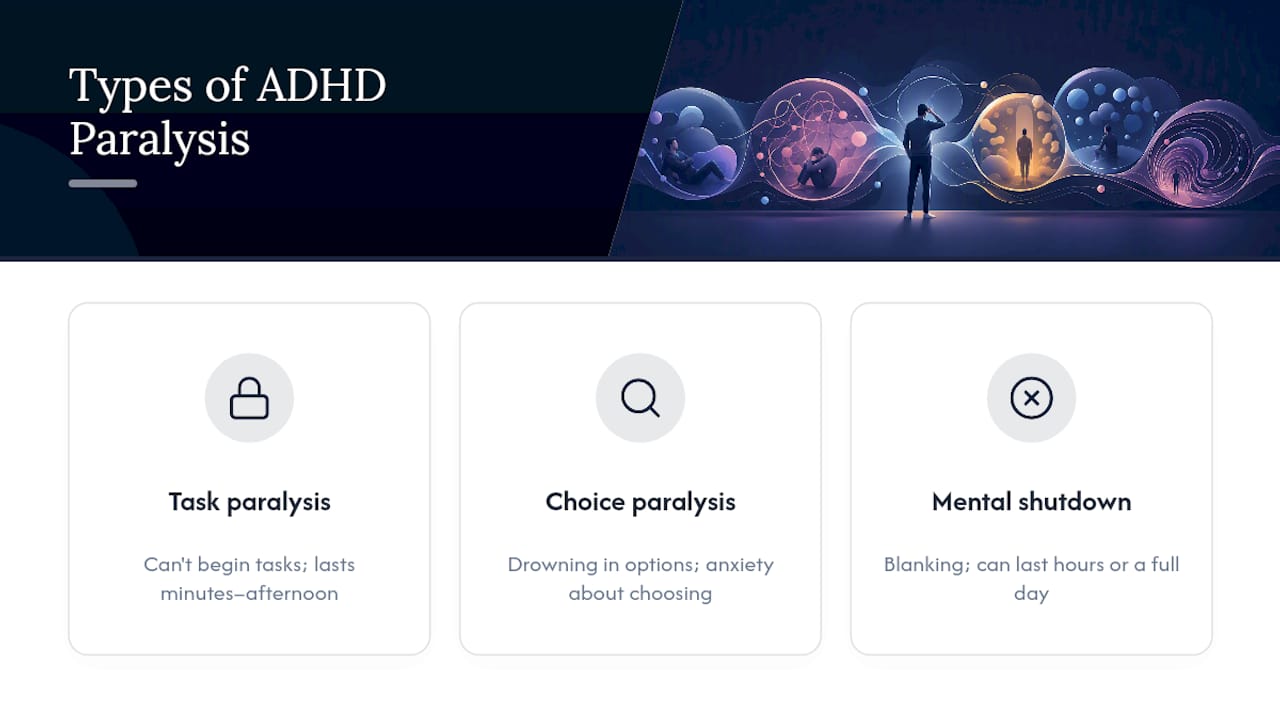
Task paralysis shows up as an inability to begin a specific action, even a simple one. Common symptoms include staring at the first step without moving, opening ten browser tabs related to the task without touching the task, physically feeling heavy or stuck in your chair, and a rising sense of dread the longer you sit there. This one usually lasts anywhere from a few minutes to a full afternoon, and it tends to spike around tasks that are boring, vague, or emotionally loaded (like a difficult conversation).

Choice or analysis paralysis is different. This is what happens when you’re drowning in options and can’t pick one, whether that’s choosing which client to email first or which font to use on a slide. Symptoms include re-reading the same options over and over, opening comparison tabs you’ll never finish reading, feeling a spike of anxiety about “getting it wrong,” and abandoning the decision entirely to avoid the discomfort. Understood explains that this stems from difficulty filtering out irrelevant information and limited working memory for holding multiple options in mind at once, which turns even small decisions, like what to eat, into exhausting work.
Mental shutdown, sometimes called ADHD shutdown or freeze, is the most severe version. Symptoms include going blank when asked a direct question, feeling foggy or disconnected from your own body, an inability to speak or respond even though you understand what’s being asked, and total loss of momentum on everything, not just one task. This one can last hours or bleed into a full day, and it often follows sensory overload, sudden confrontation, or accumulated stress.
Pro Tip: Name your freeze out loud, even just to yourself: “This is task paralysis, not laziness.” That single sentence interrupts the shame spiral fast enough that you can move to the next step instead of getting stuck defending yourself to yourself.
All three types tangle with hyperfocus, masking, and burnout. A person who masks their ADHD at work all day, holding it together in meetings, often collapses into total shutdown the second they get home, because the effort of appearing “fine” has drained the same executive-function battery they’d need to start dinner.
Why Does ADHD Cause Task Paralysis?
The short version: your brain’s dopamine system responds to interest and urgency far more than it responds to importance, and most tasks worth doing aren’t inherently interesting or urgent until the deadline is already screaming.
Neurotypical brains get a small dopamine reward just for starting a task, a kind of “good, we’re moving” signal. ADHD brains under-recruit dopamine for tasks that are routine, delayed in reward, or not personally engaging, according to the mechanisms described by Simply Psychology. That’s not a character flaw. It’s a wiring difference that shows up in imaging studies too. Research published in Frontiers in Psychiatry links network and neurotransmitter differences in ADHD brains to genuine deficits in task initiation and executive function, which means the freeze you’re feeling has a real biological signature, not just a bad attitude.
On top of dopamine, three other mechanisms stack up:
- Working memory overload. Holding a task’s steps, deadline, and context in mind simultaneously taxes a system that’s already running on limited RAM, so the whole task collapses into an unmanageable blob instead of a sequence.
- Time blindness. Many adults with ADHD experience time as either “now” or “not now,” with a fuzzy sense of how far away a deadline actually is, which strips away the urgency that would otherwise trigger dopamine and action.
- Emotional load. Fear of doing the task wrong, shame about having avoided it already, or dread of a difficult conversation all pile emotional weight on top of the cognitive weight, and ADHD brains often struggle to regulate that combined load.
The freeze isn’t about not caring. It’s often the opposite: caring so much, and feeling so much pressure to get it right, that the nervous system slams the brakes instead of letting you start messy.
Certain triggers make paralysis more likely on any given day. Watch for:
- Overwhelm, when a task has too many invisible steps (writing “clean the kitchen” instead of “put five dishes in the dishwasher”).
- Perfectionism, when the fear of doing it imperfectly outweighs the discomfort of not doing it at all.
- Fatigue, both physical and the specific mental fatigue that comes from masking ADHD traits all day.
- Sensory overload, from noise, clutter, or too many open tabs, literal and mental.
Sleep and nutrition play a quieter role too. Poor sleep and blood sugar crashes both reduce the cognitive bandwidth you have for initiation, which is part of why nutrition-focused strategies sometimes get folded into broader ADHD coping strategies, not as a cure but as one fewer thing stacked against you.
How Do You Break ADHD Task Paralysis?
Willpower doesn’t fix a wiring issue. What works is lowering the activation energy required to start, manufacturing urgency or novelty artificially, and borrowing structure from outside your own head when your internal structure has gone quiet. Here’s the toolkit, roughly in order of how fast each one works.
- Micro-initiation. Shrink the task until it’s almost insultingly small. Not “write the report,” but “open the document and type one sentence.” Not “clean the kitchen,” but “put one dish in the sink.” The goal is to get your hand moving before your brain has time to object, because once you’re two minutes in, the freeze usually thaws on its own.
- Body doubling. Work alongside someone else, in person, on a video call, or in a virtual “study with me” room, even if they’re doing something completely unrelated. The simple presence of another person creates enough low-grade social accountability to nudge your brain into gear. This is one of the most consistently recommended tactics across ADHD-specific guidance, and it’s worth treating as a first-line tool, not a last resort.
- Timeboxing. Set a timer for a short, defined sprint, five minutes for the truly stuck moments, twelve to twenty-five minutes (the classic Pomodoro range) once you’re moving. Committing to five minutes feels psychologically survivable in a way “just start” doesn’t, because your brain knows there’s an exit.
- Environmental and sensory adjustments. Move your body for sixty seconds before you sit down, literally walk to the kitchen and back. Clear the visual clutter in your immediate field of view. Put on an instrumental playlist if silence feels too loud or lyrics pull your attention sideways.
- Task structuring and externalization. Write down the first three physical steps, not the whole project, just the next three moves. Use implementation intentions, concrete “when X happens, I will do Y” statements, because Understood’s research on ADHD decision-making shows these outperform vague intentions specifically because they remove the “when” and “what” ambiguity that eats up working memory.
None of these tactics work in isolation as well as they do stacked together. A sample routine that coaching clients use often looks like this: two minutes of movement to shake off the fog, one micro-step to get a hand on the task, then a twelve-minute sprint with a body double watching the clock alongside you. By the time the timer goes off, momentum has usually taken over, and stopping becomes harder than continuing.
Pro Tip: Keep a “first three steps” list template on your phone, not for every task, just for the ones that make you feel that specific full-body dread. When dread hits, you skip the blank-page moment entirely and go straight to step one, which is often the whole battle.
If your paralysis shows up most around household tasks specifically, structured approaches to organizing and cleaning with ADHD tend to work better than generic productivity advice, because they account for the sensory and initiation issues that make “just tidy up” so much harder than it sounds.
When Should You Seek Help for ADHD Paralysis?
Occasional freezing is part of living with ADHD. It’s time to get a clinical assessment when the pattern starts costing you something real: missed deadlines that threaten your job, unpaid bills piling up despite having the money, relationships fraying because you keep failing to follow through, or paralysis that’s expanded from “sometimes” to “most days.”
The NHS and the Royal College of Psychiatrists both describe a range of options once you’ve been assessed, and no single one is “the” answer. What tends to work is a combination:
- Medication, stimulant or non-stimulant, which can raise dopamine availability enough that initiation stops feeling like climbing a wall. A partner overview of ADHD medication for adults walks through the trade-offs worth discussing with a prescriber.
- ADHD-adapted CBT, which addresses the anxiety and perfectionism that often ride shotgun with the freeze itself, rather than treating paralysis as a standalone problem.
- Coaching, which builds the day-to-day systems, accountability, and self-understanding that medication alone doesn’t provide. This is where an ADHD accountability partner, or a structured business coaching relationship, earns its keep, especially for people managing freelance or creative work with no external boss checking in.
- Occupational therapy, particularly useful when sensory triggers are a major factor.
If you’re in the UK and self-employed, it’s worth knowing that Access to Work coaching can fund ADHD coaching support directly, which makes professional help far more accessible than most people realize when they first look into it. Before an appointment, write down specific examples of when paralysis cost you something, not vague impressions, actual dates and consequences. Clinicians work faster with concrete data than with “I’ve always struggled with this.”
Comorbid issues are worth flagging honestly too. Some adults lean on alcohol or other substances to quiet the anxiety that builds up around unstarted tasks, and a resource on ADHD and substance use is worth a look if that pattern feels familiar, because untreated paralysis and self-medication often travel together.
What a Coach Sees That Clinicians Sometimes Miss
Working alongside adults with ADHD, particularly self-employed creatives and business owners who don’t have a manager checking their calendar, shows a pattern that clinical literature undersells: the freeze is rarely about the task itself. It’s about the story attached to the task, “I should already know how to do this,” “if I start and mess it up, that proves something.” Coaching goes after that story directly, alongside the mechanics.
A five-step micro-plan that works reliably for a single stalled task:
- Sixty seconds of environmental prep. Clear your immediate physical space, close unrelated tabs, and have water nearby.
- Micro-initiation. Open the one file, tool, or object connected to the task. Nothing else yet.
- Announce your start. Text an accountability partner, join a body-doubling call, or simply say out loud, “I’m starting now.”
- A twelve-minute focused sprint. Set a visible timer. The only job is to keep moving until it rings.
- Immediate micro-reward and reflection. Note what happened, even one line: “Started at 10:04, easier than expected once I opened the file.” This rewires the prediction your brain makes next time.
This structure works because it never asks you to trust motivation that isn’t there yet. It only asks for the next physical action. Adults who’ve used a version of this plan through structured executive-function coaching often report that the biggest shift isn’t the tactic itself but watching, task after task, that the freeze reliably breaks once they’ve proven it to themselves a dozen times.
Why Does Task Paralysis Come With So Much Shame?
The tactics only work once the shame spiral gets out of the way, and for most adults with ADHD, that spiral is louder than the task itself. You freeze, then you spiral about freezing, then the spiral becomes its own paralysis, layered on top of the original one.
This shows up as a familiar internal script: “everyone else can just do things,” “I’m so lazy,” “I should be better at this by now.” That narrative isn’t just unpleasant, it’s counterproductive, because shame triggers the same threat response that makes initiation harder in the first place. Anxiety about disappointing a client, missing a deadline, or letting down family piles emotional weight onto a task that was already hard to start for purely mechanical reasons.
Frustration compounds it further, especially the specific frustration of knowing exactly what to do and still not being able to make yourself do it. That gap between intention and action is one of the most demoralizing parts of ADHD, and it’s rarely discussed with the seriousness it deserves. Left unaddressed, this emotional layer often outlasts the original task avoidance and becomes the thing that actually needs treating.
How Does Self-Compassion Change the Way You Handle Paralysis?
Self-compassion isn’t a soft add-on to ADHD coping strategies. It’s often the mechanism that makes every other tactic usable, because a nervous system busy defending against shame has fewer resources left for actually starting the task.
The mindset shift that matters most is small but specific: swapping “why can’t I just do this” for “my brain needs a different entry point for this task.” The first question has no useful answer and just deepens the freeze. The second one leads somewhere, toward a micro-step, a body double, a timer, something you can actually act on in the next sixty seconds.
Self-compassion also changes what happens after a stalled attempt. Adults who treat a missed task as data (“that approach didn’t work, what’s different this time”) tend to try again faster than adults who treat it as proof of a personal flaw. That’s not a fluffy reframe, it’s the difference between staying stuck for an afternoon and staying stuck for a week. Estelle-rose’s coaching work leans on this constantly: the goal isn’t to feel differently about yourself first and then act. It’s to act in tiny enough steps that the feeling has room to catch up.
How Does Task Paralysis Show Up in Daily Life and Work?
The cumulative cost of ADHD task paralysis rarely shows up as one dramatic failure. It shows up as a slow accumulation: the unanswered email that turns into three unanswered emails, the invoice you meant to send that’s now two weeks late, the load of laundry that’s been “about to get done” for a week.
For self-employed adults and creative entrepreneurs, this hits differently than it does for someone in a structured job with external deadlines. There’s no manager noticing the stall. That autonomy, the exact thing that makes freelance and creative work appealing to many ADHD brains, also removes the external scaffolding that used to catch the freeze before it snowballed. Client work stalls, invoicing slips, and the business side of a creative practice, quotes, follow ups, admin, tends to absorb the worst of it, since it’s rarely the fun part.
Over time, repeated paralysis erodes trust in your own reliability, which is its own quiet tax on confidence and decision-making. That’s part of why ADHD business coaching tends to focus as much on systems and accountability structures as on the tasks themselves, because the goal isn’t just finishing today’s to-do list, it’s rebuilding a track record you can trust.
Does Task Paralysis Look Different for Inattentive vs. Hyperactive ADHD?
Task paralysis isn’t identical across ADHD presentations, and recognizing your own pattern helps you pick the right tactic faster.
Adults with predominantly inattentive presentations tend to experience paralysis as a quiet, internal fog: staring blankly, losing track of the task mid-thought, or drifting into unrelated browser tabs without noticing the drift happening. The freeze here often looks passive from the outside, easy to mistake for disinterest, when it’s actually an attention system that’s lost its grip on the task entirely.
Adults with hyperactive or combined presentations often experience paralysis with more visible internal agitation, restlessness, irritability, or a compulsion to do literally anything except the actual task (reorganizing a drawer instead of writing the report). The freeze is less “blank” and more “buzzing but stuck,” which can make body doubling and movement-based tactics like a sixty-second walk particularly effective, since they give the restless energy somewhere to go before redirecting it toward the task.

Both presentations respond well to micro-initiation and timeboxing, but the entry point differs: inattentive presentations often need external cues to notice the freeze is happening at all, while hyperactive presentations often need a physical outlet before the mental redirect will stick.
What Adults With ADHD Get Wrong About Beating Task Paralysis
Most advice on this topic assumes the problem is motivation, and that assumption wastes people’s time. The research is fairly consistent that ADHD task paralysis is a dopamine and executive-function issue, which means pep talks and willpower fail for a structural reason, not a character one.
Where conventional advice falls short is the size of the first step it recommends. “Just start” is not a strategy. “Open the document” is. The gap between those two instructions is the entire game, and most productivity content skips right past it because it sounds too small to matter.
If you take one thing from this article, prioritize the smallest possible entry point over any bigger system, planner, or app. Systems help later. In the first sixty seconds of a freeze, only the tiny step gets you moving, and momentum, not motivation, does the rest.
— Estelle
Ready to stop white-knuckling through every freeze on your own? Estelle-rose offers ADHD coaching for impact-focused entrepreneurs and creatives, including packages built around executive-function support, accountability, and the exact kind of micro-planning covered here. If you’d rather start with a resource you can work through at your own pace, The Empowering ADHD Workbook for Women walks through structured exercises for building initiation skills without needing a single appointment first.
This article is general information, not a substitute for advice from a qualified doctor. Consult a qualified healthcare professional about your own circumstances before acting on anything here.
Sources
- What Is ADHD Paralysis? — Child Mind Institute
- ADHD and “analysis paralysis” — Understood
- Attention deficit hyperactivity disorder (ADHD) — NHS
- Frontiers in Psychiatry — relevant peer-reviewed study

