Stress Reduction Steps for ADHD: A Practical Guide
Stress Reduction Steps for ADHD: A Practical Guide
TL;DR:
- Targeted, neurologically informed strategies can effectively reduce stress in adults with ADHD by addressing their unique processing of overwhelm and emotions.
- Building routines, identifying triggers, practicing externalized breathing and movement, and deploying immediate reset protocols help manage peak stress moments efficiently.
Stress reduction for adults with ADHD is defined by targeted, neurologically informed strategies that address the specific ways an ADHD brain processes pressure, overwhelm, and emotional dysregulation. Generic stress advice rarely works here because ADHD stress is not just “feeling busy.” It compounds executive function challenges, amplifies emotional reactivity, and creates a feedback loop where stress worsens symptoms and symptoms create more stress. The steps in this guide cover identifying your personal triggers, building routines that lower decision fatigue, using breathing techniques like the 5-2-5 pattern, incorporating movement, and deploying an acute overstimulation reset when everything peaks at once. Tools like smartphone reminders, visual checklists, and ADHD-adapted cognitive behavioral therapy (CBT) reinforce every step.
What are the most effective stress reduction steps for ADHD?
Stress reduction for adults with ADHD works best when you treat it as system design, not a willpower exercise. The most effective approach combines trigger identification, behavioral structure, physiological regulation, and acute recovery protocols. Each step targets a different layer of the ADHD stress cycle.
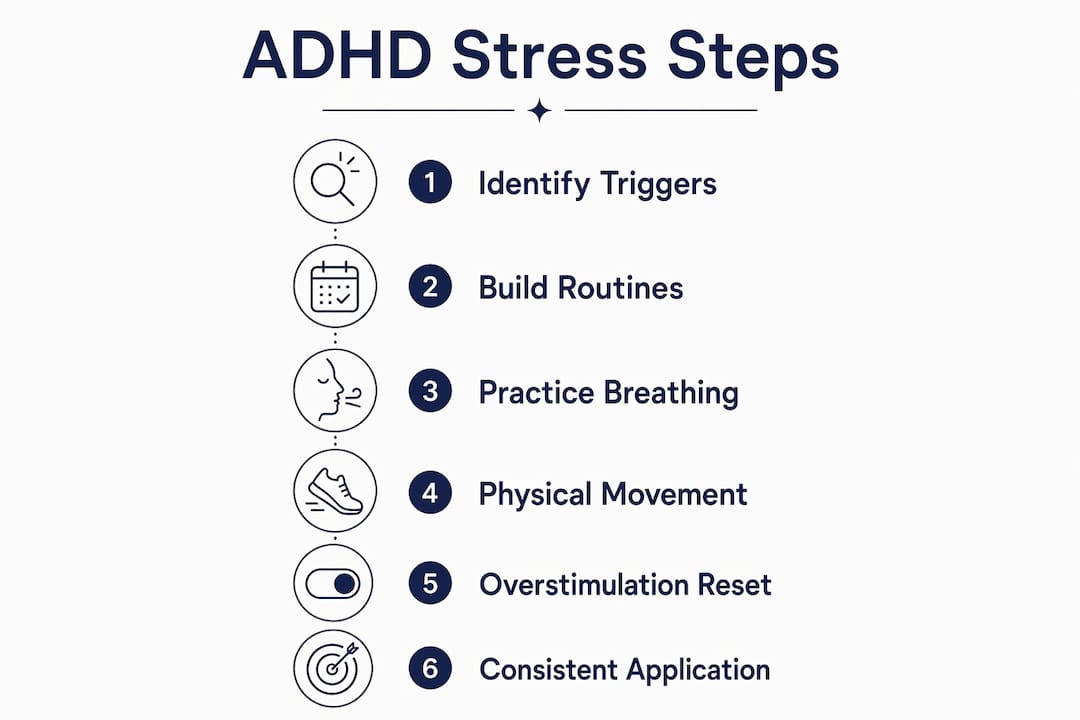
The six core steps are: identify your unique stress triggers, build predictable daily routines, practice structured breathing, incorporate regular physical movement, use externalizing tools like timers and checklists, and have a ready acute reset plan for peak overwhelm moments. None of these steps requires perfection. They require consistency at a realistic scale.
How can identifying your ADHD stress triggers reduce stress effectively?
Listing your friction points is the first concrete stress reduction step for adults with ADHD. A friction point is any recurring situation that reliably produces irritability, shutdown, or anxiety. Common examples include transitions between tasks, unexpected schedule changes, noisy environments, and open-ended to-do lists with no clear starting point.
The process is straightforward. For one week, note the time, situation, and your physical or emotional response whenever stress spikes. You do not need a fancy app. A notes app on your phone or a small notebook works. Patterns will emerge faster than you expect.
Once you have your list, sort triggers into two categories:
- Avoidable triggers: Situations you can restructure or remove. For example, if the 9 a.m. team meeting reliably derails your morning, you can request a different slot or prepare a written agenda the night before.
- Manageable triggers: Situations you cannot avoid but can prepare for. Sensory overload in open offices, for instance, can be addressed with noise-canceling headphones and a pre-agreed signal to colleagues that you need focus time.
Pro Tip: Keep your top three triggers visible. A sticky note on your monitor or a pinned note on your phone means you are not relying on memory to remember what derails you.
The goal is not to eliminate all stress. The goal is to stop being blindsided by the same stressors repeatedly.
Why are routines crucial for lowering stress in adults with ADHD?
Consistent daily routines lower the mental effort required to get through the day, which directly reduces ADHD-related stress. Every decision your brain makes costs cognitive energy. When you have ADHD, executive function deficits mean that energy depletes faster and recovers more slowly than in neurotypical adults. Routines convert repeated decisions into automatic sequences, freeing up mental bandwidth for tasks that actually need it.
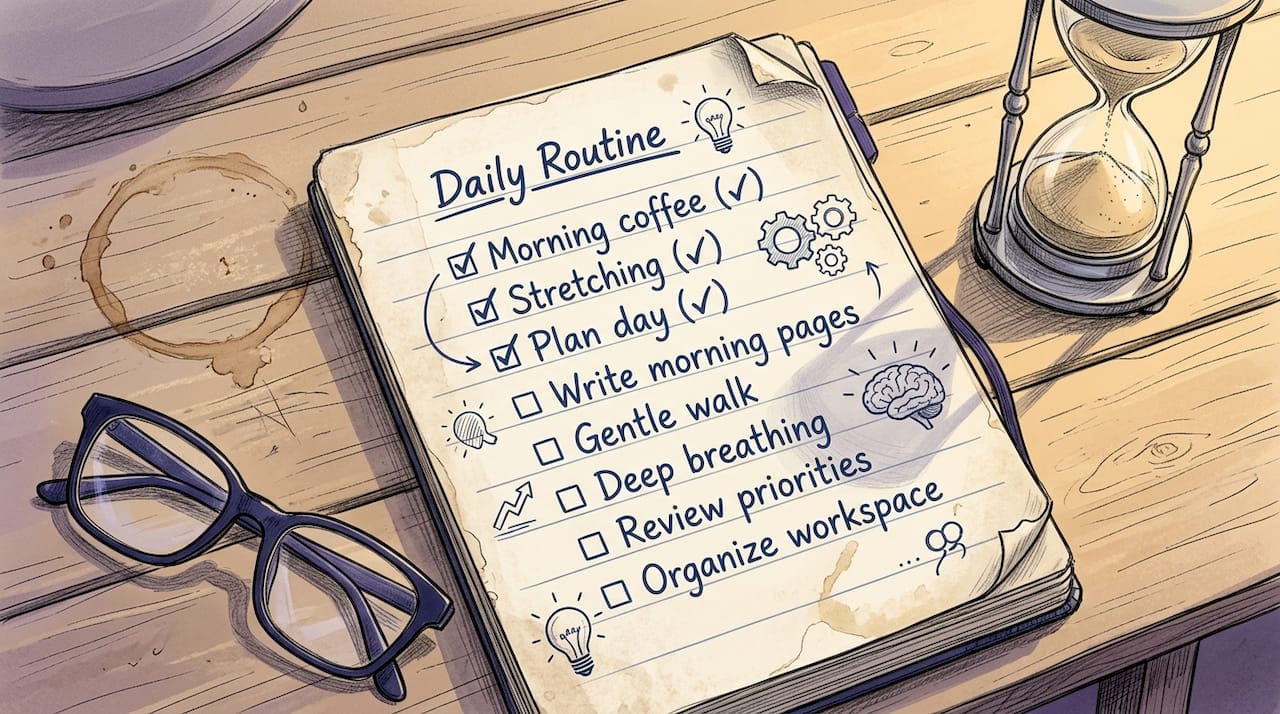
The key is anchoring new micro-routines to habits you already have. If you make coffee every morning, that moment becomes the anchor for a two-minute review of your top three priorities for the day. If you always eat lunch at your desk, that becomes the anchor for a five-minute movement break afterward. The existing habit carries the new behavior without requiring extra motivation.
Externalizing supports like timers, visual schedules, and checklists are not optional extras here. They are the infrastructure that makes routines stick when your working memory drops the ball, which it will. A phone alarm labeled “start wind-down” at 9 p.m. does more for sleep consistency than any amount of good intentions.
Pro Tip: Start with one routine only. Pick the morning or the evening, not both. Once that single routine runs on autopilot for two weeks, add the next one.
The payoff compounds. Adults who maintain even basic daily structure report lower baseline anxiety and fewer crisis moments throughout the week.
What breathing techniques can immediately reduce ADHD-related stress?
The 5-2-5 breathing pattern is the most practical immediate stress relief exercise for ADHD: inhale for five counts, hold for two, exhale for five. Repeat this four to six times. The physiological effect is real. Slow, controlled breathing activates the parasympathetic nervous system, which counteracts the stress response within minutes.
One challenge specific to ADHD is that internal sensation-based techniques are harder to sustain. Anchoring attention to external cues works better initially than trying to focus purely on how your breath feels inside your chest. Practical anchors include:
- Watch your hand rise and fall on your stomach as you breathe.
- Focus on the sound of your breath rather than the sensation.
- Hold a textured object, like a stress ball or a smooth stone, and shift attention to that physical contact during the exhale.
- Count aloud quietly if your mind keeps wandering.
Habit formation matters here. Set a phone reminder for two or three fixed points in your day, such as before a meeting, after lunch, and before bed. Pairing the breathing practice with an existing activity removes the need to remember it independently.
Pro Tip: Use the 5-2-5 pattern specifically before tasks you know will be stressful, not just after stress has already peaked. Prevention is faster than recovery.
Mindfulness for ADHD is moderately effective when combined with other tools, but it is not a standalone fix. Breathing techniques work best as one layer in a broader ADHD stress management plan.
How does regular physical movement alleviate ADHD stress and improve focus?
Movement is one of the most direct ADHD coping strategies available because it works at the neurochemical level. Exercise increases dopamine and norepinephrine, the same neurotransmitters that ADHD medications target. A 20-minute walk produces measurable improvements in attention and mood that last for hours afterward.
The practical target is 150 minutes of moderate-intensity movement per week, which breaks down to about 30 minutes on most days. If that feels out of reach right now, start with 10 to 15 minutes and build from there. The ramp-up matters more than the starting point.
Movement types that work well for ADHD stress management include:
- Walking: Low barrier, no equipment, and easy to pair with a podcast or music to maintain engagement.
- Yoga: Combines movement with breath regulation, which addresses both the physical and cognitive dimensions of ADHD stress.
- Short stretching sequences: A five-minute desk stretch every 90 minutes interrupts stress buildup before it peaks.
- Dance or rhythm-based movement: High novelty and dopamine-friendly, which makes it easier to sustain for ADHD brains.
Pro Tip: Attach movement to an existing routine anchor. A post-lunch walk or a pre-work stretch session removes the decision of when to exercise, which is often the biggest barrier.
ADHD and emotional regulation are directly connected to physical activity levels. Adults with ADHD who exercise regularly report lower emotional reactivity and faster recovery from stressful events.
What is an effective acute overstimulation reset for peak ADHD stress?
Prevention strategies and acute resets are not the same thing. Stress-management plans fail when adults with ADHD apply prevention tools to full overstimulation crises. When everything feels like too much, you need a different protocol entirely.
The five-step overstimulation reset works as follows:
- Pause all input. Silence your phone, close browser tabs, and stop the current task. Do not try to finish the sentence or the email. Stop completely.
- Change your environment. Move to a different room, step outside, or at minimum turn your chair to face a blank wall. Physical environment change signals your nervous system that the stressor is no longer present.
- Grounding action. Choose one sensory anchor: hold something cold, splash water on your face, or press your feet firmly into the floor. The goal is to bring your attention into the present physical moment rather than the mental spiral.
- Lower the pressure. Verbally or in writing, reduce your next task to its smallest possible unit. Not “finish the report” but “open the document.” Not “clean the kitchen” but “put one dish in the sink.”
- Slow re-entry. Return to activity gradually. Start with the smallest task you identified in step four. Do not attempt to catch up on everything you paused. Momentum builds from small completions.
Recognizing early overstimulation signs, such as jaw tension, irritability at minor inconveniences, or a sudden inability to read the same sentence twice, means you can deploy this reset before full shutdown occurs. Customize your grounding action in step three to something you genuinely find calming. A grounding technique you actually use beats a theoretically superior one you skip.
Key takeaways
Effective ADHD stress management requires layered strategies: trigger identification, structured routines, physiological regulation through breathing and movement, and a separate acute reset protocol for peak overwhelm.
| Point | Details |
|---|---|
| Identify triggers first | List recurring friction points and sort them into avoidable and manageable categories. |
| Routines reduce decision load | Anchor micro-routines to existing habits and use timers and checklists as external supports. |
| 5-2-5 breathing works fast | Inhale five counts, hold two, exhale five. Use it before stressful tasks, not only after. |
| Movement targets neurochemistry | Aim for 150 minutes of moderate movement weekly; start at 10 to 15 minutes if needed. |
| Acute resets are a separate tool | Use the five-step overstimulation reset for peak stress. Prevention tools do not substitute for it. |
What I have learned about stress and ADHD after years of coaching
Most adults with ADHD come to me having tried stress reduction strategies that worked for exactly three days. They blame themselves. They should not. The strategies usually failed because they were designed for neurotypical brains and required sustained internal motivation to maintain. That is not a character flaw. That is a mismatch between tool and brain.
What actually works is designing your environment to do the heavy lifting. External reminders, visual cues, and pre-planned responses to known triggers remove the need to rely on working memory and willpower in the moments when both are depleted. I have seen clients transform their stress levels not by meditating for 30 minutes every morning but by putting a sticky note on their laptop that says “pause before you reply.”
The other thing I want to say directly: self-kindness is not a soft add-on to stress management. It is load-bearing. Adults with ADHD carry a significant history of being told they are not trying hard enough. That narrative increases cortisol and makes every strategy harder to implement. When you skip a reset or blow past a routine, the response that serves you is “what made that hard today?” not “why can I never get this right?”
Small changes accumulate. One breathing practice, one anchored routine, one trigger identified and planned for. That is a real stress reduction system. It does not require you to overhaul your life this week.
— Estelle
Ready to go deeper with ADHD coaching?
The strategies in this article give you a solid foundation. Applying them consistently, especially when life gets unpredictable, is where personalized support makes a measurable difference. Estelle-rose works with adults with ADHD on exactly this: building executive function systems that hold up under real-world pressure, not just ideal conditions.
Whether you are an entrepreneur, a creative, or someone managing ADHD in a demanding job, ADHD coaching through Estelle-rose focuses on practical structure, accountability, and strategies tailored to how your brain actually works. For self-directed learning, the ADHD workbook for women offers structured exercises to build stress coping skills at your own pace. You do not have to figure this out alone, and you do not have to start from scratch.
FAQ
What are the first stress reduction steps for adults with ADHD?
The first step is identifying your specific stress triggers by tracking when irritability or overwhelm spikes during the day. Once you have a list, you can build targeted adjustments rather than applying generic stress advice.
How does the 5-2-5 breathing technique help with ADHD stress?
The 5-2-5 pattern, inhale for five counts, hold for two, exhale for five, activates the parasympathetic nervous system and produces an immediate physiological calm response. It works best when practiced before stressful tasks, not only as a recovery tool.
Can exercise really reduce ADHD-related anxiety?
Yes. Movement increases dopamine and norepinephrine, the same neurotransmitters affected by ADHD medication. 150 minutes weekly of moderate activity is the evidence-based target, with a ramp-up starting at 10 to 15 minutes for those new to regular exercise.
What is the difference between ADHD stress prevention and an acute reset?
Prevention strategies like routines and trigger management reduce baseline stress over time. An acute overstimulation reset is a separate five-step protocol used when stress has already peaked, covering pausing input, changing environment, grounding, reducing task pressure, and slow re-entry.
Does CBT help with ADHD stress management?
ADHD-adapted CBT builds executive functioning and emotional regulation skills specifically tailored to ADHD challenges like time blindness and procrastination. It is most effective when combined with externalizing tools like timers and checklists rather than used as a purely cognitive approach.

