
Supported Self-Management ADHD: A Practical Guide
Supported Self-Management ADHD: A Practical Guide
TL;DR:
- Supported self-management for ADHD combines skill-building with external supports like medication, therapy, and coaching to help adults manage symptoms effectively. It emphasizes layered approaches starting with body needs before progressing to organization and emotional regulation, tailored to individual needs and preferences. Group programs and digital tools further enhance self-efficacy, motivation, and symptom reduction through practical, evidence-based strategies.
Supported self-management for ADHD is defined as the practice of pairing personal skill-building with ongoing external supports, including medication, therapy, and peer coaching, to help adults manage symptoms and improve daily functioning. The clinical term used in research is “multimodal self-management,” and it matters because it signals that no single strategy works alone. Programs like the Winnipeg Regional Health Authority’s adult ADHD class cover 18+ practical skill areas, from mindfulness to task breakdown, built around the reality that ADHD brains need structure and support, not just willpower. If you have recently been diagnosed, this guide explains exactly what supported self-management looks like in practice.
What is supported self-management for ADHD?
Supported self-management for ADHD combines skill-building with layered supports. The skills include self-awareness, emotion regulation, routine-building, and task management. The supports include medication, cognitive behavioral therapy (CBT), coaching, and environmental adjustments. Together, they form a system that works with your brain rather than against it.
The WRHA program structures this as a scaffolded curriculum, starting with foundational body needs like sleep and sensory regulation before moving to emotion regulation and then productivity skills. This sequencing matters. Trying to fix your task management before you have addressed chronic sleep deprivation is like trying to run on a flat tire. The foundation has to come first.
The NHS describes this approach as personalized, noting that not everyone requires medication and that lifestyle changes and workplace adjustments are legitimate first-line options. That is a meaningful distinction. Supported self-management is not a prescription. It is a menu of evidence-based options you build from based on your own needs and preferences.
What practical skills make up ADHD self-management?
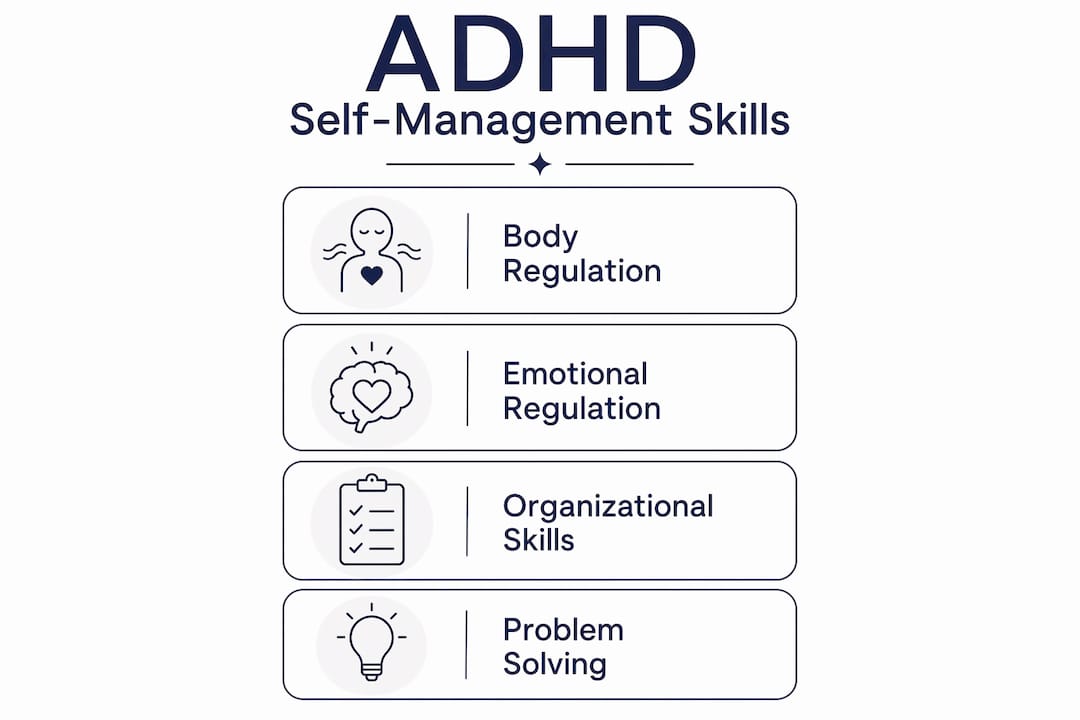
The core self-management techniques for ADHD fall into four categories: body regulation, emotional regulation, schedule management, and task management. Each builds on the last.
Body and emotional regulation
Body regulation covers sleep, nutrition, movement, and sensory needs. Brain-boosting nutrition and consistent sleep schedules directly affect executive function. Emotional regulation draws heavily from Dialectical Behavior Therapy (DBT), which teaches distress tolerance and impulse control through concrete, repeatable skills. DBT is not just for crisis situations. For adults with ADHD, it provides daily tools for managing frustration, rejection sensitivity, and emotional overwhelm.

Cbt-based organizational and problem-solving skills
A BMJ Mental Health network meta-analysis found that CBT organizational strategies enhance motivation and that problem-solving techniques specifically reduce inattention. Those are two of the most disabling ADHD symptoms for working adults. CBT in this context acts less like traditional therapy and more like structured coaching. You learn to break large tasks into smaller steps, identify obstacles before they derail you, and build systems that compensate for working memory gaps.
Self-compassion is also a skill here, not a soft add-on. Burnout from relentless self-criticism is one of the most common reasons adults with ADHD abandon strategies that were actually working.
- Mindfulness practice: Builds awareness of attention drift without judgment, making it easier to redirect focus
- Emotion regulation (DBT): Reduces impulsive reactions and improves distress tolerance in high-pressure moments
- Time blocking and schedule management: Creates external structure that compensates for weak internal time perception
- Task chunking: Breaks complex projects into steps small enough to start without triggering avoidance
- Motivation management: Identifies personal interest triggers and uses them to initiate tasks
Pro Tip: When a task feels impossible to start, reduce it to a two-minute version. Write one sentence. Open one tab. The goal is to break the freeze, not finish the project.
How do medication and therapy fit into ADHD self-management?
Medication and therapy are supports within the self-management framework, not replacements for it. Yale Medicine explains that medication is typically prescribed only when ADHD severely disrupts daily functioning, and that stimulant medications are controlled substances requiring specialist management. That context matters for newly diagnosed adults who may feel pressure to medicate immediately or, conversely, resist medication entirely.
CBT functions as skill coaching rather than emotional processing. It teaches you to organize, plan, and problem-solve in ways that your ADHD brain does not do automatically. Yale Medicine notes that combining medication with CBT often produces the best outcomes for managing executive function challenges and emotional regulation. Neither alone is as effective as both together.
| Support Type | Primary Function | Best Used When |
|---|---|---|
| Stimulant medication | Reduces inattention and impulsivity | Daily functioning is significantly impaired |
| CBT | Builds organizational and problem-solving skills | Skill gaps are driving symptom impact |
| ADHD coaching | Accountability and real-world strategy | Motivation and follow-through are the core barriers |
| Workplace adjustments | Reduces environmental barriers | Job performance is affected by sensory or focus issues |
The NHS recommends workplace adjustments such as quiet workspaces and written instructions as practical accommodations that do not require medication. These are not workarounds. They are legitimate, evidence-backed supports that belong in any self-management plan.
Pro Tip: If you are managing medication as part of your plan, a daily medication reminder tool removes one more decision from your day and reduces the cognitive load of staying consistent.
What group programs and peer support help newly diagnosed adults?
Structured group programs are one of the most underused supports in ADHD self-management. A 2025 pilot RCT published in BMC Psychiatry tested a person-centered group program for adults newly diagnosed with ADHD. The program used two two-hour sessions divided into 20-minute segments with peer facilitation and shared experiences. It produced measurable improvements in self-efficacy and quality of life.
The design itself is instructive. Short segments with breaks are not just considerate. They are clinically informed. Attention-friendly structures improve learning and retention for ADHD brains specifically. A two-hour lecture is not the same as six focused 20-minute segments, even if the content is identical.
Peer facilitation adds another layer. Hearing that someone else has the same experience with time blindness or task avoidance reduces shame and builds motivation. That is not a soft benefit. It is a documented mechanism for improving self-efficacy.
Practical options for group and peer support include:
- ADHD coaching groups: Structured accountability with peers who share similar challenges
- Psychoeducation programs: Teach the neuroscience of ADHD alongside practical coping skills
- Online peer communities: Accessible for adults with schedule constraints or limited local options
- Workplace peer coaching: Pairs you with a colleague or external coach for on-the-job support
Estelle-rose offers peer coaching and group support specifically designed for adults managing ADHD, with formats that account for attention and energy variability.
How do digital tools and environment design support ADHD self-management?
Digital tools and environmental adjustments are practical, low-barrier additions to any supported self-management plan. A 2025 RCT published on medRxiv tested a fully self-guided digital CBT and mindfulness program called Attexis as an adjunct to usual care. In a sample of 337 adults with ADHD, it produced statistically significant symptom reductions at both three and six months with no adverse events. The key word is “adjunct.” Digital tools work best alongside broader care, not as a replacement for it.
Cleveland Clinic recommends several environmental tactics that directly support ADHD focus, including removing visual distractions, using visual timers, and working in short bursts with scheduled breaks. The Pomodoro technique, which uses 25-minute work intervals followed by five-minute breaks, is one of the most widely used adaptations of this approach.
Environmental adjustments worth implementing:
- Quiet or low-stimulation workspaces: Reduce sensory overload and competing attention demands
- Visual timers: Make time concrete and visible, which compensates for weak internal time perception
- Written checklists and visual schedules: Offload working memory onto paper or a screen
- Controlled background stimulation: Some adults with ADHD focus better with white noise or instrumental music
- Distraction-blocking apps: Tools like Freedom or Cold Turkey limit access to high-dopamine sites during work periods
| Tool Category | Example | Primary Benefit |
|---|---|---|
| Digital CBT | Attexis | Reduces symptom severity over months |
| Time management | Pomodoro timer apps | Structures work into attention-friendly intervals |
| Distraction blocking | Freedom, Cold Turkey | Reduces impulsive task-switching |
| Medication tracking | Daily Dose Tracker | Supports medication consistency |
| Visual scheduling | Google Calendar, Structured app | Externalizes planning and reduces decision fatigue |
Pro Tip: Combine a visual timer with a written checklist for maximum executive function support. The timer handles time perception. The checklist handles working memory. Together, they cover two of the biggest ADHD barriers at once.
Key takeaways
Supported self-management for ADHD works because it layers skill-building, medical support, peer connection, and environmental design into a system that compensates for how the ADHD brain actually functions.
| Point | Details |
|---|---|
| Layered approach is essential | Combining skills, medication, therapy, and environment produces better outcomes than any single strategy. |
| Body needs come first | Sleep, nutrition, and sensory regulation must be addressed before tackling productivity or organization skills. |
| CBT and coaching build real skills | Organizational strategies and problem-solving techniques directly reduce inattention and improve motivation. |
| Group programs improve self-efficacy | Short-segment, peer-facilitated programs produce measurable gains in quality of life for newly diagnosed adults. |
| Digital tools work as adjuncts | Self-guided digital CBT programs show sustained symptom reduction when used alongside broader care plans. |
What i have learned about supported self-management
The most common mistake I see newly diagnosed adults make is treating self-management like a test they can either pass or fail. They find a productivity system, follow it for two weeks, lose momentum, and conclude that nothing works for their brain. That conclusion is wrong. What actually happened is that they tried one layer without the others.
The adults I work with who make the most progress are not the ones who found the perfect planner or the right app. They are the ones who got honest about what they actually need. Some need medication to create the neurological conditions for skills to stick. Some need a coach or a peer group to stay accountable. Some need their environment redesigned before any strategy has a chance.
Self-compassion is not optional in this process. The research on burnout and ADHD is clear: relentless self-criticism dismantles the motivation systems that already run lean in ADHD brains. You are not lazy. You are working with a brain that needs more structure, more support, and more external scaffolding than the average person. That is not a character flaw. It is a neurological reality, and building around it is the whole point.
The multimodal approach is not complicated. It is just honest about what actually works.
— Estelle
Ready to build your own supported ADHD system?
Understanding the framework is the first step. Putting it into practice is where real change happens.
Estelle-rose offers ADHD coaching specifically designed for adults navigating executive function, organization, and accountability challenges. Whether you are building routines from scratch or trying to figure out why your current system keeps breaking down, the ADHD executive function coaching program gives you a structured, personalized plan that accounts for how your brain actually works. For women with ADHD looking for a practical starting point, the ADHD workbook for women offers guided exercises built around the same multimodal principles covered in this article.
FAQ
What is supported self-management for ADHD?
Supported self-management for ADHD is a multimodal approach that combines personal skill-building in areas like organization and emotional regulation with external supports such as medication, CBT, coaching, and environmental adjustments. It is designed to work with the ADHD brain rather than demanding it perform like a neurotypical one.
Do i need medication to practice ADHD self-management?
Medication is one option within a broader self-management plan, not a requirement. The NHS confirms that lifestyle changes, workplace adjustments, and therapy are all valid first-line supports, and medication is typically recommended only when ADHD significantly disrupts daily functioning.
How does CBT help adults with ADHD?
CBT for ADHD focuses on organizational strategies, problem-solving, and time management rather than traditional talk therapy. A BMJ Mental Health meta-analysis found these components directly reduce inattention and improve motivation in adults with ADHD.
What are the best digital tools for ADHD self-management?
The Attexis digital CBT program showed statistically significant ADHD symptom reductions in a 337-person RCT, and tools like Freedom, the Pomodoro technique, and visual scheduling apps like Structured support focus and planning. Digital tools work best as part of a broader care plan, not as standalone solutions.
How do group programs help newly diagnosed adults with ADHD?
A 2025 BMC Psychiatry pilot RCT found that short-segment, peer-facilitated group programs improve self-efficacy and quality of life for adults newly diagnosed with ADHD. The shared experience component reduces shame and builds motivation in ways that solo strategies cannot replicate.

