
One Line 'Paused at' Fix for Adults With ADHD: Copy Ready Handoffs
One Line ‘Paused at’ Fix for Adults With ADHD: Copy Ready Handoffs
Use a quick handoff every time you switch tasks: write “Paused at / Next / Open” before you move on. That single note is the fastest fix for task handoffs ADHD brains struggle with, and it works whether you’re stepping out of a meeting, handing a project to someone else, or just getting up for coffee. The full routine is Stop, Save, Shift, Start. This is coaching guidance, not a medical diagnosis, so if switching tasks feel impossible most days, that’s worth a conversation with a clinician too.
TL;DR:
- External memory aids like writing “Paused at” and specific next actions significantly reduce the time needed to resume tasks for ADHD adults.
- Routine success depends on clear context markers, outcome-based delegation, and deliberate attention shifts, not on switching speed itself.
- Interruptions, time blindness, and emotional avoidance exacerbate task handoff difficulties, but structured routines can mitigate these factors effectively.
- Setting up consistent documentation, buffers, and predictable check-in times minimizes unnecessary switches and preserves focus.
- Coaching and templates tailored to individual workflows enhance the adoption and stickiness of handoff systems for ADHD professionals.
Table of Contents
- What Are Task Handoffs, and Why Do They Trip Up ADHD Brains?
- What Does the Research Say About ADHD and Switching?
- Why Do Transitions Feel So Much Harder Than They Should?
- The Stop, Save, Shift, Start Routine (With Templates You Can Copy)
- How Do You Recover From a Failed or Interrupted Handoff?
- How Do You Reduce Avoidable Switches in the First Place?
- Estelle’s Coaching Notes on Handoffs, Scripts, and Small Wins
- An ADHD Coach’s Honest Take on Why This Works
- How Estelle-rose Can Help You Build a Handoff System That Sticks
- Sources
- FAQ
What Are Task Handoffs, and Why Do They Trip Up ADHD Brains?
A task handoff is any moment you move your attention, or a piece of work, from one place to another. That covers three very different situations, and they each break down in their own way.
- Meeting to task: you leave a call and are supposed to return to deep work, but you can’t remember what you were doing.
- Async delegation: you hand a project to a colleague, contractor, or virtual assistant and the context lives only in your head.
- Short interruptions: a Slack ping, a text, a kid walking in, and suddenly the thread you were pulling on is gone.
None of these are the same as task paralysis, where you can’t start anything at all. Task switching is different: you were moving, something pulled you away, and now the on ramp back is missing. For most ADHD adults, that on ramp problem shows up as one of three losses. You lose the context (what was I even doing?), the priority (which thing actually matters right now?), or the initiation (I know what to do, I just can’t make myself start it again).
This article covers all three, with a routine you can test today and templates you can copy straight into your task manager. If you want the deeper mechanics of why executive function makes this so hard in the first place, Estelle-rose’s breakdown of adult ADHD executive function goes further into planning and working memory specifically.
What Does the Research Say About ADHD and Switching?
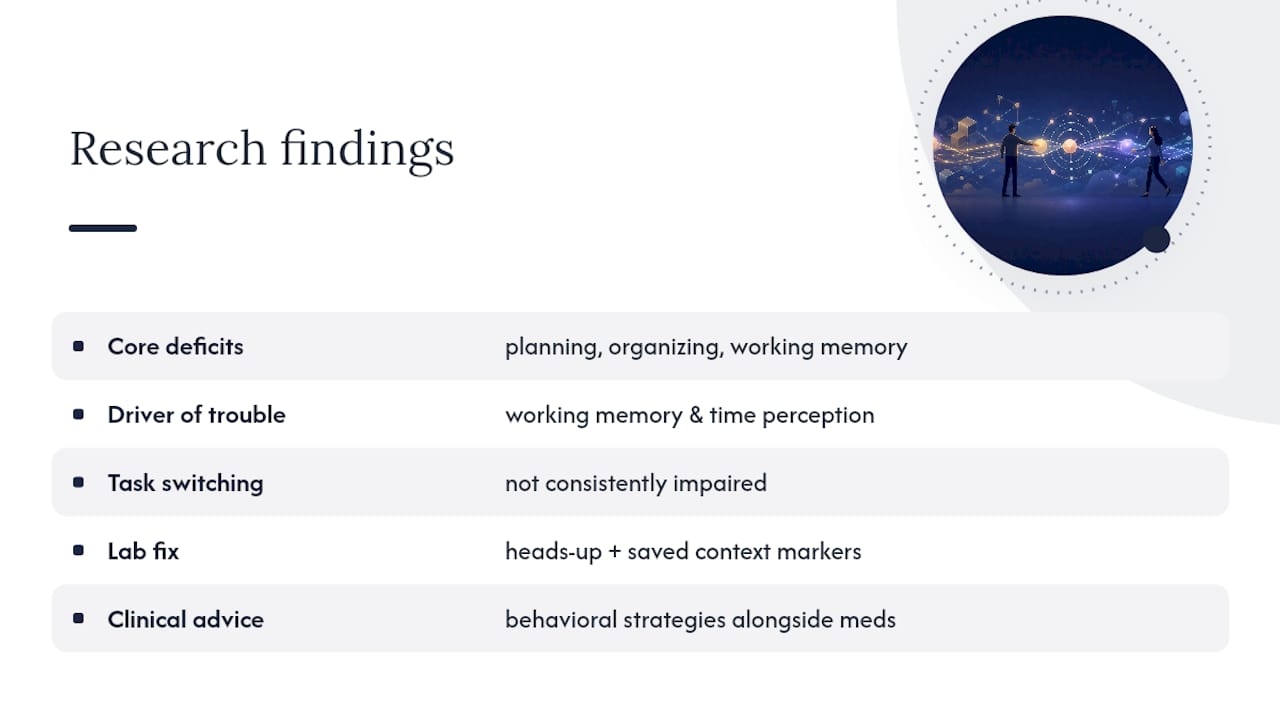
Executive function difficulties, including problems with planning, organizing, and working memory, are core features of ADHD, according to the National Institute of Mental Health. That’s the clinical foundation for why handoffs feel harder for you than they seem to for coworkers who just casually resume a task after lunch.
Here’s the part that surprises a lot of people: lab research doesn’t actually show a clean, universal “task switching deficit” in ADHD. Studies on this are mixed, and a PubMed review of task switching and executive function found that working memory and inhibitory control explain real-world transition trouble better than switching itself. In plain terms, it’s not that your brain can’t switch. It’s that the scaffolding you need to switch well, holding context, filtering priorities, inhibiting distractions, is thinner.
What the research actually shows: working memory and time perception, not switching speed itself, are the mechanisms most linked to sequencing and resumption difficulty in ADHD, per a PMC review of executive function research.
That distinction matters for how you fix this. If switching itself were the broken part, no routine would help much. But because the problem is context holding and resumption, external memory aids work surprisingly well. Interruption studies going back to Trafton and Monk’s research on warned versus unwarned interruptions found that a brief heads up and a saved context marker measurably cut resumption time in lab settings, which is the entire logic behind writing “Paused at” before you stand up.
Clinician facing overviews like ADDA’s guide to executive function disorder list time management and task switching as core executive function symptoms, and they’re clear that behavioral strategies belong alongside any medical treatment, not instead of it. Coaching and structure aren’t a consolation prize for people who “just need meds.” They’re a documented part of the toolkit either way.
Why Do Transitions Feel So Much Harder Than They Should?
Four things are usually happening at once when a handoff goes sideways, and once you can name them, they get a lot less scary.
Attention residue is the mental leftover from the task you just left. You close the report, but part of your brain is still arguing with a sentence in it. Working memory gaps mean the details you were holding (which file, which version, what you decided five minutes ago) evaporate the second something else demands space. Time blindness is the reason “I’ll just finish this email” turns into forty minutes gone, so by the time you try to switch back, you’ve lost the thread entirely. And emotional avoidance shows up when the task you’re switching to feels boring, hard, or vaguely dreadful, so your brain quietly finds something, anything, else to do instead.
Picture this: you leave a status meeting where you agreed to send a report by Friday. Ten minutes later you’re back at your desk and you genuinely cannot recall what the report needs to say, only that it’s due. That’s attention residue plus a working memory gap, stacked together.
Or: you go to lunch, and getting back into your afternoon feels like starting a car with a dead battery. Nothing about the task changed. Your activation energy just cratered because there was no bridge back in.
- Attention residue: part of your focus stays on the last task, so the new one gets partial attention.
- Working memory gaps: details you need for resumption disappear within minutes.
- Time blindness: “quick” tasks eat the buffer you needed for the actual handoff.
- Emotional avoidance: dread about the next task quietly delays starting it.
None of these are character flaws. They’re predictable mechanics, and predictable mechanics can be engineered around.
The Stop, Save, Shift, Start Routine (With Templates You Can Copy)
This is the practical core of the whole article, and it’s built to take less time than you think. Most people can run the full cycle quickly once it’s a habit.
- Stop. Physically pause. Don’t try to “finish just one more thing.” That one more thing is where handoffs die.
- Save. Write a one-line context marker before you do anything else. This is the single highest-leverage habit in this entire routine.
- Shift. Deliberately move your attention, whether that’s standing up, closing a tab, or literally saying out loud “I’m switching now.”
- Start. Open the next task with the smallest possible first move, not the whole task.
Here’s the copy-ready marker for step two:
Paused at: [the exact sentence, line, or step you stopped on] Next: [the very next physical action, not the whole remaining task] Open: [file, tab, or tool you need re-opened to resume]
That marker works because it treats the handoff like a save file for working memory. You’re not relying on your brain to remember the state; you’re recording it externally, the same way autosave protects a document. Interruption-resumption research on warned interruptions backs this up directly: a PubMed study on interruption and resumption found that a saved context cue reduced how long it took people to get back on track after being pulled away.
For async delegation, the Save step needs one more layer, because you’re not just saving context for future you, you’re handing it to someone else entirely. Use this template:
- Owner: who is doing this, by name, not “the team.”
- Deadline: an actual date, not “soon.”
- Definition of Done: what finished looks like, described as an outcome, not a method. (“Report is in the shared drive, three sections, approved by Friday 5pm” beats “write the report.”)
- Links: everything they need in one place, no hunting.
- Failure trigger: the specific point at which they should flag you, instead of guessing or going silent. (“If you haven’t heard back from the client by Wednesday, message me.”)
Focusing delegation on outcomes rather than methods matters more than it sounds like it should. It cuts down on the repeated re-explaining that eats so much energy, sometimes called the ADHD tax, because your collaborator knows what “done” looks like without needing you to micromanage the steps.
For meetings, Save looks like writing one line the second the meeting ends: what you agreed to, and the very next action. Not the whole deliverable. Just the next action.
For fast interruptions, like a five-second Slack ping, the routine compresses hard. You don’t need the full template. You need three words scribbled somewhere: what, next, open. That’s it. The goal isn’t ceremony, it’s just enough of a trail to find your way back.
Pro Tip: Set a recurring two minute buffer on your calendar between meetings, labeled nothing but “Save.” That tiny appointment gives your brain explicit permission to stop and write the marker instead of rushing straight into the next thing.
How Do You Recover From a Failed or Interrupted Handoff?
Sometimes the marker doesn’t get written, or someone you delegated to goes quiet, and now you’re just stuck. Here’s the triage sequence.
- Read whatever you saved, even a fragment. A half-finished note is still more than nothing, and it’s usually enough to jog the rest.
- Re-establish one visible next action. Don’t try to reconstruct the whole task in your head. Pick the smallest physical step and do only that.
- Timebox the re-entry. Give yourself a short time to get oriented before you’re allowed to judge how behind you are. Judging first just adds shame on top of a stalled task, and shame makes starting harder, not easier.
If the stall is on someone else’s end, meaning you delegated something and it’s gone quiet, don’t leap straight to checking in every hour. That reads as micromanaging and it will wear on the relationship. Instead, ask for a one-line async proof: a screenshot, a quick “here’s where I am,” a single sentence of status. That restores visibility without demanding a full conversation, and it respects that out-of-sight anxiety is real without turning it into surveillance.
Pro Tip: If you notice you’re re-reading the same saved marker three or four times without acting, that’s usually not a comprehension problem, it’s an activation energy problem. Try body doubling: text a friend “starting X now” or work alongside someone, even virtually. Just being witnessed can be enough to break the freeze.
How Do You Reduce Avoidable Switches in the First Place?
Not every handoff needs the full Stop, Save, Shift, Start treatment, because some switches are avoidable if you design your day a little differently.
- Add short buffers between meetings instead of booking back to back, so you’re not switching cold.
- Group similar work together (all emails in one block, all calls in another) instead of ping-ponging between types of tasks all day.
- Protect at least one block of your “genius zone” time, the hours when your focus is naturally strongest, and refuse to schedule meetings into it.
- Ask meetings to end with one written outcome and one owner, instead of a vague verbal agreement everyone half-remembers differently by Friday.
- Set predictable check-in times with collaborators instead of ad-hoc “just checking in” messages that interrupt both of you.
- Keep every handoff field, owner, deadline, Definition of Done, links, in one consistent place: a single doc, ticket system, or Notion page, not scattered across five apps, as detailed in this Autism care workflow: a practical guide for families which highlights consistent documentation to reduce cognitive load in caregiving contexts.
Cleveland Clinic’s guidance on ADHD time management frames commitments as agreements you make with yourself, backed by visible reminders and real deadlines, and that framing alone changes how seriously a switch gets treated. A checklist approach built for remote teams uses the same consistent fields for exactly this reason: predictability lowers the cognitive cost of every single handoff, one at a time.
Estelle’s Coaching Notes on Handoffs, Scripts, and Small Wins
As an ADHD coach working with self-employed professionals and creatives, I see the same pattern constantly: smart, capable people who avoid delegating not because they don’t trust others, but because explaining the task feels like more work than doing it themselves. That’s a real cost, and it’s fixable with structure, not more willpower.
A few scripts that clients use immediately:
- Requesting a written outcome: “Can you send me one line on what ‘done’ looks like before we start?”
- Setting a check-in rhythm: “Let’s do a two minute update every Thursday instead of me pinging you randomly.”
- Recovering visibility without micromanaging: “No need for a full update, just a screenshot of where you’re at.”
A short coaching arc that works well for handoff struggles specifically: session one maps where your handoffs actually break down, session two builds your personal templates, and session three tests them on real tasks and adjusts.
An ADHD Coach’s Honest Take on Why This Works
Here’s what I want you to sit with: the routine in this article is coaching derived, not a clinical protocol, and I think that’s exactly why it works for real days. A client of mine once described finally writing “Paused at” on a sticky note before a school pickup, and coming back to find her own handwriting had done the remembering for her. Small, almost embarrassingly simple. That’s usually what actually holds.
Systems beat willpower every time, not because willpower doesn’t exist, but because it’s a finite resource and systems aren’t. Try one piece of this routine this week, not the whole thing.
— Estelle
How Estelle-rose Can Help You Build a Handoff System That Sticks
Reading about a routine and actually installing it into a chaotic week are two different problems, and that gap is exactly where ADHD business coaching earns its keep. Coaching services can help self-employed professionals, creatives, and impact-driven founders turn scattered task handoffs into templates you actually reach for under pressure, not just in a calm Tuesday afternoon planning session.
Coaching sessions focus on your actual executive function patterns, not generic productivity advice, whether that means building your Definition of Done templates, practicing delegation scripts, or working through the specific moments your handoffs tend to fail. If you’re navigating this alongside ADHD coaching for creatives and impact focused entrepreneurial work, or you’re exploring Access to Work coaching support as a self-employed professional in the UK, this is exactly the kind of executive function gap coaching is built to close. For a lower-commitment starting point, the Empowering ADHD Books collection includes workbooks with the same kind of templates covered here, ready to adapt to your own work. If you want a real accountability partner rather than another app to abandon, book a first conversation with Estelle-rose’s coaching for adult ADHD executive function and bring one handoff that’s currently driving you up the wall.
Sources
- Attention-Deficit/Hyperactivity Disorder: What You Need To Know — NIMH
- PubMed entry related to task switching/executive function
- PMC review article on executive function and ADHD
FAQ
Why Do People With ADHD Struggle With Task Switching?
Task switching itself may not be uniquely impaired in ADHD, but working memory, inhibitory control, and time perception difficulties make it harder to hold context and resume tasks smoothly, according to PubMed research on executive function.
What Is the 30% Rule in ADHD?
There’s no single, widely recognized clinical definition of a “30% rule” for ADHD; if you’ve seen it referenced, it’s likely an informal productivity tip rather than an established framework, so treat it with some skepticism.
What Is the 1-3-5 Rule for ADHD?
The 1-3-5 rule is a task planning method where you pick one big task, three medium tasks, and five small tasks for the day, giving you a fixed, achievable structure instead of an open-ended list that invites overwhelm.
What Makes ADHD People Happy?
Predictable structure, visible progress, and low-friction systems tend to reduce the daily stress ADHD adults face around unfinished tasks and missed handoffs, and working with an ADHD accountability partner or coach often restores a sense of momentum that willpower alone struggles to deliver.
How Do I Hand Off a Task Without Over-Explaining It?
Use a Definition of Done statement describing the finished outcome, plus an owner, deadline, and one failure trigger, so your collaborator has what they need without you repeating instructions.

