
8 Micro Starts to Beat Task Initiation for UK Adults With ADHD
8 Micro Starts to Beat Task Initiation for UK Adults With ADHD
The single most useful move for ADHD task initiation isn’t a productivity system, it’s shrinking the first step until your brain stops treating it like a threat. Task initiation is an executive-function and dopamine issue, not a character flaw, so willpower rarely fixes it. What works instead is stacking small, concrete tactics, micro-starts, two-minute commits, body doubling, visible timers, until the activation barrier gets low enough to cross. When those tactics stop working across every area of life, it’s time to consider clinical support alongside them.
TL;DR:
- Making the first move so small that it requires no motivation can significantly reduce task initiation barriers for ADHD brains.
- Using visible timers, immediate physical launch points, and body doubling can help create momentum and lower activation thresholds across different tasks.
- Time-blocking with visible countdowns and breaking tasks into shorter sprints improve decision-making and sustain focus for ADHD individuals.
- Clinical support, including medication, is recommended when consistent, cross-domain initiation failure persists despite tactical approaches.
- Tailoring tactics to specific ADHD presentation types prevents overwhelm or distraction, and understanding whether initiation issues stem from ADHD, anxiety, or depression informs proper treatment.
Table of Contents
- Why Starting Is So Hard With ADHD
- Practical Tactics You Can Try Right Now
- Time-Management Tools That Remove Decisions
- Body Doubling and Other Ways to Borrow Activation
- When Task Initiation Needs Clinical Support
- Beyond Dopamine: Working Memory and Attention Regulation
- Emotional Regulation and Motivation in ADHD Task Initiation
- CBT Techniques Adapted for Task Initiation
- Apps and Tools Built Specifically for ADHD Initiation
- Common Pitfalls by ADHD Presentation
- Is It ADHD, Anxiety, or Depression?
- Estelle’s Coaching Perspective on Sequencing These Strategies
- Ready for Personalized ADHD Support?
- Sources
- FAQ
Why Starting Is So Hard With ADHD
Task initiation lives in your prefrontal cortex, and it runs on dopamine. When dopamine signaling is inconsistent, which is the core biological story in ADHD, your brain struggles to generate the internal “go” signal for anything that isn’t urgent, novel, or interesting. That’s why you can hyperfocus on a video essay about deep-sea creatures but stare at a tax form for forty minutes without opening it. It’s not that you don’t care. Your brain genuinely can’t find the on ramp.
Here’s the trap almost everyone falls into first: adding pressure. Telling yourself “just do it” or piling on guilt about the deadline usually backfires, because it triggers a threat response instead of a motivation response. Your nervous system reads the pressure as danger, and danger makes avoidance stronger, not weaker.
Two other pieces make this worse:
- Time blindness distorts how “later” feels, so a task due in three days doesn’t register as real until it’s due in three hours.
- The interest-based nervous system means your activation depends on novelty, urgency, challenge, or connection, not on importance alone.
The Numbers: NHS survey data puts adult ADHD prevalence in England at roughly 3 to 4 percent, with guidance recommending psychosocial support alongside medication where it’s needed, not instead of it.
None of this means you’re broken. It means the “just try harder” advice you’ve been given your whole life was built for a different brain.
Practical Tactics You Can Try Right Now
Forget the thirty-minute morning routine you saw on social media. What actually moves the needle for ADHD task initiation is making the first action so small it doesn’t require motivation, just movement.
Launch points are pre-decided physical first moves, not decisions you make in the moment. The goal is to remove the “what do I even do first” question entirely, because that question is often where initiation dies. Here are eight you can copy today:
- Email you’re avoiding: open it and type the subject line for your reply. Nothing else.
- Writing project: open the document and type one sentence, even a bad one.
- Cleaning a room: pick up exactly five items and put them where they belong.
- Admin paperwork: take the paper out of the pile and place it on your desk.
- A phone call you’re dreading: write the first sentence you’ll say, out loud, once.
- Exercise: put your shoes on. That’s the whole task.
- A big project: open a blank note and title it. Save it.
- Invoicing or budgeting: open the spreadsheet and type today’s date in the first cell.
Practitioner and coaching guidance consistently backs this up: tiny, physical first moves change your brain’s relationship to the task before you’ve done any of the actual work.
Once you’ve launched, use the two-minute rule, or its slightly more generous cousin, the ten-minute commit. Tell yourself you only have to work for that long, with an honest stop rule: if you genuinely want to quit at ten minutes, you can. Most people don’t, because momentum is real once the engine turns over. But the promise has to be honest, or your brain stops trusting the deal.
Pro Tip: Five to ten minutes of movement, a walk, jumping jacks, even pacing while you talk through the task out loud, can raise dopamine and norepinephrine enough to make the next launch point easier to hit.

Friction reduction matters as much as motivation. Lay out your materials the night before. Keep a “starter kit” for recurring dreaded tasks (the right folder, the right tab open, the right playlist cued). For genuinely stubborn tasks, stack tactics: launch point, then a visible timer, then a recorded body double playing in the background. Three small supports often succeed where one big push fails.
Time-Management Tools That Remove Decisions
To-do lists tell you what to do. They don’t tell you when, and “when” is exactly where ADHD task initiation collapses. A list with twelve items gives your brain twelve chances to freeze on which one to pick. Time-blocking removes that decision entirely, because past-you already decided, and present-you just has to show up.
Blocks of 25 to 45 minutes tend to work best for ADHD, long enough to get real traction, short enough that your brain doesn’t revolt at the commitment. Pair every block with a visible countdown, not a silent one. A phone timer buried in your pocket doesn’t help. A big, visible countdown on your desk or screen does, because it turns time from an abstract idea into something you can see ticking down.
Short Pomodoro variants, 10 to 15 minute sprints instead of the standard 25, often suit ADHD better because they match a shorter natural attention span and create more frequent “wins.”
A three-step mini workflow turns any vague to-do into a startable block:
- Name the launch point (the exact physical first action, not the goal).
- Set a visible timer for 10 to 15 minutes and start the moment you hit go.
- Write the next block’s launch point before you finish, so future-you never faces a blank slate.
Templates help too. A simple checklist that breaks “clean the kitchen” into “clear counters, load dishwasher, wipe surfaces, take out trash” turns one intimidating word into four startable actions.
Body Doubling and Other Ways to Borrow Activation
Body doubling means working alongside another person, in person or on video, who isn’t helping you directly but whose presence makes starting easier. The mechanism is simple: social presence raises accountability and activation even when the other person is just quietly doing their own thing.
Not every version needs a real-time human, which is good news if scheduling with another person feels like its own task initiation problem.
- Live co-working (in person or video) gives the strongest activation boost but requires coordination.
- Silent video calls offer nearly the same effect with less social pressure to chat.
- Recorded “study with me” videos work as micro-doubling, no scheduling, no disclosure, just presence on a screen.
- Voice-only calls suit tasks where video feels like too much exposure.
If asking someone to body double feels awkward, keep the ask light: “Can I work near you for twenty minutes? You don’t need to do anything, I just focus better with company.” No diagnosis required.
Pro Tip: If live presence spikes your anxiety instead of your focus, drop to a recorded video or silent audio track before you drop the tactic entirely. Micro-doubling often provides enough of a nudge without the pressure of being watched.
When Task Initiation Needs Clinical Support
If launch points, timers, and body doubling still leave you stuck across work, home, and relationships, not just on one annoying task, that’s a signal worth raising with a doctor. Consistent impairment across multiple domains is the red flag that separates “everyone struggles sometimes” from a pattern worth assessing.
A major synthesis from Oxford and Southampton researchers found that stimulants and atomoxetine show the strongest evidence for reducing adult ADHD symptoms, while non-drug approaches showed some clinician-reported benefit too. A related network meta-analysis found meaningful differences in efficacy and tolerability between stimulants, methylphenidate, and atomoxetine, which is exactly why this conversation belongs with a clinician, not a forum thread.
Medication can lower your activation threshold. It rarely replaces the scaffolding above, it just makes the scaffolding easier to use.
In UK pathways, this typically starts with a GP referral, moves to specialist assessment, and continues through shared-care prescribing arrangements between your GP and specialist for ongoing monitoring.
- Write down specific examples of tasks you can’t start, across at least two life areas.
- Note how long the pattern has lasted (weeks versus years matters).
- Ask your GP directly for an ADHD assessment referral, using that phrase.
Beyond Dopamine: Working Memory and Attention Regulation
Dopamine gets the headlines, but it’s not the whole story. Working memory, your ability to hold a goal in mind while you act on it, plays an enormous role in task initiation. If you can’t keep “I need to start the report” active in your head long enough to act on it, something else in the room will hijack your attention first. That’s not distraction in the casual sense. It’s a working-memory bottleneck.
Attention regulation is a separate piece again. ADHD brains don’t lack attention, they have trouble directing it on demand. You can concentrate intensely, just not always on the thing you chose. This is why a task can feel impossible at 9 AM and completely absorbing in 9 PM once something (often stress, novelty, or a deadline) finally captures the attention system involuntarily.
Put together, this means initiation failure often isn’t one thing breaking, it’s several systems, dopamine signaling, working memory, and attention regulation, all needing to line up at once. Launch points work partly because they reduce the working-memory load: instead of holding “write the whole report” in mind, you only need to hold “type one sentence.” Visible timers work partly because they give attention regulation something concrete to lock onto instead of an abstract deadline days away.
Understanding this matters because it explains why some tactics work on some days and not others. Your working memory load that day, how much else is competing for attention, shifts the difficulty of the exact same task from hour to hour.
Emotional Regulation and Motivation in ADHD Task Initiation
Task initiation isn’t purely cognitive. Emotional regulation shapes it heavily, often more than people expect. Many adults with ADHD carry years of shame around unfinished tasks, missed deadlines, and being called lazy, and that history creates an emotional charge around starting that has nothing to do with the task’s actual difficulty.
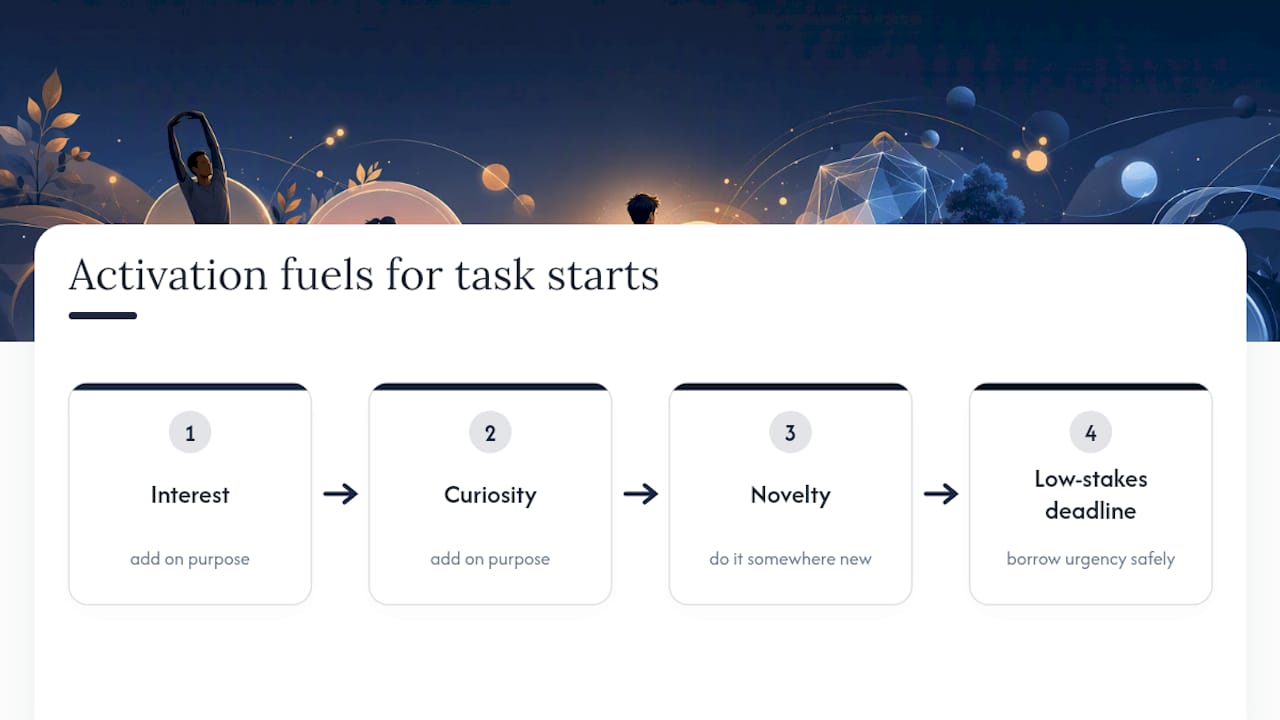
This is where the interest, curiosity, novelty, and urgency framework can become genuinely useful. Your brain needs one of those four fuels present to activate reliably. Relying on urgency alone, waiting until the deadline creates panic, works in the short term but burns you out over months, because your nervous system is essentially running on adrenaline as a substitute for dopamine.
A more sustainable approach is asking which fuel you can add on purpose. Can you make the task slightly novel (do it somewhere new, use a different tool)? Can you frame it as a challenge (beat your own time from last week)? Can you borrow urgency safely, a real but low-stakes deadline, rather than waiting for panic to force your hand?
Motivation challenges specific to ADHD often get mislabeled as low effort or poor discipline. What’s actually happening is a mismatch between the task’s built-in reward and what your dopamine system needs to engage. That’s a design problem you can solve with the fuels above, not a moral failing that responds to guilt.
CBT Techniques Adapted for Task Initiation
Standard cognitive behavioral therapy focuses on identifying distorted thoughts and testing them against evidence. Adapted for ADHD task initiation, the target shifts from thoughts about the world to thoughts about the task itself, “this will take forever,” “I’ll fail at it anyway,” “I should be able to just do this.”
Behavioral activation, a CBT technique built around taking small action before motivation arrives rather than waiting for motivation to strike first, maps almost perfectly onto the micro-start approach. The clinical insight behind it is the same one coaches use with launch points: action often precedes motivation, not the other way around, and waiting to “feel ready” is frequently the thing standing between you and starting.
Cognitive restructuring adapted for initiation means catching catastrophic task predictions and testing them in real time. If you believe a task will take two hours, and you actually time it at fourteen minutes, that gap becomes evidence your brain uses to trust the next similarly framed prediction less.
Graded exposure, another CBT staple, applies directly to tasks you’ve been avoiding for so long they’ve become emotionally loaded. Instead of tackling the whole avoided task, you approach it in small doses, opening the email without replying, sitting near the pile of paperwork without touching it, until the emotional charge around it drops enough that starting stops feeling like a threat.
Apps and Tools Built Specifically for ADHD Initiation
General time-management apps assume you already know how to start. ADHD-specific tools instead try to remove the starting decision itself. Apps built around body doubling connect you to live or virtual co-working sessions on demand, so you don’t need to schedule a friend, you just open the app when you’re stuck.
Other tools use gamified task breakdown, turning a vague task like “clean the apartment” into a randomized sequence of tiny, specific actions, so the app makes the decision your brain won’t. Some ADHD-focused apps use randomized “surprise” task selection from a list you’ve pre-loaded, borrowing the novelty fuel automatically instead of asking you to manufacture it.
Visual and audio countdown tools designed specifically for ADHD, rather than repurposed kitchen timers, tend to use color gradients or escalating sound cues instead of a flat digital number, because a shrinking colored bar registers more viscerally with time blindness than digits do.
The common thread across all of these tools is that they’re not trying to make you more disciplined. They’re trying to make the first move require less of you.
Common Pitfalls by ADHD Presentation
Task initiation tactics don’t land the same way for every ADHD presentation, and using the wrong tactic for your presentation can make things worse instead of better.
If you have the predominantly inattentive presentation, the common pitfall is picking tactics that are too stimulating early. A loud accountability call or an intense gamified app can overload your system before you’ve even started, leaving you more scattered, not less. Quieter tools, silent body doubling, a simple visible timer, tend to work better as a first step.
If you have the hyperactive-impulsive presentation, the pitfall runs the other way: you start too many things at once because starting itself isn’t the problem, sustaining is. Launch points barely help you, because you’re already good at beginning. What you need instead is a structure that limits how many launch points you’re allowed to trigger before finishing one, otherwise you’ll have five browser tabs of half-started tasks by lunchtime.
Combined presentation often needs both guardrails at once, gentle entry tactics for the inattentive moments, and a hard cap on new starts for the impulsive ones, which is exactly why one-size-fits-all productivity advice fails ADHD adults so consistently.
Is It ADHD, Anxiety, or Depression?
Task initiation problems show up in ADHD, anxiety, and depression, and telling them apart matters because the right tactic differs by cause.
ADHD-driven initiation trouble tends to be task-specific and inconsistent, you can’t start the tax return but you started a new hobby project within the hour. The block is about engagement and dopamine, not dread.
Anxiety-driven avoidance usually comes with a specific feared outcome attached, “if I open this email, I’ll find out I made a mistake.” The task itself might be easy; it’s the anticipated consequence that stops you.
Depression-driven initiation trouble tends to be broader and flatter, low energy and low interest across nearly everything, including things you’d normally enjoy, rather than the selective, interest-dependent pattern typical of ADHD.
These three frequently overlap, and years of ADHD-related task failure can genuinely produce secondary anxiety or low mood. If your initiation struggles come with persistent low mood, loss of interest in things you used to enjoy, or a specific fear driving the avoidance, mention that explicitly when you talk to a GP, because it changes what support looks like.
Estelle’s Coaching Perspective on Sequencing These Strategies
In coaching sessions, the order these tactics get introduced matters as much as the tactics themselves. Launch points come first because they build a quick, believable win. Time scaffolds like visible timers and blocking come second, once a client trusts that starting doesn’t have to feel awful. Body doubling gets layered in for the specific tasks that resist everything else. Clinical referral enters the conversation only when the pattern is consistent and cross-domain, not as a first resort.
Try this for one week: pick your single most avoided task, apply one launch point to it daily, and log whether you started within five minutes. Notice which fuel, interest, novelty, urgency, or company, made the difference. That log becomes the evidence for what your brain actually needs, not what a generic list says it should need.
— Estelle
Ready for Personalized ADHD Support?
Reading about launch points is different from having someone design the right ones for your actual life, your actual deadlines, your actual dread-inducing tasks. That’s the gap ADHD business coaching is built to close, one-to-one work with a coach who understands late diagnosis, creative work, and the specific chaos of running your own business with an ADHD brain.
Coaching sessions build on everything above: personalized launch-point design for your specific stuck points, accountability that doesn’t feel like being watched, and structure that adapts when your capacity changes week to week. If you’d rather start with self-guided practice, the Adult ADHD Executive Function 7-Week Power-Up workbook walks through structured exercises you can use alongside the tactics in this guide. For hands-on coaching, especially if you’re self-employed, an executive, or navigating Access to Work coaching support, visit the ADHD coaching page to see how a session or package could work for you.
This article is general information, not a substitute for advice from a qualified doctor. Consult a qualified healthcare professional about your own circumstances before acting on anything here.
Sources
- Survey of mental health and wellbeing, England 2023–24: attention-deficit hyperactivity disorder
- Oxford and Southampton study identifies the most effective treatments for ADHD in adults
FAQ
Do people with ADHD struggle with starting tasks?
Yes. Task initiation is one of the most commonly impaired executive functions in ADHD, tied to inconsistent dopamine signaling in the prefrontal cortex rather than a lack of effort or care. It’s often the single most frustrating symptom adults report, because it looks like laziness from the outside while feeling like a genuine wall from the inside.
What is ADHD burnout?
ADHD burnout happens when you’ve been compensating for executive function gaps, masking, overworking, running on urgency and adrenaline, for so long that your capacity collapses. It shows up as exhaustion, a total loss of initiation ability even for easy tasks, and heightened emotional sensitivity, and it typically needs rest plus a rebuild of sustainable systems, not just a weekend off.
What is the 10 to 3 rule for ADHD?
Definitions of this rule vary across different sources, so treat any specific version cautiously. Broadly, it refers to committing to a short, defined window of focused work, similar in spirit to the two-minute or ten-minute commit tactics described above, where you agree to work for a short set time and allow yourself an honest stop afterward if you want it.
Which ADHD medication is best for task initiation?
There’s no single “best” medication for everyone. A network meta-analysis found stimulants like methylphenidate and amphetamines generally show strong short-term efficacy in adults, with atomoxetine as another evidence-backed option, but tolerability varies enough that this needs a conversation with your GP or specialist rather than a general answer.
How much does ADHD coaching with Estelle-rose cost?
Pricing for ADHD business coaching sessions and packages is available directly on the coaching page, since packages vary by need and length of support. Workbooks and self-guided resources are listed separately on the books page.

