
3 Session Coaching Fix for Adults with ADHD Time Blindness
3 Session Coaching Fix for Adults with ADHD Time Blindness
Time blindness is a brain-based difficulty sensing how much time has passed or how long a task will take, and it’s one of the most common, least-talked-about features of ADHD. If this sounds like you, the fastest first move isn’t a new planner. It’s a visible timer (digital or analog) plus a buffer you add to every estimate. This isn’t a willpower problem, and you’re not alone in it.
TL;DR:
- Visual timers and layered alarms significantly improve time awareness for adults with ADHD by converting abstract time into observable visual cues.
- Adding a 50% buffer to time estimates helps account for inherent inaccuracies in perception, reducing chronic lateness and overcommitment.
- Professional support, including coaching and structured accommodations, is often necessary when timers and buffers alone do not resolve deep-seated time perception issues.
- Time perception deficits are supported by neuroimaging research showing disrupted brain connectivity and dopamine signaling differences in ADHD brains.
- Comparing actual task durations with pre-estimates over time creates personalized data that enhances future time management accuracy.
Table of Contents
- What Time Blindness in ADHD Actually Means
- The Brain Science Behind Why Time Feels Different
- What Time Blindness Looks Like Day to Day
- Tools and Systems That Actually Move the Needle
- When Self-Help Isn’t Enough: Getting Professional Support
- What a Coaching-First Plan for Time Blindness Looks Like
- Time Blindness vs. Other ADHD Time Struggles
- How Time Blindness Shows Up Differently by Age
- Why Anxiety and Depression Make Time Blindness Worse
- The Research Base Behind ADHD and Time Perception
- Accommodations That Actually Help at School and Work
- A Note From Estelle
- Ready for Accountability That Actually Fits Your Brain?
- Sources
- FAQ
What Time Blindness in ADHD Actually Means
Time blindness is the clinical shorthand for a cluster of related problems: struggling to estimate how long something will take, losing track of how much time has already passed, and failing to feel the future approaching until it’s already arrived. Researchers studying time perception in adult ADHD increasingly treat it as a core feature of the condition, not a side effect of disorganization or laziness.
To talk about it precisely, it helps to borrow the vocabulary researchers actually use:
- Time estimation is guessing how long a task will take before you start it (the classic “this will take 20 minutes” that turns into two hours).
- Time reproduction is trying to recreate a duration you experienced earlier, like tapping a button when you think a minute has passed.
- Time production is generating a specific duration from scratch, such as waiting exactly five minutes without a clock.
- Time horizon refers to how far into the future something feels real to you. A deadline three weeks out can feel as abstract as a deadline three years out.
Everyone loses track of time occasionally; that’s normal human distractibility. ADHD time blindness is different in scale and consequence. It’s not “I got absorbed in a good book and missed dinner” once a year. It’s a recurring pattern that shows up across contexts, work, home, relationships, and creates real damage: missed rent payments, blown client deadlines, relationships strained by chronic lateness.
A review of adult ADHD and time perception found consistent deficits across estimation, reproduction, and time management tasks compared to neurotypical adults, which is part of why some researchers now argue time perception differences deserve more attention as a diagnostic marker rather than a footnote. If you’ve spent years being told you’re “just bad with time,” there’s a real, documented phenomenon behind that experience. You didn’t invent it to excuse yourself.
The Brain Science Behind Why Time Feels Different
Here’s the part that tends to land as relief rather than jargon: your brain is likely processing time through a different circuit than most people’s.
Time perception depends heavily on communication between the prefrontal cortex, which handles planning and holding information in mind, and the cerebellum, which helps time movement and internal rhythms. Neuroimaging research has found reduced connectivity between frontoparietal and cerebellar networks during timing tasks in people with ADHD, meaning the parts of the brain that should be coordinating to track duration simply talk to each other less efficiently.
Dopamine plays a starring role here too. Dopamine helps regulate the internal “clock” that lets you sense duration passing, and ADHD brains tend to run on different dopamine signaling patterns than neurotypical brains. That’s part of why time can feel like it’s either crawling (waiting for something boring) or vanishing entirely (hyperfocus on something engaging), with very little in between.
Here’s a number worth sitting with: research on ADHD and timing consistently identifies deficits in time estimation, reproduction, and management as central, not peripheral, symptoms of the condition, according to the same review of ADHD as a focal time-perception symptom. Some of that research also shows medication can help normalize timing performance on lab tasks, though the evidence base in adults is still catching up to what’s known in children, so treat medication considerations for immigration medicals as a promising signal rather than a settled fact.
None of this happens in isolation from your other executive functions. Working memory, your ability to hold information “online” while you use it, is the same system you rely on to remember that a task has a deadline while you’re absorbed in something else. Impulsivity plays a role too: the pull toward whatever feels urgent right now consistently wins against a deadline that feels distant and abstract. Time blindness, poor working memory, and impulsivity aren’t three separate problems. They’re one interconnected system misfiring in predictable ways.
What Time Blindness Looks Like Day to Day
Time blindness rarely announces itself with a label. It shows up as a pattern of moments that, individually, seem like bad luck or bad planning, but add up to something more consistent.
Common signs include:
- Chronic lateness despite genuinely believing you left “plenty of time.”
- Hyperfocus spirals, where three hours evaporate while you’re deep in a task, an email, or a scroll session.
- “Waiting mode” paralysis, where you can’t start anything meaningful in the 45 minutes before an appointment because your brain treats that window as unusable.
- Double-booking or overcommitting, because two events “felt like” they’d fit in the same afternoon.
- Wildly inaccurate task estimates, in both directions: thinking a report will take 20 minutes when it takes three hours, or assuming a five-minute errand will eat your whole morning and avoiding it for weeks.
In real life, this plays out in specific, almost embarrassing ways. You put pasta on to boil and then can’t understand how it’s suddenly stuck to the pot 25 minutes later. You tell a client “I’ll have this to you by end of day” without any real sense of whether that’s four hours of work or fourteen. You sit in a parking lot for 20 minutes before a doctor’s appointment because starting anything else felt riskier than doing nothing.
The Cleveland Clinic’s explainer on time blindness connects a lot of this to the difference between automatic attention (things that grab you without effort, like a gripping show) and directed attention (things you have to consciously sustain, like billing hours or laundry). ADHD brains shift between these modes less smoothly, which is a big part of why hyperfocus and time blindness are often two sides of the same coin.
Try this for one day: pick three tasks and write down your predicted time before you start, then log the actual time when you finish. Most adults with ADHD are stunned by the gap the first time they do this honestly. That gap is data, not a character flaw, and it’s the first ingredient in fixing your estimates going forward.
Tools and Systems That Actually Move the Needle
Strategies for time blindness work best when they stop asking your brain to do something it’s bad at (silently tracking abstract duration) and start giving it something it’s good at (responding to concrete, visual, external cues).
Visual timers beat numeric clocks for most ADHD brains. A device like the Time Timer, which shows time as a shrinking red disk instead of numbers counting down, works because it turns an abstract concept into something you can literally watch disappear. Digital countdowns require you to do math (“47 minutes left, what does that mean for my afternoon?”). A visual timer just requires you to glance at shrinking space. Analog clocks with visible hands offer a milder version of the same benefit; the physical position of the hands gives your eyes something to anchor to that a digital “3:47” doesn’t.
Time blocking works, but it needs ADHD-specific adjustments to survive contact with real life:
- Estimate how long a task will take, then add 50% as buffer. If you think it’s an hour, block 90 minutes.
- Use a modified Pomodoro technique: instead of rigid 25 minute blocks, experiment with 15, 25, and 45 minute versions to find what your attention span actually supports on a given task.
- Set an alarm for the start of a task, not just the end. Transition points are where time blindness does the most damage.
- Leave visible gaps between blocks instead of stacking them edge to edge. One overrun shouldn’t wreck your entire afternoon.
Digital hygiene matters more than most people admit. App blockers during focus blocks reduce the number of “quick checks” that turn into 40 minute detours. Multiple layered alarms, a phone alert, a wearable vibration, and a visible clock in the room, work better than any single reminder, because a single alarm is easy to dismiss on autopilot and forget within ninety seconds.
Social accountability is one of the most underused tools in this entire toolkit. Body doubling, working alongside another person (in person or on a video call) even when you’re doing unrelated tasks, helps many ADHD adults sustain directed attention simply because another human’s presence makes time feel more real. An accountability partner who checks in at set points does something similar: they act as an external time horizon when your internal one is unreliable. If your work involves demanding, competing schedules, the kind of structured time blocking used by student athletes juggling academics and training offers a useful model worth adapting to your own week.
Pro Tip: Don’t trust a single alarm to save you. Layer at least three reminders for anything time-sensitive: one 30 minutes before (start prepping), one 10 minutes before (stop what you’re doing), and one at the actual time. Redundancy isn’t overkill for an ADHD brain. It’s the whole strategy.
Finally, build your own time-estimate database. Keep a running note (a phone app, a spreadsheet, whatever you’ll actually use) logging how long recurring tasks really take: laundry, email triage, a client call, grocery shopping. Review it monthly. Over a few months, you’ll have real data replacing the optimistic guesses that keep getting you in trouble.
When Self-Help Isn’t Enough: Getting Professional Support
Some time blindness responds well to timers and buffers alone. Some doesn’t, and that’s not a sign you’re doing it wrong. It’s a sign the underlying dysregulation needs more support than a phone alarm can provide.
A proper ADHD assessment should include specific questions about time perception, not just attention and hyperactivity checklists. If you’re being evaluated, mention explicitly that you lose track of time, misjudge durations, or struggle to feel deadlines as real until they’re imminent. This detail sharpens both diagnosis and treatment planning, and it’s frequently left out because people assume it’s just a personality quirk rather than a symptom worth naming.
On treatment, the evidence is encouraging but not absolute. That said, most of this research has focused on children, and adult-specific data is still developing, so medication should be framed as one lever among several rather than a guaranteed fix.
This is exactly where combined approaches outperform any single intervention:
- CBT helps challenge the specific thought patterns that fuel time blindness, like the belief that “I’ll definitely have more time later.”
- Occupational therapy focuses on restructuring your physical and digital environment so it supports time awareness instead of undermining it.
- ADHD coaching builds accountability, tests strategies as real experiments, and adjusts them based on what actually works for your brain rather than a generic template.
If you’re preparing for an appointment, bring specific, dated examples: three recent instances of being late, missing a deadline, or losing hours to hyperfocus, with rough time estimates versus what actually happened. If you’re interviewing a coach, ask how they measure progress, what a typical first month looks like, and whether they’ve worked with clients on executive function challenges specifically, not just general goal-setting.
What a Coaching-First Plan for Time Blindness Looks Like
Clinical explanations matter, but they don’t fix your Tuesday. This is where coaching earns its keep: turning “your prefrontal cortex and cerebellum aren’t syncing well” into a plan you can actually run.
A typical first arc looks like three sessions, not thirty. Session one is a time audit: logging real hours against real intentions for a few days to see exactly where the gap lives. Session two introduces one experiment, usually a visual timer paired with layered alarms, and treats it exactly like a lab test: does it change your on-time arrival rate this week, yes or no? Session three reviews the data and adjusts, maybe the timer works but the buffer time needs to double, maybe body doubling matters more than the timer itself.
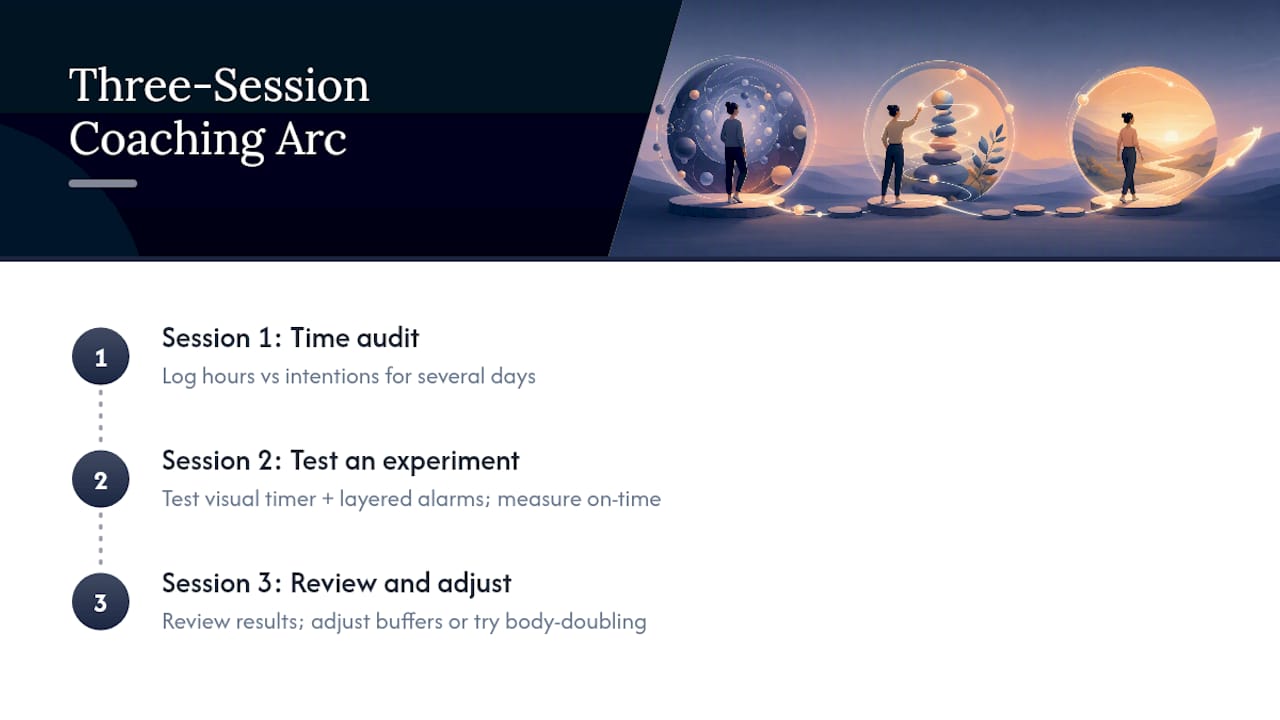
Assignments stay concrete and measurable: “arrive on time to three appointments this week using a 15-minute pre-alarm” or “complete four 25-minute focus blocks without checking your phone.” Success isn’t vague improvement. It’s a number you can count at the end of the week.
This is the same experiment-based approach behind ADHD business coaching for creatives and impact-driven entrepreneurs: fewer abstract goals, more testable weekly hypotheses about what actually helps your specific brain manage time. If you’re self-employed and using Access to Work funding, this structure also happens to map well onto how that coaching gets scoped and reported.
Time Blindness vs. Other ADHD Time Struggles
Not every ADHD time problem is time blindness, and lumping them together makes it harder to pick the right fix.
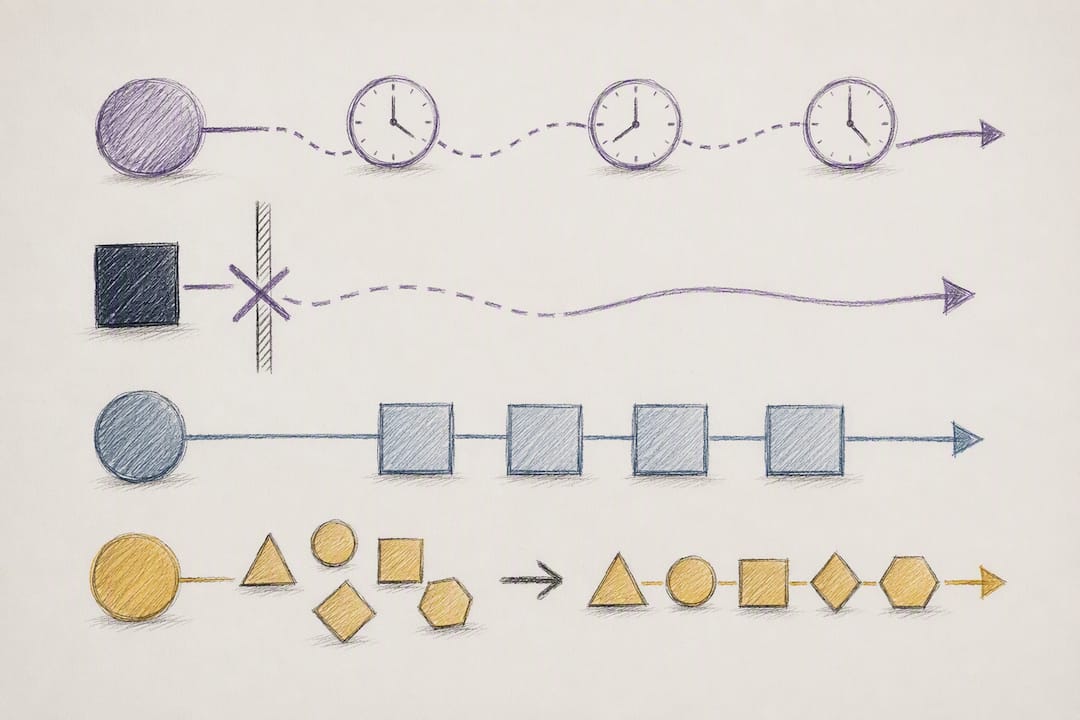
Time blindness specifically means an impaired internal sense of duration: you genuinely don’t feel time passing accurately, whether that’s underestimating how long a task takes or losing awareness of the clock entirely during hyperfocus.
Procrastination is a distinct, though related, struggle. It’s often driven less by not knowing how much time you have and more by task aversion, a task feels boring, hard, or emotionally loaded, so your brain avoids starting it regardless of the deadline. You can have accurate time perception and still procrastinate hard.
Time management difficulty is broader still: it covers planning, prioritizing, and sequencing tasks, skills that depend on time perception but also involve organization and decision making.
Sequencing problems, meanwhile, show up as trouble ordering steps within a task correctly, which can look like time blindness (“this is taking forever”) but is actually about workflow logic, not duration sensing.
The overlap matters because your fix should match your actual bottleneck. A visual timer helps time blindness directly. It does very little for procrastination rooted in task aversion, which usually needs a different tool: breaking the task into a smaller, less threatening first step. Misdiagnosing which problem you’re actually facing is one of the quietest reasons well-intentioned strategies fail. If timers alone aren’t moving the needle, it’s worth asking whether procrastination, not time perception, is the real driver.
How Time Blindness Shows Up Differently by Age
Time blindness doesn’t look the same at eight, eighteen, and forty, because the demands placed on time awareness change dramatically across those ages.
In children, time blindness often reads as “not listening” or defiance: a kid genuinely doesn’t grasp that “five more minutes” means something concrete, and transitions (turning off a game, leaving for school) become flashpoints because the abstract concept of elapsing time hasn’t fully developed yet, ADHD or not. The difference for ADHD kids is the gap persists and intensifies rather than resolving with typical development.
Adolescents face a harder version: school introduces long-term projects, multiple competing deadlines, and less external structure than elementary school provided. This is often when time blindness becomes genuinely costly for the first time, showing up as all-nighters, forgotten assignments, and a growing sense of falling behind peers who seem to “just handle it.”
Adults carry the highest stakes: rent, employment, relationships, and parenting all run on time commitments with real financial and social consequences for missing them. Adults have also usually built more compensatory habits, alarms, calendars, favors called in from patient partners, which can mask the underlying issue for years until a job change or life transition strips those supports away and the time blindness resurfaces in full force.
Across all three stages, the mechanism is likely similar: a brain that processes duration less automatically than a neurotypical one. What changes is the cost of that difference and the tools available to compensate for it.
Why Anxiety and Depression Make Time Blindness Worse
Time blindness rarely shows up alone, and comorbid conditions can amplify it in ways that are easy to misread as “getting worse at ADHD” when the real driver is something layered on top.
Anxiety and time blindness feed each other in a particularly cruel loop. Anxiety about being late or missing a deadline can trigger avoidance, which eats the very time you needed to prepare, which then confirms the anxiety and deepens the avoidance next time. Some people develop a kind of anticipatory freeze before time-sensitive events specifically because the stakes of getting it wrong feel so high after years of missed marks.
Depression affects time perception differently, often by slowing subjective experience and sapping the motivation needed to act on time awareness even when it’s technically present. You might know intellectually that a deadline is close and still feel unable to mobilize toward it, which looks like time blindness from the outside but has a different emotional engine underneath.
This matters practically because a strategy that works for “pure” ADHD time blindness, a visual timer, a buffer, might not touch the version that’s tangled up with anxiety-driven avoidance or depressive inertia. If timers and alarms aren’t helping the way you’d expect, it’s worth asking whether an unaddressed mood or anxiety condition is part of the picture, and raising that directly with whoever is supporting your care. Treating the comorbid condition alongside the ADHD often does more for time management than any scheduling tool ever could.
The Research Base Behind ADHD and Time Perception
The connection between ADHD and time blindness isn’t a wellness trend; it’s an active area of clinical research with a growing evidence base.
A 2021 review proposed that time perception deficits function as a focal symptom of ADHD rather than a downstream consequence of inattention, arguing that estimation, reproduction, and time management problems show up consistently enough across studies to deserve more direct clinical attention. A separate explorative review of time perception in adult ADHD pulled together neuropsychological and neuroimaging findings, pointing to frontoparietal and cerebellar system involvement as a likely biological substrate for these difficulties.
Related clinical literature has also examined how pairing behavioral strategies with medication tends to produce better functional outcomes than medication alone, reinforcing why coaching, therapy, and environmental changes matter even when medication is part of the picture. None of this research claims to have solved time blindness completely. Adult-specific studies remain fewer than researchers would like, and questions about which interventions work best for which subtype of time blindness are still open. But the core claim, that ADHD involves a measurably different relationship with time, is now well supported rather than speculative.
Accommodations That Actually Help at School and Work
Formal accommodations turn “try harder” into “change the environment,” which is where lasting improvement actually tends to come from.
In educational settings, useful adjustments include extended time on assignments and exams, breaking large projects into smaller graded checkpoints instead of one distant due date, and permission to use visual timers during in-class work. Structured check-ins with a teacher or advisor at set intervals help make the time horizon of a long project feel concrete rather than abstract.
At work, the CHADD framework of Adapt, Adjust, Ask, and Accommodate offers a practical structure: adapting personal systems (timers, calendar blocks), adjusting expectations around realistic task duration, asking directly for what you need, and formally requesting accommodations when informal fixes aren’t enough. Reasonable workplace accommodations can include visible team calendars with buffer built in, written follow-ups after verbal deadlines, and permission to use body doubling or focus tools during work hours.
For UK-based self-employed professionals and freelancers, Access to Work coaching can fund exactly this kind of structured support, covering coaching sessions aimed at building sustainable time systems rather than leaving you to white-knuckle it through another missed deadline. The accommodation isn’t a favor. It’s a recognition that a brain wired differently for time needs a differently wired environment to succeed in.
A Note From Estelle
Here’s the thing nobody tells you early enough: the shame around time blindness usually costs more than the missed deadlines themselves. The late fees, the reschedule fees, the apology texts, that’s the ADHD tax, and it’s real money and real energy leaking out of your life for something that was never a character flaw to begin with.
So here’s my ask. Not a five-step system, just one thing. Set a visible timer right now for 20 or 30 minutes and treat it as non-negotiable, like a lab experiment with exactly one data point: did it change how the next half hour felt? That’s it. That’s the whole assignment.
If you want someone in your corner testing the next experiment with you, that’s what coaching is for.
— Estelle
Ready for Accountability That Actually Fits Your Brain?
Books and blog posts can explain time blindness. What most adults with ADHD actually need is someone tracking the experiments with them week to week, which is the entire premise behind working with an ADHD accountability partner instead of going it alone with a stack of productivity apps. Estelle-rose’s coaching starts with a time audit like the one described above, then builds a short, testable plan around your actual work: creative deadlines, business ownership, or executive responsibilities that don’t leave room for guesswork.
For self-employed professionals and impact-driven founders, ADHD business coaching focuses specifically on the executive function and time management skills that generic productivity advice tends to skip. If you’d rather start with a self-guided resource, The Empowering ADHD Workbook for Women walks through many of the same time-tracking exercises covered here. Ready to talk it through? Book an exploratory call through Estelle-rose’s coaching page and bring one specific example of a missed deadline. That’s plenty to start building your plan.
This article is general information, not a substitute for advice from a qualified doctor. Consult a qualified healthcare professional about your own circumstances before acting on anything here.
Sources
- Time Perception is a Focal Symptom of Attention-Deficit … - PMC
- What Is Time Blindness? — Cleveland Clinic
- Time Unbound: Managing Time Blindness at Work - CHADD
FAQ
What does ADHD time blindness feel like?
It often feels like time either disappears entirely, hours vanish during hyperfocus, or stretches unbearably during a boring wait, with very little accurate sense of duration in between. Many adults describe being genuinely shocked when a clock reveals how much time has actually passed.
Is time blindness a real, recognized condition?
Time blindness isn’t a standalone diagnosis, but the perception difficulties behind it are well documented in ADHD research, including reviews describing time perception as a focal ADHD symptom. It’s a real, studied phenomenon rather than an excuse or a personality trait.
Is time blindness a symptom of autism, ADHD, or both?
Time blindness is most consistently studied and described in ADHD, where estimation and time management deficits show up across multiple reviews. Some autistic individuals also report time perception differences, but the research base and mechanisms described here focus specifically on ADHD.
Does ADHD make time feel like it’s moving faster or slower?
Both, depending on the activity. Engaging tasks can trigger hyperfocus where time seems to disappear, while boring or effortful tasks can make minutes feel like they’re crawling, a pattern researchers link to the automatic-versus-directed attention differences described by the Cleveland Clinic.
How is ADHD coaching different from therapy for time blindness?
Coaching focuses on building and testing practical systems, timers, buffers, accountability check-ins, as measurable weekly experiments, while therapy tends to address underlying thought patterns and emotional regulation. Many adults find the two work best together, with coaching providing the accountability structure that turns clinical insight into daily habit change.

