
Time management for ADHD: practical strategies that work
Time management for ADHD: practical strategies that work
TL;DR:
- Traditional time management tools often overwhelm adults with ADHD due to decision fatigue and rigidity.
- Strategies that align with natural energy patterns and use visual timers improve focus and task initiation.
- Self-compassion, experimentation, and personalized support are key for sustainable ADHD time management.
Standard time management advice tells you to use a planner, set a timer, and stick to your schedule. For adults with ADHD, that advice often fails. Not because you lack discipline, but because common strategies aren’t universally effective for brains wired differently. ADHD affects executive function and time awareness in ways that make generic tools feel like wearing shoes on the wrong feet. This guide covers what actually works, grounded in evidence, and designed specifically for how your brain operates.
Table of Contents
- Why traditional time management methods fall short for ADHD
- Core concepts: Time blindness, executive function, and ADHD
- Evidence-based time management strategies for ADHD adults
- Choosing and adapting tools for your ADHD brain
- A new perspective: Why self-compassion and experimentation matter most
- Next steps: Support and solutions for ADHD time management
- Frequently asked questions
Key Takeaways
| Point | Details |
|---|---|
| Traditional tools may not fit | Standard time management methods often fail for ADHD because they create more decisions and pressure. |
| Tailor your approach | Personalized strategies based on your energy and executive needs work better than generic routines. |
| Experiment and adapt | Trying different techniques and adjusting over time helps find sustainable tools for ADHD time success. |
| Technology can help | Apps, visual timers, and alarms ease planning and build routine for ADHD brains. |
Why traditional time management methods fall short for ADHD
Time blocking, the Pomodoro technique, color-coded planners. These tools work well for neurotypical brains. For ADHD brains, they often create more problems than they solve.
Here is why. Each of these systems requires a series of micro-decisions. When does this block start? How long is this task? What comes next? For an ADHD brain already taxed by executive function demands, that decision load creates friction before the work even begins. Rigid methods can backfire for ADHD by adding cognitive weight instead of reducing it.
Three core ADHD symptoms make traditional tools especially challenging:
- Distractibility: External or internal interruptions break focus quickly, making timed blocks feel impossible to maintain.
- Time blindness: The inability to sense time passing means a 25-minute Pomodoro block might feel like 5 minutes or 2 hours.
- Difficulty with initiation: Even with a schedule in front of you, starting the first task can feel like pushing through a wall.
Consider this comparison between traditional and ADHD-adapted approaches:
| Traditional method | Why it struggles with ADHD | ADHD-adapted alternative |
|---|---|---|
| Fixed time blocks | Too rigid, ignores energy shifts | Flexible energy-based blocks |
| Pomodoro timer | Interrupts flow states | Variable intervals with buffer time |
| To-do lists | Can feel overwhelming | Single-task focus cards |
| Generic planners | No visual time cues | Visual timers and color systems |
“The best system is the one that works with your brain, not against it. Fewer decisions, more momentum.”
Research on executive function and ADHD confirms that approaches reducing decision load and aligning with energy patterns produce more consistent results. The takeaway: you are not failing the system. The system is failing you.
Core concepts: Time blindness, executive function, and ADHD
Before you can choose the right tools, you need to understand what you are actually working with. Two concepts are central here: time blindness and executive dysfunction.
Time blindness is not a metaphor. It is a documented feature of ADHD where the brain struggles to perceive how much time is actually passing. You sit down to check email for five minutes and look up to find an hour is gone. Deadlines feel abstract until they are immediate. Planning future tasks requires sensing future time, and when that sense is unreliable, planning breaks down.

Executive function covers a cluster of mental skills: planning, prioritizing, initiating tasks, switching between them, and following through to completion. Cognitive training and executive skills both directly shape how well adults with ADHD manage time on a daily basis.
Here is how these two issues show up practically:
| Challenge | What it looks like | Impact on time management |
|---|---|---|
| Time blindness | Losing track of minutes or hours | Missing deadlines, underestimating task length |
| Poor initiation | Delaying tasks despite intention | Procrastination, last-minute rushing |
| Difficulty prioritizing | Treating all tasks as equal urgency | Working on low-value tasks first |
| Task switching difficulty | Getting stuck or avoiding transitions | Incomplete tasks, scattered output |
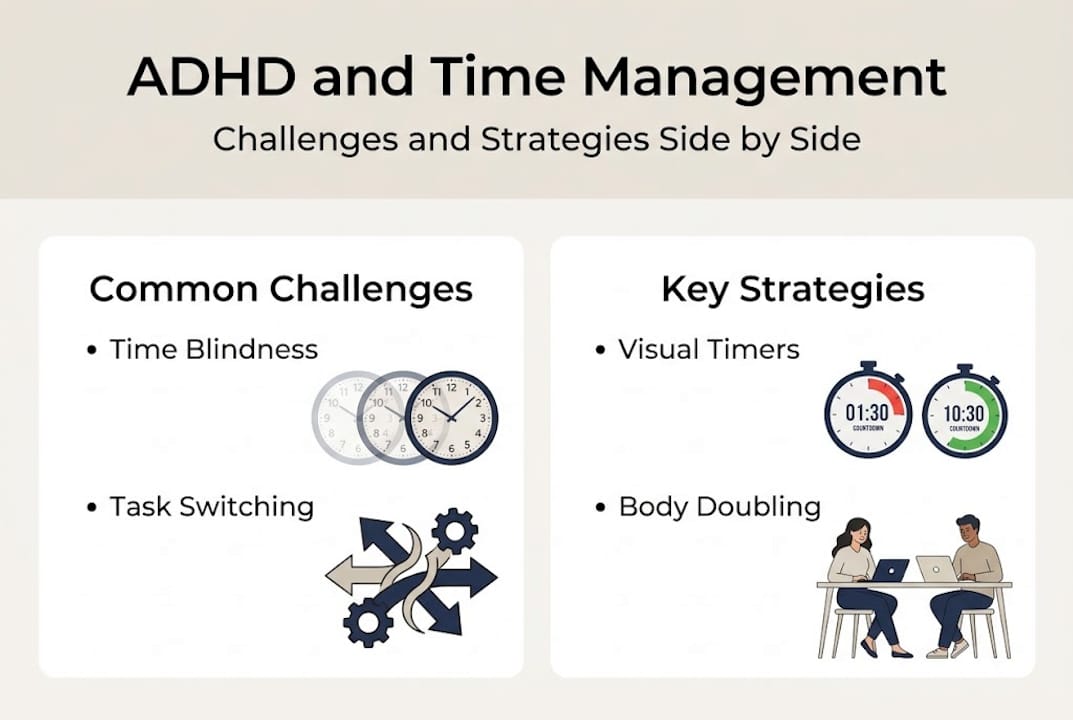
Knowing your specific pattern matters. Some adults with ADHD struggle most with initiation. Others get lost in hyperfocus and miss transitions entirely. The right tools depend on which of these challenges shows up most often for you. Practical executive function tips can help you identify your specific profile and target your approach accordingly.
Pro Tip: Set three alarms throughout the day labeled with what you should be doing at that moment, not just a generic alert. Pairing the alarm with a specific action reduces the decision required when it goes off.
Evidence-based time management strategies for ADHD adults
With the root challenges identified, here are practical methods that work with ADHD neurology rather than against it.
-
Energy-based time blocks. Instead of scheduling tasks by clock time alone, map your day around your natural energy peaks. High-focus work goes in your peak window. Admin and low-demand tasks fill the low-energy periods. This reduces the effort required to start and sustain work.
-
Visual timers. A clock face or countdown display gives your brain a concrete representation of time moving. The Time Timer is a popular option. Seeing time shrink is a stronger cue than watching numbers change.
-
Smart alarms and app reminders. Apps like Focusmate, Structured, or even Google Calendar with layered reminders can reduce the burden of remembering what comes next. Supporting brain health also matters here, since nutrition and sleep directly affect how well these tools stick.
-
Body doubling. Working alongside another person, physically or virtually, provides the external structure that ADHD brains often need to stay on task. This works because the presence of another person activates social accountability without requiring direct supervision.
-
Just one thing focus. At the start of each work period, identify one task that counts as a win if completed. Not a list. One item. This reduces overwhelm and gives your brain a clear target.
-
Organization routines for ADHD work best when they are consistent, low-decision, and tied to existing habits. Attach a new routine to something you already do reliably.
Consistent cognitive practice shows dose-response gains, meaning the more regularly you apply a strategy, the stronger its effect. Start small and build gradually.
Pro Tip: Pick one strategy from this list and use it every day for two weeks. Track how you feel after each session, not just whether you completed tasks. Emotional data helps you identify what is actually sustainable.
Choosing and adapting tools for your ADHD brain
There is no single tool that works for every adult with ADHD. Some people thrive with heavy structure. Others feel trapped by it and need loose, flexible frameworks. Both responses are valid.
When selecting a time management tool, consider these factors:
- Your energy pattern: Are you a morning person or do you hit your stride in the afternoon? Build your schedule around reality, not ideal.
- Your biggest friction point: Is it starting tasks, finishing them, or transitioning between them? Choose tools that target your specific bottleneck.
- Your history: What have you tried before? What worked briefly? What caused more stress? Patterns from the past are useful data.
- Your environment: Do you work alone, in an office, or in a shared space? Body doubling requires a partner. Visual timers work better with visual workspace setups.
Statistic: CBT, routines, and technology all show varying effectiveness for ADHD time management. Fit and frequency of use matter more than which specific tool you choose.
If a tool is not working after a genuine two-week trial, switch or combine methods. Using a visual timer alongside body doubling, for example, gives you both external time awareness and social accountability at once.
A customizable ADHD workbook can help you track which strategies are gaining traction over time. Structured reflection takes the guesswork out of what to keep and what to drop. Working with coaching for ADHD time management adds another layer of personalized guidance, especially when self-directed experimentation feels overwhelming.
The goal is not to find the perfect system. It is to find a system that is good enough and that you will actually use.
A new perspective: Why self-compassion and experimentation matter most
Here is something most productivity advice will not tell you: chasing the perfect time management system creates its own form of burnout. When a method fails, the instinct is to blame yourself. You did not try hard enough. You were not consistent enough. That cycle drains the energy you need to actually get things done.
Real progress looks different. It is noticing that one strategy helped a little, then building on it. It is forgiving a bad week and starting fresh on Monday without a spiral of shame. It is treating your time management like an experiment, not a test of your worth.
The adults with ADHD who make the most progress are not the ones who found the best system. They are the ones who kept adjusting without giving up. Start with one small change. Observe what happens. Iterate. That is the actual method.
Next steps: Support and solutions for ADHD time management
If you are ready to build sustainable time management routines, consider taking the next step with specialized support. Generic productivity tools are designed for neurotypical brains. What works for you requires a different foundation.
Working with an executive function coaching specialist can help you identify your specific challenges and build a system around your actual life, not an idealized version of it. The empowering ADHD workbook offers structured prompts to help you track patterns, set realistic goals, and celebrate small wins. For practical day-to-day structure, ADHD-friendly organization help gives you tools to reduce the friction that slows you down. The right support makes the strategies in this article stick.
Frequently asked questions
What is time blindness in ADHD?
Time blindness means difficulty accurately sensing how much time is passing, making it tough to judge deadlines or plan tasks. It is a neurological feature of ADHD, not a personal failing.
Are there time management apps designed for ADHD?
Yes, many apps use visual cues and reminders to support ADHD time management. Options like Structured, Focusmate, and Tiimo are specifically built with ADHD users in mind.
Can routines actually help adults with ADHD manage time?
Yes. Flexible routines matched to individual energy levels reduce overwhelm and improve follow-through far more than rigid schedules do.
Is cognitive training effective for ADHD time management?
Real-world cognitive training can support time management, especially when practiced consistently and adapted to the specific executive function challenges of ADHD.
Recommended
- Adult ADHD Executive Function
- ADHD Coaching for Impact-Focused Entrepreneurs & Creatives
- Empowering ADHD Organization and Cleaning
- Brain Boosting Food for Women with ADHD
- Build a daily workflow for lasting energy and mental clarity – CP-1
- Как да организирате ефективен работен ден за максимален фокус – Neurofuel™️

