Top ADHD coaching tools to boost productivity: 5 picks
Top ADHD coaching tools to boost productivity: 5 picks
TL;DR:
- Choosing goal-specific, research-backed, and user-friendly tools is essential for effective ADHD coaching.
- Personalizing and regularly adjusting tools and routines lead to lasting improvements in executive functioning.
- Combining digital, physical, and behavioral strategies with professional support maximizes success.
A new ADHD diagnosis brings relief for many adults, but it quickly raises a practical question: what do you do next? The range of coaching tools available is wide, and not all of them deliver real results. Some are backed by solid research. Others are trendy but thin on evidence. This article walks you through how to choose the right ADHD coaching tools, which ones are worth your time, and how to build a system that actually fits your life. Whether you struggle most with focus, organization, or follow-through, the right combination of tools can make a measurable difference.
Table of Contents
- How to choose the right ADHD coaching tools
- Top digital ADHD coaching tools
- Essential physical tools for ADHD coaching
- Behavioral approaches and self-coaching frameworks
- Matching tools with your ADHD needs: Personalized recommendations
- What most ADHD coaching lists miss: The real magic is in customizing
- Get expert support to find your ideal ADHD toolkit
- Frequently asked questions
Key Takeaways
| Point | Details |
|---|---|
| Start with your priorities | Select ADHD coaching tools that directly address your biggest productivity or organization struggles first. |
| Mix digital and physical | Combining apps with tangible planners or timers usually delivers the best results for adults with ADHD. |
| Behavioral strategies matter | Techniques like CBT and routine self-review complement checklists and reminders for lasting impact. |
| Personalization is key | Experiment and adapt tools as your needs shift instead of expecting a universal solution. |
| Support can accelerate change | Professional coaching helps integrate these tools into habits for sustained focus and confidence. |
How to choose the right ADHD coaching tools
Choosing a coaching tool without a clear goal is one of the most common mistakes adults with ADHD make. Before you download an app or buy a planner, identify your primary challenge. Is it starting tasks? Remembering deadlines? Managing time? Your answer shapes everything.
Here are the key criteria to evaluate any ADHD coaching tool:
- Goal alignment: Does the tool directly address your biggest daily struggle?
- User-friendliness: If setup takes more than 10 minutes, many adults with ADHD will abandon it.
- Scientific support: Look for tools grounded in behavioral research or executive function training.
- Customization: Rigid systems rarely work long-term. Flexibility matters.
- Cost and accessibility: Free trials help you test before committing.
You also need to decide between digital tools, physical tools, or one-on-one coaching. Each serves a different purpose. Digital tools offer reminders and automation. Physical tools provide tactile engagement. Professional coaching offers accountability and personalized feedback.
ADHD coaching develops executive functioning and self-determination skills over months, supporting time management, stress reduction, and concentration. This means results take time. Patience is part of the process.
For those focused on improving executive function, the tool selection process itself becomes a useful exercise in planning and decision-making.
Pro Tip: Start with one tool that targets your biggest day-to-day struggle. Add more only after the first becomes a habit.
Top digital ADHD coaching tools
Digital tools are popular for good reason. They live on devices you already use, they send reminders, and many are designed with ADHD users in mind. Here are four tools worth considering.
- Focusmate: A virtual co-working platform. You book a session, show up on video with a partner, and work in parallel. Accountability is built in.
- Todoist: A task manager with priority labels, recurring tasks, and project views. Clean interface, low friction.
- Trello: A visual board system using cards and columns. Ideal for project-based thinkers who need to see the big picture.
- Lumosity: A brain training platform with attention and memory exercises. Attention improvement research shows digital tools like Lumosity improve attention in adults with ADHD, with a measurable dose-response effect.
| Tool | User-friendliness | Key feature | Evidence base | Free tier |
|---|---|---|---|---|
| Focusmate | High | Accountability sessions | Behavioral | Yes |
| Todoist | High | Task prioritization | Productivity research | Yes |
| Trello | Medium | Visual boards | Organizational theory | Yes |
| Lumosity | Medium | Cognitive training | Clinical research | Limited |
Digital tools work best when you use them consistently and keep them simple. Overloading one app with too many features creates friction. For executive function help, a focused tool beats a feature-heavy one every time.
For those also working on staying organized with ADHD, pairing Todoist with a visual timer can significantly reduce task avoidance.

Pro Tip: Combine a task manager like Todoist with a focus timer like the Pomodoro method for stronger results than either tool alone.
Essential physical tools for ADHD coaching
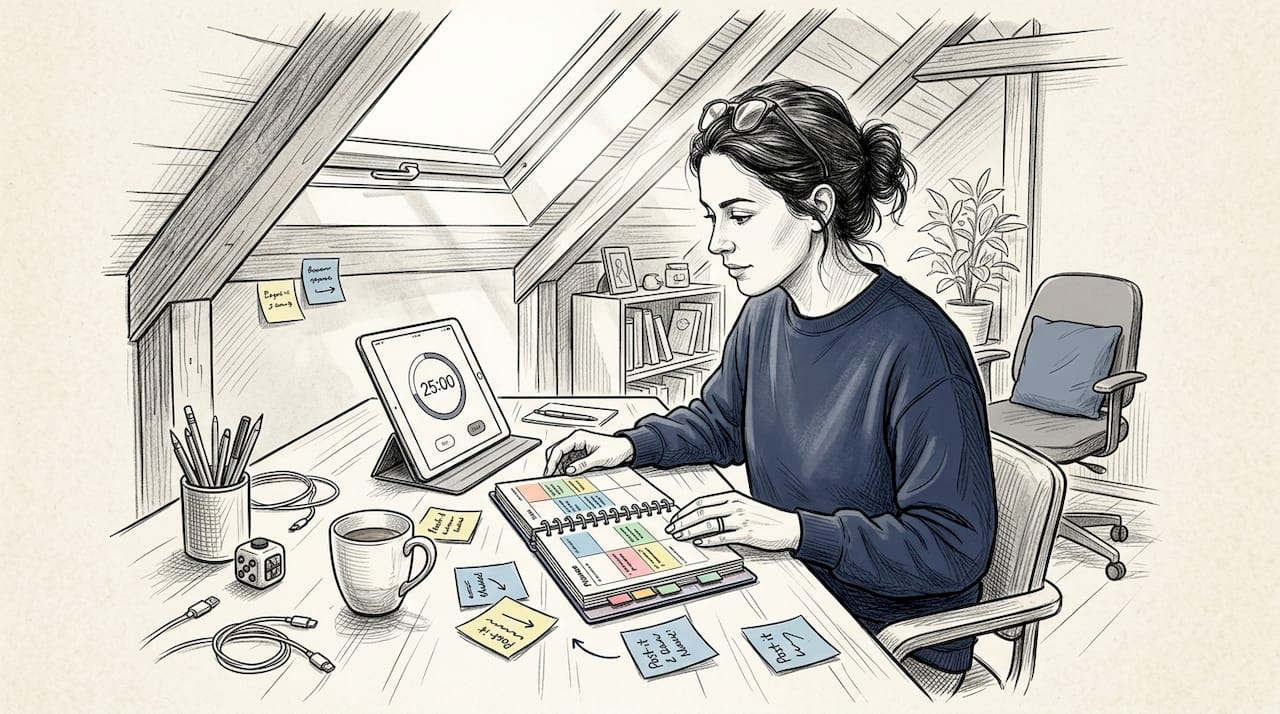
Not every solution lives on a screen. Many adults with ADHD find that physical, hands-on tools create structure in ways that digital tools cannot. There is something about writing things down or seeing a timer count down that engages the ADHD brain differently.
Top physical tools for ADHD coaching include:
- Daily planners: Time-blocked planners with hourly slots reduce decision fatigue and make the day visible.
- Visual timers: Devices like the Time Timer show time passing as a shrinking color arc. Useful for task transitions and avoiding hyperfocus traps.
- Whiteboards: A large whiteboard in a visible spot works as an external working memory. Write today’s top three tasks. Erase when done.
- Fidget tools: Stress balls, rings, or textured objects help regulate sensory input during focus-heavy tasks.
- Bullet journals: A flexible, structured notebook system that combines task lists, habit tracking, and reflection.
Psychoeducational group interventions improve quality of life and satisfaction with information in adults with ADHD. This finding supports the value of structured, tangible approaches to self-management.
For a structured starting point, the ADHD workbook offers guided exercises that complement physical planning tools.
Pro Tip: Keep physical tools visible and in a consistent location. Out of sight means out of mind for most adults with ADHD.
Behavioral approaches and self-coaching frameworks
Tools are only part of the picture. How you use them, and the behavioral frameworks behind them, determines whether they stick.
Three evidence-based approaches stand out:
- Cognitive behavioral therapy (CBT): Targets negative thought patterns, procrastination, and emotional dysregulation. Works well alongside medication or as a standalone intervention.
- Psychoeducation: Learning about how ADHD affects your brain reduces self-blame and improves strategy adoption.
- Habit stacking: Attaching a new behavior to an existing one. For example, reviewing your planner right after your morning coffee.
For self-coaching, a simple daily structure helps:
- Morning intention: Write down your top three tasks for the day.
- Midday check-in: Review what is done and what needs adjusting.
- Evening review: Note what worked and what did not.
- Weekly reset: Clear your list, reflect on patterns, and plan ahead.
“CBT shows both short-term and long-term efficacy for ADHD core symptoms, depression, and anxiety in adults, making it one of the most versatile non-pharmacological options available.” CBT research
On the pharmacological side, stimulants and atomoxetine are most effective for reducing core ADHD symptoms short-term, but non-pharmacological approaches like CBT show strong results on clinician ratings and quality of life measures.
| Method | Short-term effect | Long-term effect | Best for |
|---|---|---|---|
| CBT | Strong | Strong | Focus, mood, anxiety |
| Psychoeducation | Moderate | Moderate | Self-awareness, strategy |
| Habit stacking | Moderate | Strong | Routine building |
| Medication | Strong | Limited data | Core symptom reduction |
Matching tools with your ADHD needs: Personalized recommendations
You now have a range of options. The next step is matching them to your specific situation.
Start by identifying your most disruptive symptoms:
- Forgetfulness: Prioritize task managers and daily planners.
- Time blindness: Add a visual timer and calendar blocking.
- Procrastination: Use accountability tools like Focusmate and CBT techniques.
- Disorganization: Combine a whiteboard with a digital organizer.
- Low motivation: Habit stacking and self-coaching frameworks help maintain momentum.
Mixing digital and physical tools is often more effective than relying on one type. A digital task manager handles reminders. A physical planner handles daily structure. Together, they cover more ground.
Track your progress simply. A weekly note in your journal asking “what worked this week?” is enough to spot patterns. Adjust based on what you observe, not what looks good in theory.
Digital coaching and outcomes research notes that empirical benchmarks for coaching specifically are still developing, but CBT and psychoeducation show consistent quality of life and symptom gains, and digital tools like Lumosity improve attention measurably.
For support for women with ADHD, personalized tool selection is especially important given the unique ways ADHD presents across different life stages and contexts.
| Symptom | Recommended tool | Format |
|---|---|---|
| Forgetfulness | Todoist, daily planner | Digital and physical |
| Time blindness | Visual timer, calendar | Physical and digital |
| Procrastination | Focusmate, CBT | Digital and behavioral |
| Disorganization | Whiteboard, Trello | Physical and digital |
What most ADHD coaching lists miss: The real magic is in customizing
Most articles on ADHD coaching tools present a list and stop there. That is useful for getting started, but it misses the most important point. No static list will deliver results without active personalization.
The tools that work for you in January may not work in July. Life changes. Workloads shift. Stress levels fluctuate. A good ADHD management system is not a fixed structure. It is a living one.
The biggest productivity gains I see come not from finding the right tool on the first try, but from the process of adjusting, discarding, and revisiting tools as needs evolve. That process itself builds developing executive function skills, including planning, self-monitoring, and cognitive flexibility.
The uncomfortable truth is that there is no perfect toolkit. There is only the one you keep refining. Owning that process, rather than searching for a final answer, is where real progress lives. Start somewhere. Adjust often. That is the actual method.
Get expert support to find your ideal ADHD toolkit
Knowing which tools exist is one thing. Building them into daily life is another. ADHD coaching programs turn information into sustainable habits with structured support and accountability built in.
If you want to move faster and with more confidence, executive function coaching offers a direct path to identifying which tools fit your life and how to use them consistently. For practical, day-to-day support with structure and routines, organizing with ADHD support provides targeted strategies you can apply immediately. Expert guidance removes the guesswork and helps you build a system that actually holds.
Frequently asked questions
What is the most effective ADHD coaching tool for adults?
No single tool is best for everyone, but combining digital organizers, physical planners, and behavioral techniques like CBT for ADHD consistently produces the strongest outcomes across symptom areas.
Are digital apps or paper planners better for ADHD?
Both formats are effective in different ways. Many adults get the best results by pairing digital reminders with a physical planner for daily structure and motivation.
Does ADHD coaching work without medication?
Yes. CBT and behavioral coaching have demonstrated measurable improvements in focus and executive function for adults with ADHD, independent of medication use.
How do I fit new ADHD tools into my daily routine?
Introduce one tool at a time and use it consistently before adding another. Building routines with ADHD coaching takes months, so small, steady steps outperform large overhauls.
Are group interventions or one-on-one coaching more effective?
Psychoeducational groups improve quality of life and information satisfaction, but one-on-one coaching is better for tailoring specific strategies to individual symptoms and goals.

