
Why focus is difficult with ADHD: A guide for adults
Why focus is difficult with ADHD: A guide for adults
TL;DR:
- ADHD-related focus problems arise from neurobiological differences in dopamine regulation, executive functioning, and arousal levels. Sleep disruptions, mental health issues like anxiety and depression, and environmental factors further impair concentration. External supports, tailored strategies, and holistic approaches are essential for improving focus beyond mere effort or willpower.
If you were recently diagnosed with ADHD and still believe that trying harder should fix your focus, you are not alone — and you are also working with incomplete information. Understanding why focus is difficult with ADHD goes far deeper than willpower or discipline. The real reasons are neurobiological, and they involve brain chemistry, sleep regulation, and mental health in ways that no amount of effort can override. This guide breaks down exactly what is happening in your brain, why common advice often fails, and what actually works for adults navigating ADHD focus challenges every day.
Table of Contents
- The neurobiological roots of focus problems in ADHD
- How sleep and circadian rhythms worsen focus difficulties
- The impact of anxiety and mood disorders on ADHD focus problems
- Why effort alone can’t fix ADHD focus challenges
- Practical strategies to improve focus and productivity with ADHD
- Why focusing better with ADHD means addressing the whole person
- Finding support to boost your ADHD focus and productivity
- Frequently asked questions
Key Takeaways
| Point | Details |
|---|---|
| Focus difficulty is neurological | ADHD-related focus problems arise from brain chemistry and executive function impairments, not laziness. |
| Sleep impacts attention | Delayed circadian rhythms common in ADHD reduce brain readiness for sustained focus. |
| Mental health factors matter | Anxiety and mood disorders frequently co-occur with ADHD and worsen focus challenges. |
| Effort alone isn’t enough | Trying harder fails due to brain regulation differences; strategy and support are essential. |
| Combination treatments work best | Medications combined with behavioral strategies and coaching improve focus and productivity. |
The neurobiological roots of focus problems in ADHD
The word “attention” makes it sound like focus is a choice. For adults with ADHD, it is not. ADHD affects the brain’s dopamine system, which is responsible for signaling what is worth paying attention to and what the brain should find motivating. When dopamine activity is altered, the brain struggles to consistently sustain attention, especially on tasks that are not immediately stimulating or rewarding.
Executive functions are also directly impaired. These are the mental processes you use to plan, organize, prioritize, and shift attention deliberately. In an ADHD brain, these functions run inconsistently. That inconsistency is not a character flaw. It is a feature of how the neurobiological basis of ADHD affects real-time performance.
One of the most misunderstood aspects of ADHD attention issues is hyperfocus. Many adults with ADHD can lock onto a video game, a creative project, or a research topic for hours without stopping. This seems to contradict the idea of a focus problem. But hyperfocus is not controlled focus. It happens when a task triggers enough dopamine response to sustain attention automatically. The problem is that you cannot reliably choose when it activates.
“The core issue in ADHD is not the absence of attention, but the inability to regulate attention on demand. The brain attaches, detaches, and redirects based on neurochemical signals rather than intention.”
Key neurobiological factors that drive difficulty concentrating in ADHD:
- Dopamine dysregulation: The brain underresponds to low-stimulation tasks, making it hard to stay engaged without external novelty or pressure.
- Impaired working memory: Holding information in mind while completing a task is harder, leading to frequent derailments mid-task.
- Weak inhibitory control: Filtering out irrelevant thoughts or distractions requires effort that depletes quickly.
- Variable arousal levels: The ADHD brain often swings between underarousal (boredom, mental fog) and overarousal (anxiety, racing thoughts), both of which disrupt attention.
With this basic brain-level understanding, let’s explore how other factors make focus problems worse.
How sleep and circadian rhythms worsen focus difficulties
Beyond brain chemistry, disrupted sleep cycles present a major hurdle for focus in ADHD. Most adults with ADHD do not just sleep badly. Their biological clocks run late. This is called delayed circadian phase, and it means the natural sleep window shifts toward later at night and later in the morning. When life demands an early start, the result is chronic sleep deprivation.

Research shows that 73 to 78% of people with ADHD have delayed sleep-wake cycles, which directly reduce baseline brain arousal. Lower baseline arousal means the brain starts the day already underpowered for attention tasks. Concentration, working memory, and impulse control all take an additional hit before any external distraction enters the picture.
| Sleep factor | Impact on ADHD focus |
|---|---|
| Delayed sleep phase | Late sleep onset, early wake times cause chronic sleep debt |
| Reduced REM sleep | Impairs memory consolidation and emotional regulation |
| Frequent night waking | Fragments restorative sleep, lowering daytime alertness |
| Irregular sleep schedule | Disrupts circadian rhythm, worsening dopamine regulation |
Treatments that advance the circadian phase can make a real difference. These include low-dose melatonin taken two to three hours before the desired sleep time, timed bright light exposure in the morning, and consistent wake times even on weekends. These are not just sleep hygiene tips. They are health interventions for ADHD focus that work by targeting the underlying circadian disruption rather than just the surface-level tiredness.
Pro Tip: Set a consistent wake time before adjusting your bedtime. Anchoring the morning signal stabilizes your circadian rhythm faster than trying to fall asleep earlier first.
The impact of anxiety and mood disorders on ADHD focus problems
Mental health conditions add another layer of complexity beyond biology and sleep to explain focus struggles. ADHD rarely travels alone. Over half of adults with ADHD have co-occurring anxiety disorders, and nearly half have mood disorders. Both conditions interfere directly with the ability to concentrate and follow through on tasks.
Anxiety floods the brain with competing mental content. While you are trying to read a report, anxiety is simultaneously running threat assessments, replaying yesterday’s conversation, and generating worst-case scenarios. That is not distraction in the casual sense. It is a competing cognitive load that the ADHD brain, with its already limited filtering capacity, cannot easily manage.
“When anxiety and ADHD coexist, treating only one condition often leaves the other one driving the attention problems. Both need to be on the treatment radar.”
Mood disorders like depression reduce the dopamine and serotonin signals that support motivation and sustained effort. This creates a compounding effect. The ADHD brain already struggles with low dopamine drive for non-stimulating tasks. Add depression, and the baseline drops further. The result is not laziness. It is a neurochemical shortfall that requires combined treatment for focus issues.
What this means practically:
- Track your symptoms separately. Note when focus loss seems linked to anxious thought spirals versus flat, low-energy days versus pure distraction. The pattern matters for treatment decisions.
- Work with a clinician familiar with ADHD comorbidities. A clinical assessment that accounts for overlapping symptoms leads to more accurate treatment plans.
- Do not assume medication will fix everything. If anxiety or mood disorders are active, they need direct attention through therapy, lifestyle adjustments, or appropriate medication.
- Consider cognitive behavioral therapy (CBT). CBT directly addresses the negative thought patterns that worsen both anxiety and ADHD-related attention deficits.
Why effort alone can’t fix ADHD focus challenges
Knowing why motivation is not enough sets the stage for practical strategies to improve focus. The belief that “just focusing” is a choice feels true from the outside. From the inside of an ADHD brain, it is not that simple. The difficulty focusing in ADHD stems from differences in the brain’s regulatory systems, not from a lack of intention.
Here is what happens when you try to force focus through willpower alone:
- You recognize you need to start a task.
- The brain’s dopamine response does not generate enough motivational signal to initiate it.
- You sit down, feel the resistance, and interpret it as laziness or failure.
- Self-criticism activates the stress response, which further impairs prefrontal function.
- The original task becomes even harder to start.
This cycle is not a character issue. It is a regulatory loop that effort cannot break from the inside. What breaks it is external structure. The brain needs outside supports to do what a neurotypical brain does automatically.
Shifting from a willpower model to a neurobiological reasons focus is difficult model is not about lowering expectations. It is about replacing ineffective strategies with ones that actually match how the ADHD brain operates.
Pro Tip: When you cannot start a task, reduce the entry point to something almost insultingly small. Open the document. Write one sentence. The brain responds to initiation cues more reliably than to motivational pressure.
Practical strategies to improve focus and productivity with ADHD
With understanding and a mindset shift, here are practical ways to strengthen your focus every day. None of these are quick fixes, but each one addresses a real mechanism behind ADHD and focus problems.
Medical and therapeutic support:
- Medication combined with behavioral strategies produces the best outcomes for day-to-day functioning. Medication alone does not teach skills. Skills alone do not compensate for neurochemical deficits. Both together work better than either separately.
- Psychoeducation about ADHD is itself a treatment. Understanding your brain reduces self-blame and improves treatment engagement.
- CBT and ADHD-specific coaching address the behavioral and organizational gaps that medication does not fill.
Structural and environmental strategies:
- Use time blocking. Assign specific tasks to specific time windows rather than working from an open to-do list. The structure provides external scaffolding for the ADHD brain’s weak internal scheduling.
- Build in transition cues. Use alarms, visual timers, or environmental signals to shift between tasks, since the ADHD brain struggles with voluntary task switching.
- Work with combined pharmacological and behavioral treatment if ADHD and anxiety or mood issues both need addressing.
- Reduce decision fatigue. Lay out your workspace, clothes, and materials the night before. Every unnecessary decision drains executive function reserves faster in ADHD.
| Strategy | Best for | Why it works |
|---|---|---|
| Time blocking | Task initiation and completion | Removes open-ended decisions |
| Body doubling | Sustained attention | Social presence increases accountability |
| Pomodoro technique | Managing overload | Short intervals match ADHD attention windows |
| Environment design | Reducing distraction | Removes triggers before they activate |
Pro Tip: Body doubling — working alongside another person, even on video — is one of the most underused and most effective focus tools for adults with ADHD. It works because the social presence activates just enough arousal to sustain attention without requiring ongoing conversation.
For specific organizational tools and approaches, organizing and cleaning strategies tailored to ADHD can reduce the cognitive load that makes focus even harder when your environment is chaotic.
Why focusing better with ADHD means addressing the whole person
Most focus advice for ADHD is incomplete. It picks one variable, a planning app, a breathing exercise, a new morning routine, and treats it as the solution. The reason so many adults with ADHD burn through strategies without lasting results is that each strategy is addressing only one part of a system that has multiple points of failure.
ADHD focus challenges are not a single problem. They are a stack. Dopamine regulation affects baseline motivation. Sleep quality affects baseline arousal. Anxiety amplifies distraction. Negative self-talk reduces initiation. Environment either supports or sabotages attention. When any one of these layers is ignored, the whole system underperforms regardless of how good the individual strategy is.
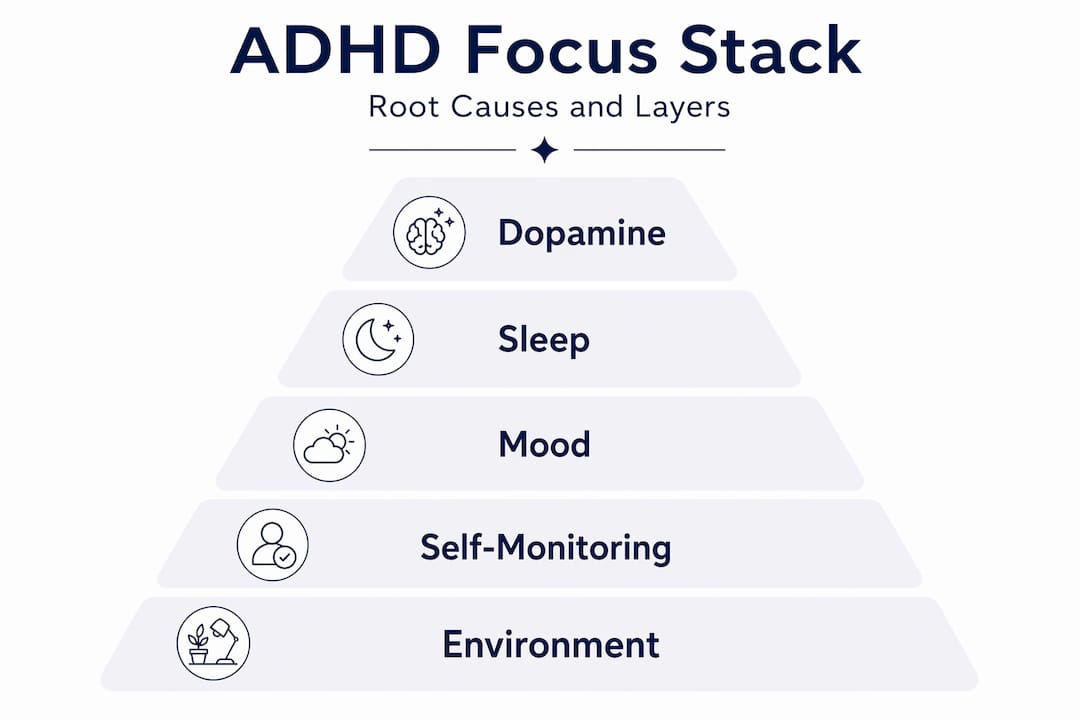
The honest reality is that most focus advice also ignores the cost of self-monitoring. For adults with ADHD, tracking your strategies, assessing what is working, and adjusting your approach requires executive function. The thing you are trying to improve is the thing you need in order to improve it. That is why external accountability — through coaching, a trusted partner, or structured check-ins — is not a luxury. It is a functional workaround for a real constraint.
What I see consistently is that adults who make sustainable progress do so by accepting that their holistic ADHD strategies need regular updating. ADHD does not stay static. Life stages, job demands, relationships, and health all shift the balance. The goal is not to find the perfect system once. It is to build the capacity to assess and adjust over time without burning out in the process. That is the actual skill worth developing.
Finding support to boost your ADHD focus and productivity
Understanding why ADHD makes focus difficult is the first step. Knowing where to get targeted support is what turns that understanding into real change.
Estelle Rose offers ADHD executive function coaching designed specifically for adults who want to move past generic productivity advice and work with strategies built around how their brain actually operates. Whether you are a creative, an entrepreneur, or a professional managing competing demands, there is ADHD coaching for creatives and specialized support that fits your context. From focus and accountability coaching to organization and cleaning coaching, every service is built on ADHD neurobiology rather than one-size-fits-all templates. If you are ready to stop white-knuckling your way through the day, this is where to start.
Frequently asked questions
What causes focus difficulties in adults with ADHD?
Focus difficulties in ADHD primarily stem from neurobiological differences, including altered dopamine function and impaired executive function, along with compounding factors like sleep disruption and co-occurring mental health conditions. These are not behavioral choices but brain-level regulatory differences.
How does poor sleep affect focus in ADHD?
Sleep problems and delayed biological clocks common in ADHD reduce baseline brain arousal, which directly limits the capacity to sustain attention. Research shows 73 to 78% of people with ADHD have delayed sleep-wake cycles, meaning most are starting each day already cognitively depleted.
Can anxiety worsen focus problems in ADHD?
Yes, significantly. Over half of adults with ADHD have co-occurring anxiety disorders, and the constant cognitive load of anxious thinking competes directly with the brain’s already limited attention capacity, making combined treatment essential.
Why doesn’t trying harder fix focus issues in ADHD?
Because ADHD involves neurobiological regulation differences that exist outside conscious control, effort alone cannot override them. Effective focus management requires external structure, appropriate support, and strategies matched to actual brain function rather than willpower.

