
Workplace organization for ADHD adults: a practical guide
Workplace organization for ADHD adults: a practical guide
TL;DR:
- Adults with ADHD face unique workplace challenges due to differences in executive function that affect organization and task management. Implementing simple, consistent environmental cues and low-maintenance systems helps accommodate these neurological patterns and improve productivity. Legal accommodations and personalized coaching support further empower adults with ADHD to create sustainable, effective work routines.
Adults with ADHD face a specific kind of workplace chaos that productivity blogs rarely address honestly. Workplace organization for ADHD adults is not a matter of trying harder or buying a better planner. The ADHD brain processes executive function differently, making it harder to locate items, switch tasks cleanly, and maintain systems over time. This guide gives you a direct, evidence-based path through the noise: how to set up your environment, manage your time around your actual energy, access legal accommodations, and build systems that survive real life.
Table of Contents
- Understanding ADHD challenges in workplace organization
- Preparing your workspace and mindset for ADHD-friendly organization
- Executing ADHD-friendly task and time management strategies
- Verifying progress and maintaining your ADHD workplace system
- Accessing workplace accommodations and coaching support in the UK and USA
- Rethinking workplace organization for adults with ADHD: beyond willpower and fancy systems
- Supporting your ADHD workplace journey with personalized coaching and resources
- Frequently asked questions
Key Takeaways
| Point | Details |
|---|---|
| ADHD impacts workplace organization | Executive function challenges cause frequent disorganization and lost time for adults with ADHD. |
| Optimize your workspace | Set up a clutter-free zone with dedicated spots for essentials to cut down distractions and searches. |
| Use tailored task management | Break tasks into cognitive buckets and track energy to plan work effectively around focus. |
| Maintain systems with kindness | Expect lapses and have easy ways to restart your organization without shame or guilt. |
| Leverage legal and coaching support | Access workplace accommodations and ADHD-specific coaching to enhance productivity and well-being. |
Understanding ADHD challenges in workplace organization
ADHD does not affect intelligence. It affects the brain’s executive functions, specifically working memory, impulse control, and sustained attention. These are the exact skills needed to stay organized at work. When working memory is limited, you forget where you put things. When impulse control is reduced, you respond to every notification. When sustained attention is inconsistent, tasks pile up unfinished.
The numbers confirm what you already feel. More than 50% of adults with ADHD report disorganization as a serious problem, with 40% of women over age 40 citing it as their most urgent issue. That is not a character flaw. It is a measurable neurological pattern.
Task-switching is one of the most costly workplace behaviors for adults with ADHD. Each time you shift from one task to another without a clean mental transition, you pay a cognitive price. That price adds up across a full workday. Common signs this is happening to you:
- You open tabs to “come back to later” and never do
- You start three tasks before finishing one
- You lose track of time mid-project and miss deadlines
- You misplace essential items daily, then search frantically before meetings
Understanding adult ADHD executive function is the foundation for choosing the right tools and strategies. Without that understanding, most organization advice simply does not stick.
“Most ADHD adults are not failing to organize. They are organizing with tools designed for a different brain.”
Preparing your workspace and mindset for ADHD-friendly organization
Your environment is doing work for you, or against you. The goal is to reduce the number of decisions your brain has to make each day. Every item that has no fixed home costs you focus every time you need to find it.
Start with these steps, in order:
- Create a launch pad. Designate a single spot near your desk or door for your keys, wallet, phone, and work badge. Use a tray, a hook, or a drawer. The rule is: these items go nowhere else. This eliminates the most common cause of frantic mornings.
- Introduce one clutter box. Instead of trying to deal with miscellaneous items in the moment, drop them all into a single box. Every Friday, spend five minutes clearing it. This keeps surfaces clean without requiring ongoing decisions.
- Remove your phone from your line of sight. This is not optional advice. Research consistently shows that even a visible phone reduces cognitive capacity, regardless of whether you check it. Turn it face down or put it in a drawer during deep work.
- Label everything. Labeled shelves, bins, and drawers remove the need to remember where things go. For adults with ADHD, visible organization beats invisible organization every time.
- Reduce desk surface items to the minimum. A clear desk reduces visual distraction. Keep only what you need for the current task in front of you. Everything else goes into a drawer or off the desk entirely.
These steps address ADHD organization and cleaning at the environmental level, before strategies or willpower even enter the picture.
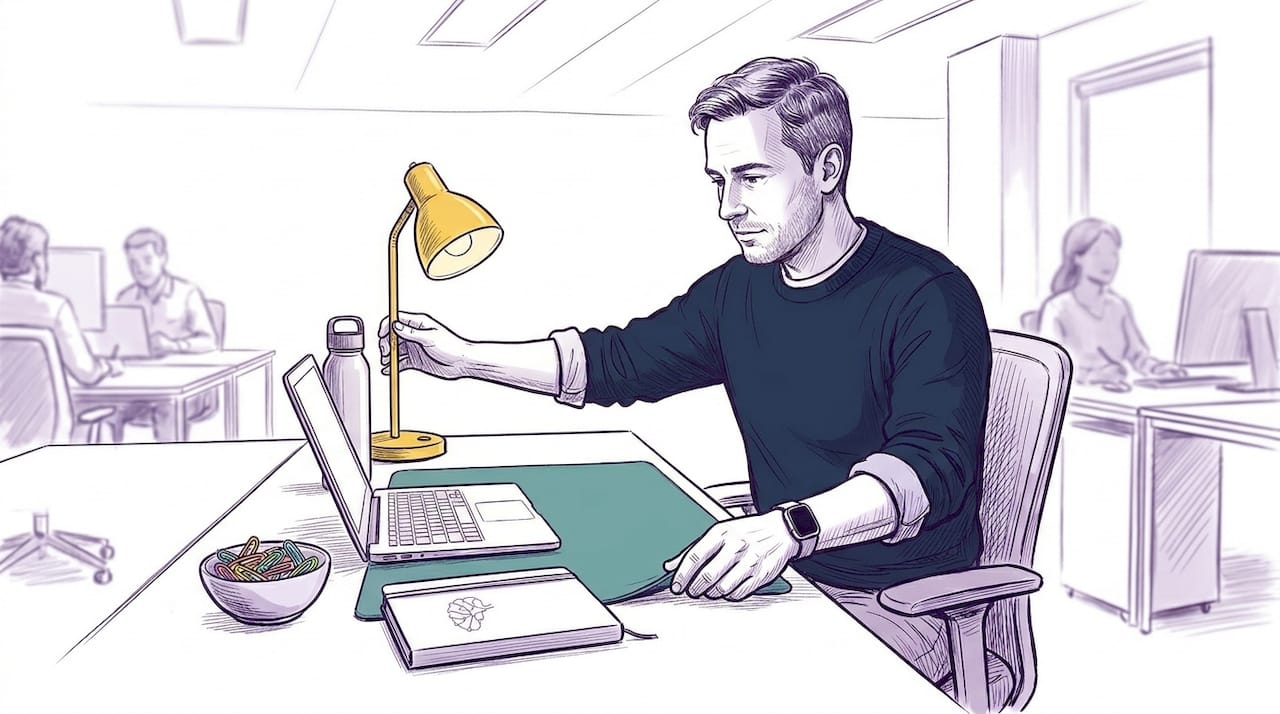
Pro Tip: If you work from home, use a visual boundary to signal “work mode.” A specific lamp, a desk mat, or even a particular mug can train your brain to shift into focus. It sounds simple because it is. Simple works.
Executing ADHD-friendly task and time management strategies
Environment sets the stage. Task management is where the real daily work happens. The most common mistake adults with ADHD make is using a task system built for neurotypical patterns, then blaming themselves when it fails.
Energy is the constraint, not time. Systems need to accommodate fluctuating focus, not assume a constant eight-hour productive window.
Here is a practical task management approach built around ADHD realities:
- Sort tasks into three buckets by cognitive load.
- Quick Hits: Tasks under five minutes. Email replies, form submissions, quick calls.
- Deep Work: Tasks requiring sustained focus. Writing, analysis, strategic planning.
- Brain Tax: Tasks that are draining regardless of difficulty. Admin, billing, anything bureaucratic.
- Log your energy three times a day. Rate your focus on a 1 to 5 scale at 9am, 1pm, and 4pm for one week. Most adults with ADHD find a consistent peak. Schedule Deep Work during that window. Use Brain Tax tasks when energy is lower.
- Use the Pomodoro method during Deep Work. 25 minutes of focused work, then a five-minute break. This creates a rhythm the ADHD brain can use. Pair it with auditory tools for ADHD like background soundscapes or white noise to sustain attention.
- Limit your daily dashboard to three tasks. Not ten. Not seven. Three. Choose them the night before or at the start of each morning. Everything else is secondary. This prevents the overwhelm that leads to doing nothing.
| Strategy | Best for | Difficulty to start |
|---|---|---|
| Three-bucket task sort | Daily planning | Low |
| Energy logging | Scheduling Deep Work | Low |
| Pomodoro technique | Sustained focus | Low |
| Three-task dashboard | Avoiding overwhelm | Low |
| Launch pad system | Reducing lost time | Very low |
These executive function strategies are not complicated. Their power is in consistent, low-friction use.
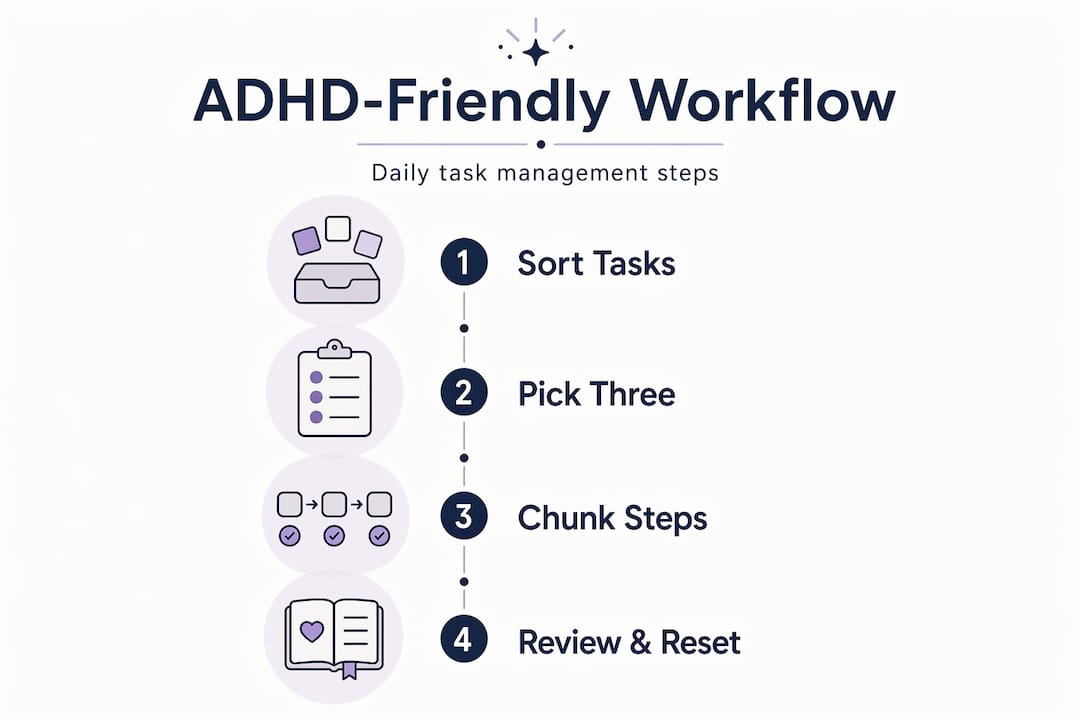
Pro Tip: Write tomorrow’s three tasks before you close your laptop today. Decision fatigue is highest at the end of the day, but so is clarity about what actually matters. Capture that clarity before you shut down.
Verifying progress and maintaining your ADHD workplace system
Every ADHD system eventually breaks down. That is not failure. That is predictable. The problem is not the collapse. It is having no plan for what to do after it.
Build a weekly reset into your schedule. Friday afternoons or Monday mornings work well. During this five-minute check, ask:
- What three things were on my dashboard this week?
- Which ones got done, and which did not?
- Is my launch pad still functional?
- What is cluttering my workspace right now?
- What is one thing I will do differently next week?
This is not a review meeting with yourself. It is a maintenance check, like restarting a system that has been running too long. Keep it under ten minutes.
Add a shutdown ritual to signal the end of each workday. Write tomorrow’s three tasks, clear your desk to a baseline, close all browser tabs, and say a set phrase out loud like “workday done.” This sounds odd until you try it. It genuinely helps the ADHD brain disengage from work, which reduces evening restlessness and burnout.
ADHD systems inevitably collapse periodically. Designing for easy re-entry without guilt is what makes a system sustainable long term.
Your re-entry protocol after a lapse should be exactly three steps: reset the launch pad, clear the clutter box, write three tasks. That is it. Full restart in under ten minutes, no shame required. Learn more about maintaining ADHD systems and building resilience over time.
Pro Tip: Treat your system like you treat a phone battery. It needs regular recharging. You would not throw away your phone because the battery hit zero. Do not abandon your system because it lapsed.
Accessing workplace accommodations and coaching support in the UK and USA
You have legal rights at work. This is not a gray area. Both UK and US law require employers to provide reasonable accommodations for adults with ADHD.
In the UK, Access to Work grants can fund up to £66,000 annually for workplace coaching, assistive technology, and support workers. This is a government-funded program, not a charity. You apply through the UK government’s Access to Work scheme. Many adults with ADHD do not know it exists, which means they are leaving significant support unclaimed.
In the US, employers must provide reasonable accommodations for ADHD under the Americans with Disabilities Act unless doing so would cause undue hardship. That is a high bar for employers to clear. Reasonable accommodations commonly granted to adults with ADHD include:
- Flexible start and end times
- A quiet workspace or noise-canceling headphones
- Written instructions instead of verbal-only briefings
- Regular check-ins with a manager for structured accountability
- Extended deadlines for certain project types
| Country | Legal framework | Funding available |
|---|---|---|
| UK | Equality Act 2010 | Access to Work: up to £66,000/year |
| USA | ADA (Americans with Disabilities Act) | Employer-funded accommodations |
ADHD executive function coaching goes beyond accommodations. A coach works with you to build personalized systems, identify where your specific brain gets stuck, and create accountability structures that hold up over time. Explore ADHD executive function coaching to understand what that support looks like in practice.
Rethinking workplace organization for adults with ADHD: beyond willpower and fancy systems
Here is what most productivity advice gets wrong: it treats ADHD workplace challenges as a motivation problem. If you just wanted it enough, you would be organized. That framing is not only inaccurate. It actively causes harm by creating shame cycles that make the problem worse.
Externalizing structure and reducing decision fatigue outperforms relying on willpower for ADHD management at work. The brain cannot willpower its way through a neurological difference. But it can use visual cues, physical anchors, and scheduled breaks to reduce the load on executive function.
The most effective systems I have seen adults with ADHD build are boring to look at. A whiteboard with three tasks. A hook by the door. A 25-minute timer. They are not color-coded productivity apps or elaborate Notion databases. They are low-friction, always visible, and require almost no maintenance. Fancy systems fail because they add complexity. Complexity is exactly what the ADHD brain struggles to sustain.
Forgiveness in the system is not a weakness. It is an engineering decision. When you design your organization system to assume lapses will happen and to restart in under ten minutes, you remove the shame that usually turns a one-day lapse into a three-week spiral. That design choice is what makes practical ADHD organization sustainable for years instead of weeks.
The goal is not perfect organization. The goal is a system that works most of the time and recovers fast when it does not.
Supporting your ADHD workplace journey with personalized coaching and resources
Managing workplace organization with ADHD is genuinely easier with the right support in place.
Personalized ADHD coaching helps you identify exactly where your organization breaks down and builds systems around your actual work demands, not a generic template. Executive function coaching services address the specific skills that make workplace organization hard: planning, prioritizing, and following through. For adults who need hands-on support with physical and digital organization, ADHD organization coaching provides structured, practical guidance. And if you want self-directed resources alongside coaching, ADHD books and workbooks designed specifically for adults and women with ADHD offer tools you can apply immediately. With the right coaching and tools, managing workplace organization with ADHD is not only possible but something you can sustain.
Frequently asked questions
What are some ADHD-friendly organization tips for the workplace?
Designate a single spot near your desk for daily essentials, break tasks into steps by cognitive load, use a 25-minute timer for focused work, and clear a clutter box weekly to maintain a functional workspace.
Can adults with ADHD get workplace accommodations?
Yes. Adults with ADHD are entitled to reasonable accommodations under the UK Equality Act 2010 and the US ADA. Employers must provide accommodations for ADHD unless they can prove undue hardship, which is a high legal bar.
How does coaching help adults with ADHD at work?
Coaching builds personalized executive function strategies, creates accountability structures, and helps you identify where your specific system breaks down. Access to Work can fund ADHD coaching that builds these skills for UK-based adults.
What is Access to Work funding in the UK?
It is a UK government grant that provides up to £66,000 yearly to fund workplace coaching, assistive technology, and other practical support for adults with ADHD or other disabilities.
How can I manage ADHD task-switching that costs me hours each day?
Splitting tasks by cognitive load and logging your energy levels daily helps you schedule the right work at the right time. Limiting your daily focus to three key tasks removes the decision paralysis that drives constant task-switching.

