
Decide Quickly: Coach or Therapist for Adult ADHD, Backed by Research
Decide Quickly: Coach or Therapist for Adult ADHD, Backed by Research
If you need practical systems, accountability, and task focused strategies, an ADHD coach is usually your best first call. If you need to process trauma, treat anxiety or depression, or manage emotional dysregulation that’s knocking you flat, start with a therapist. Neither replaces a proper diagnosis or medication review, and plenty of people end up using both.
TL;DR:
- ADHD coaching effectively improves executive functioning skills such as task initiation, planning, and follow-through, with evidence showing medium to large effects after a 12-session program.
- Therapists provide emotional regulation, trauma processing, and treatment for co-occurring conditions, especially in cases involving severe depression, trauma, or safety risks.
- When choosing between them, prioritize a therapist for urgent clinical needs and an ADHD coach for structural, organizational, or task management challenges.
- Most adults with ADHD benefit from a combination of therapy and coaching, coordinated carefully to address both emotional and practical problems.
- Credentialing, session structure, and personal fit are key factors in selecting a reliable provider, with a strong emphasis on asking specific questions during discovery calls.
Table of Contents
- ADHD Coach vs Therapist: What Actually Separates Them
- What Does an ADHD Coaching Session Actually Look Like?
- What Happens in Therapy for Adult ADHD?
- How Do You Choose Between an ADHD Coach and a Therapist?
- Can You Use an ADHD Coach and a Therapist at the Same Time?
- Where Do You Actually Find a Good ADHD Coach or Therapist?
- Why Fit Beats Framework Every Time
- Ready to Build Systems That Actually Stick?
- Sources
- FAQ
ADHD Coach vs Therapist: What Actually Separates Them
Here’s the split that matters: a coach helps with how, a therapist helps with why. That’s not a cute soundbite, it’s the actual clinical distinction. ADHD coaching is action oriented and future focused, built around building the systems your brain won’t build on its own. Therapy digs into the emotional and psychological terrain, which means it’s the better tool when you’re untangling why you shut down every time you get feedback at work, or why every deadline feels like a personal referendum on your worth, according to a Psychology Today breakdown of the two roles.
Some practitioners frame it as overwhelm versus overload related to ADHD executive function impairments. Overload is structural: too many tabs open, too many half-finished projects, no functioning inbox. A coach’s job is turning that overload into a task list you can actually execute, according to a CHADD article on evidence-based coaching. Overwhelm is emotional: the shame spiral, the shutdown, the “why can’t I just be normal” 2am spiral. That’s therapy territory.
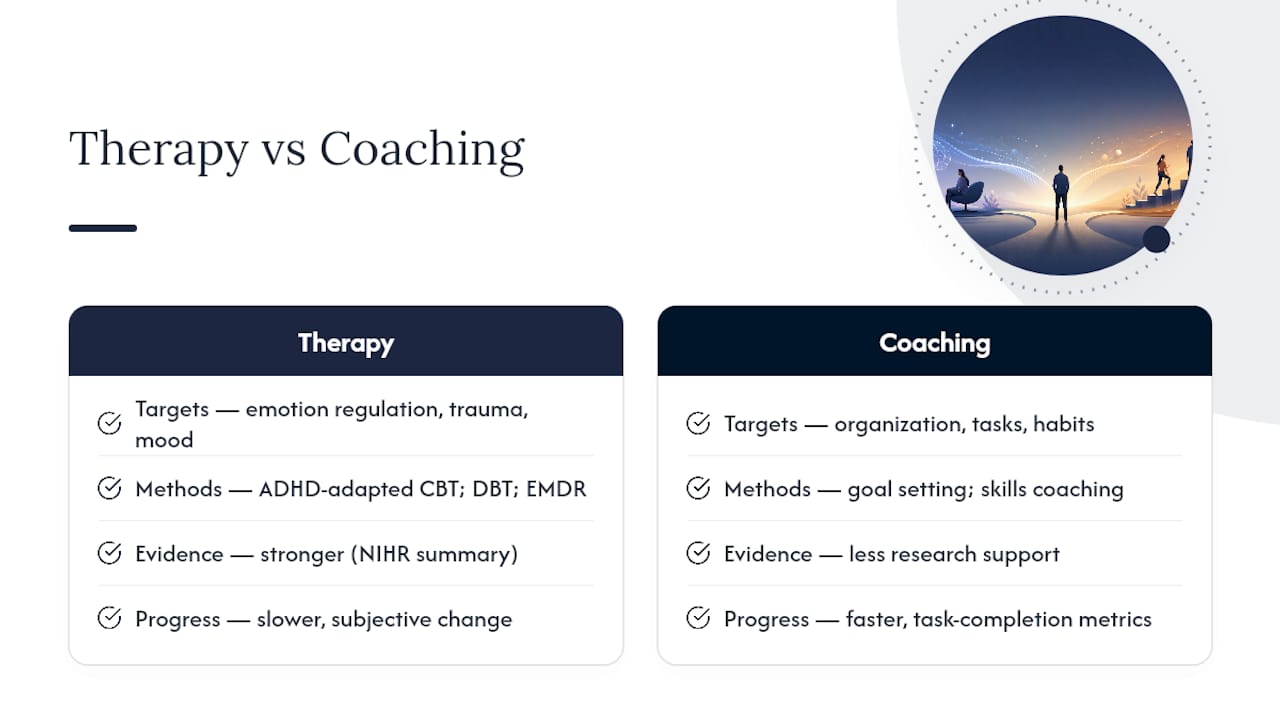
Methods differ just as sharply. Coaches use planners, time blocking, body doubling, environment redesign, and accountability check-ins. Therapists lean on evidence-based modalities like cognitive behavioral therapy adapted for ADHD, sometimes DBT-informed emotion regulation work, and occasionally EMDR when trauma is in the mix.
Session logistics differ too:
- Coaching sessions often run for a moderate duration, weekly or biweekly, often by phone or video, with “homework” that’s concrete: set up the calendar system, try the new morning routine.
- Therapy sessions generally last a standard session length, weekly at first, with homework that’s more reflective: track your mood, notice the trigger, journal the pattern.
- Credentialing is the biggest legal gap between them. Therapists are licensed clinicians, regulated, and accountable to a professional body. ADHD coaching is largely unregulated, so a certification badge means whatever the certifying body decided it means, nothing more.
- Cost varies by provider and region, but therapy delivered by a licensed clinician is more likely to be partially covered by insurance or, in the UK, accessed through the NHS or workplace schemes, while coaching is typically paid out of pocket.
None of this means coaching is the lightweight option. A 2026 peer-reviewed pre-post study found statistically significant improvements in ADHD symptoms, executive functioning, and daily functional impairment after a 12-session coaching program, with medium to large effect sizes. It’s a single-arm study, so we’re still waiting on randomized trials to nail down causality. But it’s a real signal that structured coaching moves the needle, not just a feel-good add-on. And professional guidance is consistent on one point: coaching is not a substitute for clinical diagnosis or treatment, and works best alongside medical care when medical care is needed, per CHADD’s evidence summary.
What Does an ADHD Coaching Session Actually Look Like?
Picture this instead of a therapy couch: a weekly video call where you and your coach open with a two-minute check-in (“did the new alarm system work or did you sleep through it again?”), then spend the bulk of the session building or troubleshooting a concrete system. Maybe that’s a time-blocked calendar. Maybe it’s finally tackling the organization and decluttering spiral that’s been eating your Sundays. Maybe it’s breaking a terrifying, vague work project into steps small enough that your brain will actually start one.
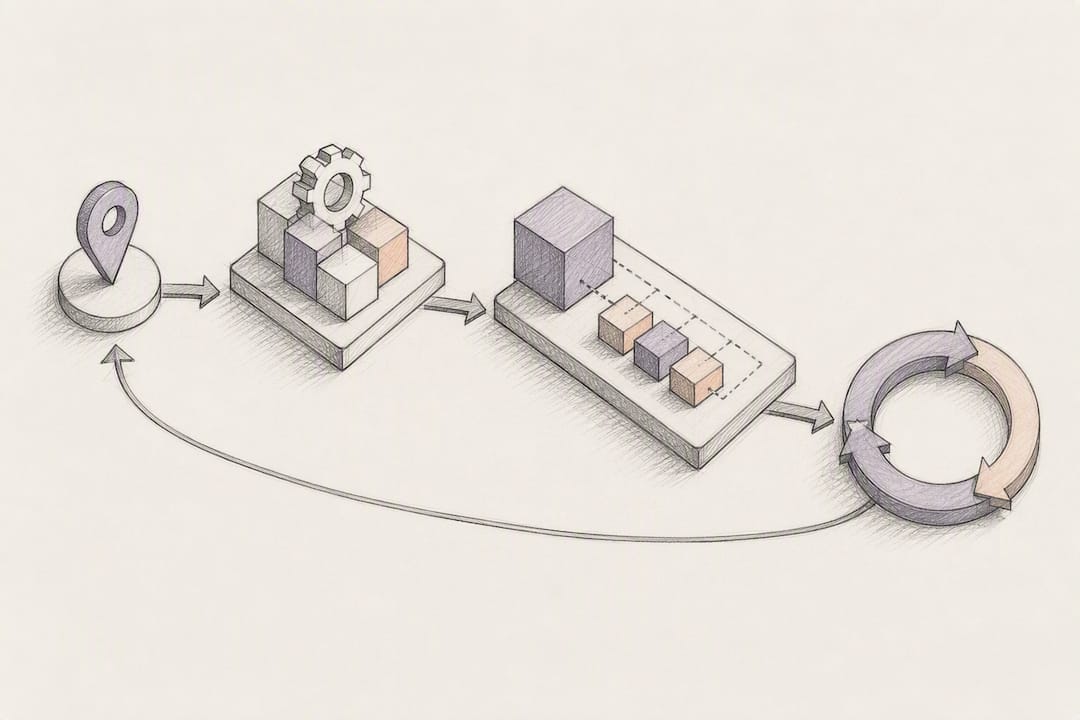
Coaches lean on a toolkit that’s refreshingly unglamorous: planners, timers, environment redesign (moving your keys so you can’t leave without them), and micro-habits stacked onto things you already do. Accountability is the engine. You report back next week, and that social pressure, gentle as it is, does something willpower alone never manages.
The research backing this up is still young but promising. That 2026 coaching study is the strongest data point yet, showing real gains in executive function skills like task initiation, planning, and follow-through. What coaching doesn’t do, and shouldn’t pretend to do, is diagnose you, treat depression, work through childhood trauma, or manage a mental health crisis. A good coach knows that boundary cold and will refer you to a therapist the moment a session veers into clinical territory. If yours doesn’t, that’s a red flag worth taking seriously.
What Happens in Therapy for Adult ADHD?
Therapy’s job is the internal weather, not just the external mess. Goals center on emotion regulation, processing trauma (including the very real trauma of years of being called lazy or careless before diagnosis), and treating co-occurring anxiety or depression, which show up in the majority of adults with ADHD at some point.
The evidence base here is more established than coaching’s. Cognitive behavioral therapy adapted for adult ADHD has real support behind it, according to an NIHR evidence summary, and clinicians increasingly use ADHD-specific CBT adaptations rather than generic protocols. DBT-informed work helps with the emotional intensity many ADHDers describe as feeling like the volume knob is permanently stuck on ten. EMDR gets brought in specifically when trauma processing is the goal, not the general first step.
Progress in therapy is tracked more slowly and more subjectively than coaching’s task-completion metrics. Some clinicians use structured symptom scales, but a lot of the real movement shows up in how you talk about yourself, whether the shame story is loosening its grip, whether a panic response is shrinking from an hour to five minutes. Harvard Health’s summary of intensive CBT notes that concentrated formats can produce noticeable change faster than the traditional weekly model, though the standard weekly pace is still where most people start.
Here’s the part that isn’t optional: if you’re dealing with suicidal thoughts, severe depression, active trauma symptoms, or any situation involving real safety risk, therapy is not the “nice to have” alternative to coaching. It’s where you start, full stop. A coach is not equipped to manage a mental health crisis and a responsible one will tell you that directly.
How Do You Choose Between an ADHD Coach and a Therapist?
Run this quick triage before you book anything:
- Is there an urgent clinical need? Suicidal ideation, severe depression, unmanaged trauma symptoms, or a mental health crisis means you see a therapist first, no detour.
- Is your main problem structural? Chronic lateness, a chaotic inbox, missed deadlines, a business that’s growing faster than your systems, that’s coaching territory.
- Is it both? Most adults with ADHD land here. Sequential or parallel care, therapist for the emotional load, coach for the daily systems, is often the answer.
Once you know which lane you’re in, vet the actual human before you commit a dime. Ask:
- What’s your training specifically in ADHD, not just general coaching or general therapy certification?
- How many adult ADHD clients have you worked with?
- What’s outside your scope, and who do you refer to when a session hits that line?
- How do you handle a client in crisis?
- How do you measure whether this is working after eight or twelve weeks?
- What does a typical session structure look like?
- What’s the cancellation and rescheduling policy?
- Do you offer a trial session before I commit to a package?
Budget and logistics matter too. If you’re in the UK and the issue is specifically workplace performance, Access to Work coaching can fund job-focused coaching support, which is worth checking before you pay out of pocket. Watch for red flags: vague answers about credentials, no mention of referral boundaries, or a hard sales pitch before they’ve asked a single question about your situation. Trust signals go the other way: they ask about your ADHD history unprompted, they’re upfront about what they can’t help with, and they don’t oversell.
Can You Use an ADHD Coach and a Therapist at the Same Time?
Yes, and for a lot of people it’s the smartest configuration, not a fallback plan. Some run both in parallel, weekly therapy for the internal work, biweekly coaching for the external systems. Others sequence it: stabilize with therapy first, bring in a coach once the emotional ground is steadier and the goal shifts to building routines.
Coordination matters more than people expect. If you’re on medication, make sure everyone involved, prescriber, therapist, coach, knows the full picture, even if only your prescriber manages the medication itself. Medication often levels out attention enough that you can practice new skills, but it rarely builds the skills automatically. That’s the coach’s job, translating a calmer brain into habits that stick.
Professional guidance backs the both-and model over the either-or one. CHADD’s own evidence summary frames coaching as a complement to medication and therapy, not a competitor to either. A typical integrated pathway might look like this: diagnosis and medication review with a psychiatrist, weekly CBT with a therapist to manage anxiety around executive dysfunction, and biweekly coaching to build the daily systems that make the anxiety less likely to flare up in the first place. None of the three roles is duplicating another’s work.
Where Do You Actually Find a Good ADHD Coach or Therapist?
Start with directories built for this specifically, not a general search. CHADD’s professional directory lists ADHD-aware coaches and clinicians, and a GP referral is the standard route into NHS or private therapy in the UK. If the goal is workplace performance, revisit Access to Work before you pay privately.
Before booking, check: credentials and any ADHD-specific training, clear scope of practice, transparent fees and cancellation terms, and whether they’ll do a short intro call before you commit to a full package.
Try this six-question script on a discovery call: What’s your ADHD-specific training? How many adult clients have you supported? What’s outside your scope? How do you measure progress? What does a typical session look like? Do you offer a trial session? A good answer sounds specific and a little humble. A bad one sounds like a sales script.
Pro Tip: Pay attention to how you feel after the first session, not just what was covered. Working alliance, the sense that this person actually gets your brain, predicts outcomes more reliably than the letters after their name.
Why Fit Beats Framework Every Time
Clients rarely stay in one lane. Most cycle between therapy and coaching as life throws different problems at them, a rough quarter needs therapy, a business launch needs a coach, and that back and forth is normal, not a sign anything failed. What predicts whether either one actually helps isn’t the modality, it’s whether you trust the person across from you enough to be honest when things aren’t working.
I’d rather see someone pick imperfectly and adjust than freeze trying to find the “correct” answer on paper. If you’re weighing a taster coaching session or want to see what structured ADHD support looks like day to day, that’s a reasonable next step to take.
— Estelle
Ready to Build Systems That Actually Stick?
There are coaching options designed specifically for self-employed ADHDers, creatives, and impact-focused founders who have tried generic productivity advice and found it ineffective. Effective coaching is designed around how your particular brain actually works, often drawing on DBT and burnout coaching experience and an understanding of the effects of a late diagnosis.
The ADHD Business Coaching for Impact-Focused Entrepreneurs and Creative Freelancers covers exactly the ground this article walked through, executive function systems, accountability structures, and workplace strategies, delivered by someone who’s lived the diagnosis, not just studied it. Training and workshops for organizations and business consulting may also be available for teams navigating ADHD in the workplace. If you’d rather start with self-directed work, the Empowering ADHD Workbook collection, including the Adult ADHD Executive Function 7-Week Power-Up, gives you a structured starting point without booking a single call. Whichever entry point fits, book a first conversation and see if the fit is right before committing to anything bigger.
Sources
- Cognitive behavioural therapy could benefit adults with ADHD (NIHR)
- 2026 peer-reviewed study reporting positive pre-post outcomes for individual ADHD coaching
- Do I Need an ADHD Coach and a Therapist? (Psychology Today)
FAQ
How Do I Know if I Need a Therapist or a Coach?
If the problem is emotional, trauma, anxiety, depression, shame spirals, start with a therapist. If the problem is structural, missed deadlines, disorganization, follow-through, an ADHD coach is the better first call.
Is an ADHD Coach Better Than a Therapist?
Neither is objectively better; they solve different problems. Coaching tends to outperform for building daily systems and accountability, while therapy is the stronger choice for emotional processing and treating co-occurring mental health conditions.
Are ADHD Coaches in High Demand?
Demand has grown alongside rising adult ADHD diagnoses, though the field remains largely unregulated, so vetting credentials and ADHD-specific training matters more than picking based on availability alone.
Should People With ADHD See a Therapist?
Many benefit from therapy, especially when anxiety, depression, trauma, or emotional dysregulation are present alongside ADHD; those with urgent clinical needs should prioritize therapy over coaching.
What Does Estelle-rose’s ADHD Coaching Cost?
Pricing for Estelle-rose’s coaching packages and workshops is available directly on the coaching services page.

