
Finish More Work: ADHD Coaching for Creatives, Coach's Take
Finish More Work: ADHD Coaching for Creatives, Coach’s Take
The main ADHD coaching benefits for adults are better executive function, sharper time management, more finished tasks, less daily overwhelm, and a real bump in confidence. Coaching does not replace medication or therapy. It’s a skills-and-support process that sits alongside clinical care, and a growing body of research shows measurable gains in executive function and goal attainment for people who stick with it.
TL;DR:
- ADHD coaching significantly improves executive functioning and goal tracking, especially for adults who are newly diagnosed or managing self-employment challenges.
- Sessions include accountability check-ins, body doubling, and psychoeducation to help turn insights into practical systems.
- Research indicates moderate to large effects on ADHD symptoms and functioning, but results vary due to small study sizes and inconsistent coach training.
- Coaching works best when clients are committed to active participation and focus on specific, measurable goals rather than expecting complete symptom eradication.
- It is a complementary process that supports daily system building alongside medication or therapy, with short engagement blocks common for targeted progress.
Table of Contents
- What Are the Practical Benefits of ADHD Coaching?
- How Does ADHD Coaching Actually Work in a Session?
- Is ADHD Coaching Effective? Here’s What the Research Shows
- Who Benefits Most From ADHD Coaching?
- How Do You Actually Start ADHD Coaching?
- What Is ADHD Coaching (And How Is It Different From Therapy)?
- An Honest Take on Coaching From the Inside
- Ready to Put These Benefits to Work?
- Where This Information Comes From
- Sources
- FAQ
What Are the Practical Benefits of ADHD Coaching?
Here’s the thing nobody tells you when you get diagnosed: knowing you have ADHD and knowing what to do about your Tuesday afternoon are two completely different problems. ADHD coaching benefits show up in the gap between those two things.
Executive function is usually where it starts. A coach helps you build planning systems that survive contact with real life, not the color-coded planner you bought and abandoned in February. If you run your own business, that might mean timeboxing client work so invoicing doesn’t pile up into a shame spiral three months later.
Task initiation and completion get easier through structure, not willpower. Body doubling, scheduled check-ins, and breaking a huge task into an almost embarrassingly small first step (open the document, that’s it) are the tools that actually move the needle.
Organization stops being a personality flaw and becomes a system problem. Coaches help build workable setups for your inbox, your desk, your kitchen counter, and your financial admin.
Goal attainment turns vague ambitions (“I want to grow my business”) into trackable steps with actual dates attached.
The emotional side matters just as much:
- Less shame around missed deadlines and “why can’t I just do this” self-talk
- More self-compassion, because you finally understand the wiring instead of just the failures
- Steadier finances, because paperwork stops living in a pile of dread
- Better relationships at work, because you’re not disappearing during crunch time
Pro Tip: Track one small win a week, on paper, in your own handwriting. ADHD brains discount past effort almost instantly. A written log is proof your brain will otherwise refuse to believe.
How Does ADHD Coaching Actually Work in a Session?
You might be picturing a coach nodding sympathetically while you vent about your inbox. That happens sometimes, sure, but the actual mechanics are more specific than that.
- Accountability structures. A weekly check-in usually starts with “what did you commit to last week” and ends with one or two concrete next steps, not a vague pep talk.
- Verbal processing. Saying a decision out loud, to a person who’s listening for the actual decision buried in your rambling, gets you unstuck faster than another hour of solo overthinking.
- Psychoeducation. Understanding why your brain stalls on boring tasks cuts the “I’m just lazy” narrative down fast, and that shift alone improves how well strategies stick.
- Small experiments. Try a system for a week, report back on what broke, adjust. Coaches use this iterative approach because one-size-fits-all planners rarely survive contact with a real ADHD brain.
Sessions run one-to-one, in groups, or remotely, and most coaches supplement live calls with brief text or email check-ins between sessions to keep momentum from evaporating.
Is ADHD Coaching Effective? Here’s What the Research Shows
Short answer: yes, with honest caveats attached. A prospective study of a 12-session individual coaching program found statistically significant improvements in ADHD symptoms, executive functioning, and functional impairment, with medium to large effect sizes and high client satisfaction. That’s a real number, not marketing copy.
A broader literature review of 19 studies found consistent improvements in executive functioning, ADHD-related behaviors, and overall well-being across different coaching models, though the review flagged real variability in coach training and study design.
What the effect sizes actually mean: a “medium to large” effect in a study like this suggests the average coached client improved more than most uncoached peers, not that every client sees dramatic change. Individual results vary widely.
Where coaching sits next to other treatments matters too. Medication tends to target attention and impulsivity at the neurological level. CBT often targets thought patterns and mood. Coaching’s edge is turning insight into daily systems, which is why it’s usually framed as complementary rather than a substitute.
The honest limitations:
- Sample sizes across most coaching studies remain small
- Coach training and certification standards vary widely, which makes results harder to generalize
- Many studies use single-arm designs without a control group
The realistic takeaway: expect reliable gains in executive function skills and goal attainment. Expect less certainty around full symptom remission, because that’s simply not what most of the research measures.
Who Benefits Most From ADHD Coaching?
Coaching isn’t a universal fix, and pretending otherwise would be dishonest. It tends to work best for specific situations.
- Newly diagnosed adults who need a translator between “I have ADHD” and “here’s what I do Monday morning.”
- Students juggling deadlines without the external structure school used to provide.
- Creatives and the self-employed building routines from scratch, with no manager setting the pace.
- People in transition, changing careers, launching a business, or returning to work after leave.
Coaching is not the right first step if you’re dealing with a serious comorbid mood disorder, active suicidality, or impairment severe enough to interfere with basic daily safety. That’s a job for a GP or psychiatrist first, coaching second. And outcomes track closely with client commitment: people who show up with one clear goal tend to do better than people hoping a coach will hand them motivation.
How Do You Actually Start ADHD Coaching?
Most engagements run in short, focused blocks, six to twelve sessions is common, aimed at one or two specific goals, or as ongoing monthly check-ins for longer-term support. Coaching can be paused once a goal is met rather than treated as a lifelong commitment.
Costs vary by coach experience and region. In the UK, Access to Work coaching can sometimes fund sessions for employed adults, though NHS-funded ADHD coaching itself is not standard, and availability depends on your local trust, so check directly rather than assuming coverage.
- Ask about their specific experience coaching adults, creatives, or entrepreneurs.
- Ask what methods they use and how they measure progress.
- Ask about cancellation policy and confidentiality up front.
- Watch for red flags: vague promises of a “cure,” no ADHD-specific training, or a refusal to build a collaborative plan with you.
Pro Tip: If a coach can’t clearly explain how they’ll measure your progress in month one, that’s a real answer, and it’s not a good one.
What Is ADHD Coaching (And How Is It Different From Therapy)?
ADHD coaching is a practical, collaborative process focused on building systems and skills to close the gap between where you are and where you want to be. It’s distinct from psychotherapy, which typically works on emotional processing, past experiences, and mental health diagnoses.
A therapist might help you understand why deadline panic triggers a shame spiral rooted in childhood report cards. A coach helps you build the calendar system that prevents the deadline panic in the first place. Both are valuable. They’re just answering different questions.
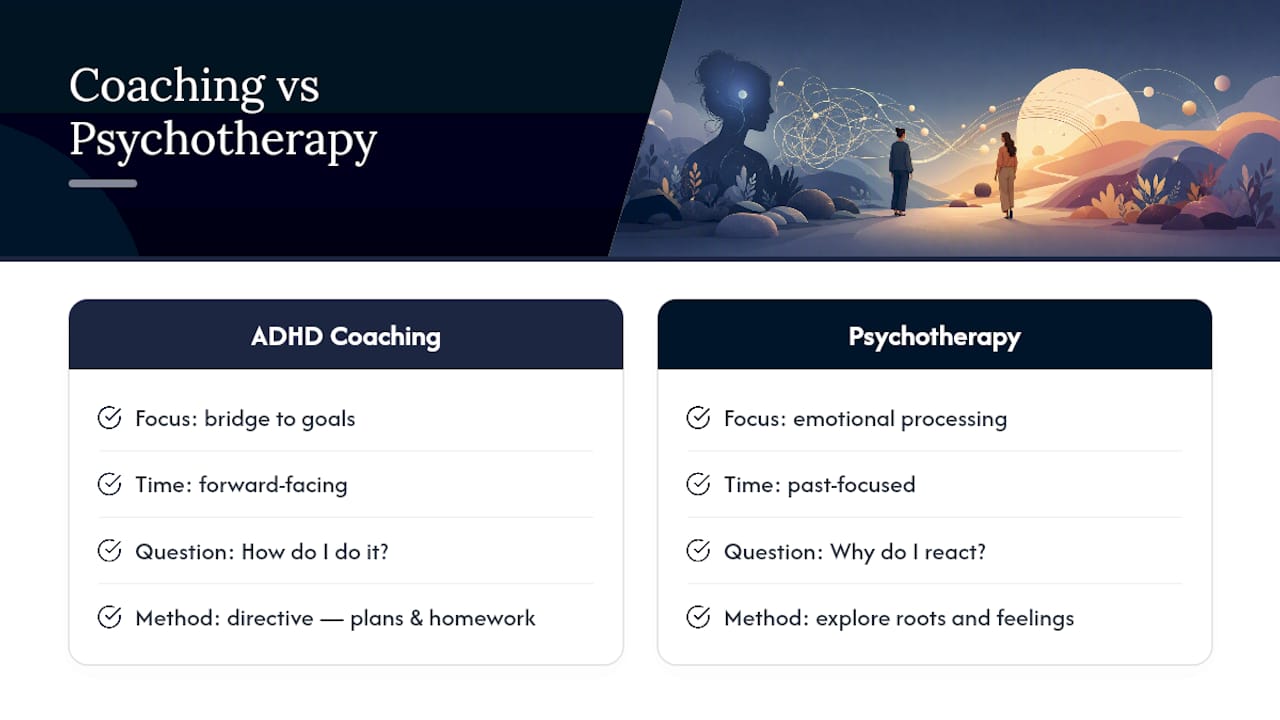
Coaching also tends to be more directive and forward-facing. Sessions revolve around your stated goals this week, this month, this quarter, with homework, check-ins, and adjustments based on what actually happened, not what you hoped would happen. It’s often part of a wider, multimodal approach that includes medication or therapy rather than standing in for either. If you’re choosing between the two, ask yourself whether you need to process something painful (therapy) or need help doing something specific (coaching). Many adults with ADHD eventually use both, at different points, for different reasons.
An Honest Take on Coaching From the Inside
People come into coaching expecting to be fixed. That’s not what this is, and I think the ADHD coaching industry does itself a disservice by letting that expectation slide by unchallenged.
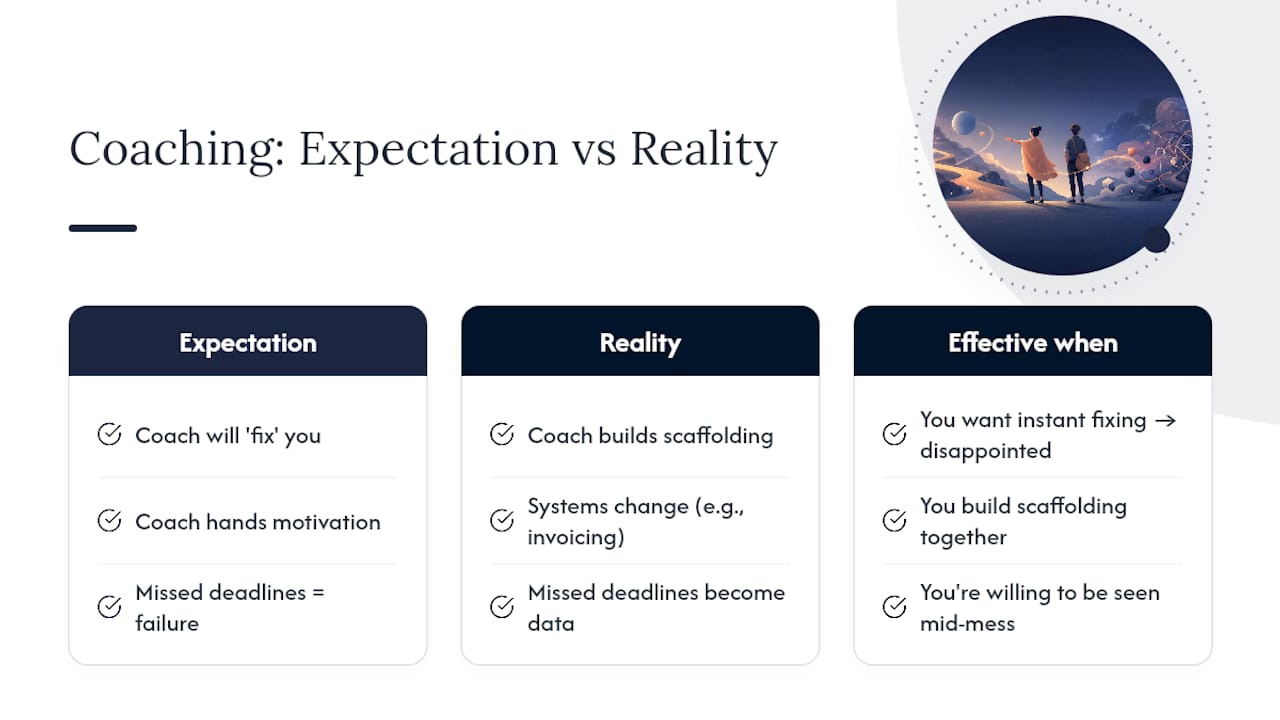
A creative entrepreneur realizes their business wasn’t failing from lack of talent, it was failing from an invoicing system that assumed a brain that doesn’t exist. A newly diagnosed adult stops treating every missed deadline as proof of moral failure and starts treating it as data.
The uncomfortable truth is that coaching works best for people willing to be seen mid-mess, not after they’ve cleaned up. If you’re looking for a coach who will hand you motivation, you’ll be disappointed. If you’re looking for someone to build the scaffolding with you while you figure out your own gears, that’s where the real gains in executive function tend to show up.
— Estelle
Ready to Put These Benefits to Work?
ADHD coaching is built around the actual shape of your week, not a generic planner template that assumes a brain that isn’t yours. For entrepreneurs and creatives especially, that means sessions built around business rhythms, client deadlines, and the specific chaos of running something you built yourself.
A first session usually maps your current systems (or lack of them), names one or two high-impact goals, and sets a realistic check-in rhythm from there, whether that’s weekly accountability or a focused six-session block. If you’d rather start with something lower-commitment, the self-help books and workbooks cover executive function, organization, and emotional regulation on your own timeline. When you’re ready for direct support, book a coaching consultation and bring one goal you actually want to move on. That’s genuinely enough to start.
Where This Information Comes From
- The prospective coaching study supplies the effect-size data behind the research section.
- CHADD’s literature review synthesizes 19 studies on coaching outcomes.
- Medical News Today’s coaching explainer clarifies how coaching differs from therapy.
- CHADD’s coach-fit article informs the guidance on choosing a coach.
Sources
- Coaching for Adults With ADHD: A Prospective Study
- Emerging Evidence for the Effectiveness of Coaching for ADHD — CHADD
- ADHD coach: Benefits, finding a coach, cost, and more — Medical News Today
FAQ
What is the 30% rule for ADHD?
It’s a commonly cited idea that adults with ADHD may lag roughly 30% behind same-age peers in emotional and executive maturity, though it’s a practical rule of thumb rather than a precise clinical measure. Coaching targets that exact gap by building the executive-function skills that catch someone up in practice.
What makes people with ADHD happy?
Structure that fits their actual brain, not a borrowed system, tends to matter more than motivation or discipline. Completing tasks, finishing what they start, and feeling capable instead of chaotic show up repeatedly as sources of genuine relief and confidence.
How can ADHD coaching help?
Coaching helps by building executive function skills, accountability structures, and organizational systems tailored to how your brain actually works, rather than how a productivity book assumes it works. Research shows measurable improvements in symptoms and functioning from structured coaching programs.
Is ADHD coaching available on the NHS?
NHS-funded ADHD coaching is not standard in the UK, though Access to Work funding can sometimes cover coaching costs for employed adults. Availability varies by local trust and individual circumstances, so check directly rather than assuming coverage.
Does ADHD coaching work for entrepreneurs and creatives specifically?
Yes, coaching tends to work especially well for self-employed and creative professionals because it builds business systems, like invoicing routines and project timelines, around ADHD-specific challenges rather than generic productivity advice. That fit is exactly why coaching for creatives and entrepreneurs is structured differently from standard executive coaching.

