
How to handle ADHD procrastination: practical strategies that work
How to handle ADHD procrastination: practical strategies that work
TL;DR:
- Procrastination in adults with ADHD results from executive function challenges that hinder task initiation and effort. Building lifestyle supports, environmental organization, and using targeted techniques like timers and micro-tasks can effectively reduce avoidance and improve focus. Flexibility, personalization, and ongoing self-assessment are essential for sustainable ADHD management and progress.
Procrastination is one of the most reported challenges for adults newly diagnosed with ADHD, and it rarely improves just by trying harder. Executive function difficulties in ADHD make it genuinely harder to start, organize, and follow through on tasks, and that has real consequences at work, at home, and in relationships. This guide delivers practical, evidence-based strategies built specifically for adults with ADHD, not generic productivity advice. If you have recently received a diagnosis and want to know what actually works, this is your starting point.
Table of Contents
- Understanding why ADHD leads to procrastination
- What you need to start: Foundational supports
- Step-by-step: Evidence-based strategies to overcome procrastination
- Common obstacles: Perfectionism, overwhelm, and medication
- Verify and adjust: Tracking progress and making changes
- Our perspective: Why ADHD procrastination strategies must fit real life, not just theory
- Get personalized help for ADHD procrastination
- Frequently asked questions
Key Takeaways
| Point | Details |
|---|---|
| Procrastination has a cause | ADHD procrastination comes from executive function challenges, not laziness. |
| Start with proven supports | Lifestyle adjustments and personalized work systems are essential before applying new strategies. |
| Use structured strategies | Visual cues, time management tools, and chunked tasks work better than willpower alone. |
| Address perfectionism early | Progress over perfection helps prevent task avoidance and overwhelm. |
| Individualize and adjust | Tracking results and adapting methods leads to more sustainable change. |
Understanding why ADHD leads to procrastination
Before applying solutions, it helps to understand the actual mechanism. Procrastination in adults with ADHD is not a character flaw. It is tied directly to how the ADHD brain manages activation and task initiation.
Executive function and ADHD research shows that the ADHD brain struggles with a group of cognitive skills that control planning, starting, and sustaining effort on tasks. When executive function is impaired, the brain does not automatically generate the motivation or activation signal needed to begin a task, even when you know it is important.
This is why you can sit in front of a report for an hour and still not type a single word. It is not unwillingness. It is a real neurological gap.
“Procrastination in ADHD is linked to executive function challenges, particularly task initiation and activation difficulties. CBT-style interventions targeting behavioral activation and procrastination are actively being studied.” Scandinavian Journal of Psychology
Several key factors drive ADHD-related procrastination:
- Task initiation deficit: The brain delays sending the start signal, especially for low-interest or complex tasks.
- Working memory limitations: Holding a task plan in mind while also executing steps is cognitively expensive for ADHD adults.
- Emotional avoidance: Tasks linked to past failure, boredom, or criticism feel threatening, triggering avoidance behavior.
- Time blindness: ADHD adults often underestimate how long tasks take, which disrupts planning and creates last-minute panic cycles.
| ADHD challenge | Effect on task behavior | Common outcome |
|---|---|---|
| Weak task initiation | Cannot start despite intention | Missed deadlines |
| Time blindness | Misjudges time needed | Chronic lateness |
| Emotional avoidance | Avoids anxiety-linked tasks | Task pile-up |
| Working memory deficits | Loses track of steps | Incomplete work |
Understanding this table is useful. Procrastination in ADHD often mediates a reduced quality of life, meaning it does not just affect productivity. It affects wellbeing, relationships, and self-worth over time. Willpower alone cannot override these neurological patterns, so the strategies that follow are designed to work with the ADHD brain, not against it.
What you need to start: Foundational supports
Once you understand why procrastination occurs, the next step is putting supports in place before adding strategies on top. Think of this as building the platform first.
For adults with ADHD, NHS guidance confirms that management typically combines lifestyle adjustments, work or study accommodations, and psychological therapies like CBT or mindfulness, alongside medication where appropriate. That is a wide-angle view, and it matters because no single strategy works in isolation.
Lifestyle foundations to put in place:
- Regular physical exercise: Even 20 to 30 minutes of moderate aerobic activity improves dopamine and norepinephrine levels, both of which support attention and task motivation.
- Sleep consistency: Poor sleep significantly worsens executive function. Prioritize a fixed sleep and wake schedule, even on weekends.
- Nutrition basics: Blood sugar swings worsen ADHD symptoms. Regular meals with protein and complex carbohydrates help maintain focus across the day.
- Mindfulness practice: Short daily mindfulness sessions reduce impulsivity and improve attentional control over time.
Pro Tip: Start with just one lifestyle change at a time. Attempting to fix sleep, diet, and exercise simultaneously is overwhelming and rarely sticks. Choose the one that feels most achievable and build from there.
Environmental and organizational supports are equally important. Setting up an ADHD-friendly organization system at home and at your desk removes friction from the start of tasks. That means dedicated task zones, visual reminders, labeled storage, and a clear workflow for incoming tasks. When the environment is structured, the brain does not have to work as hard to get started.

If you work or study, investigate what accommodations are available to you. In the UK, the Equality Act 2010 requires employers to make reasonable adjustments. In the US, the Americans with Disabilities Act covers similar ground. Extended deadlines, flexible scheduling, and reduced-distraction workspaces are all legitimate accommodations that can significantly reduce daily procrastination pressure.
Finally, consider whether a medication review with a specialist is warranted. Medication does not replace behavioral strategies, but for many adults it lowers the activation barrier enough that strategies become far more effective. This is a conversation to have with your prescribing doctor or ADHD specialist, and also exploring relaxation strategies for ADHD can complement both lifestyle and medical supports.
Step-by-step: Evidence-based strategies to overcome procrastination
With your foundation in place, follow this sequence of proven strategies. Each one addresses a specific ADHD-related challenge.
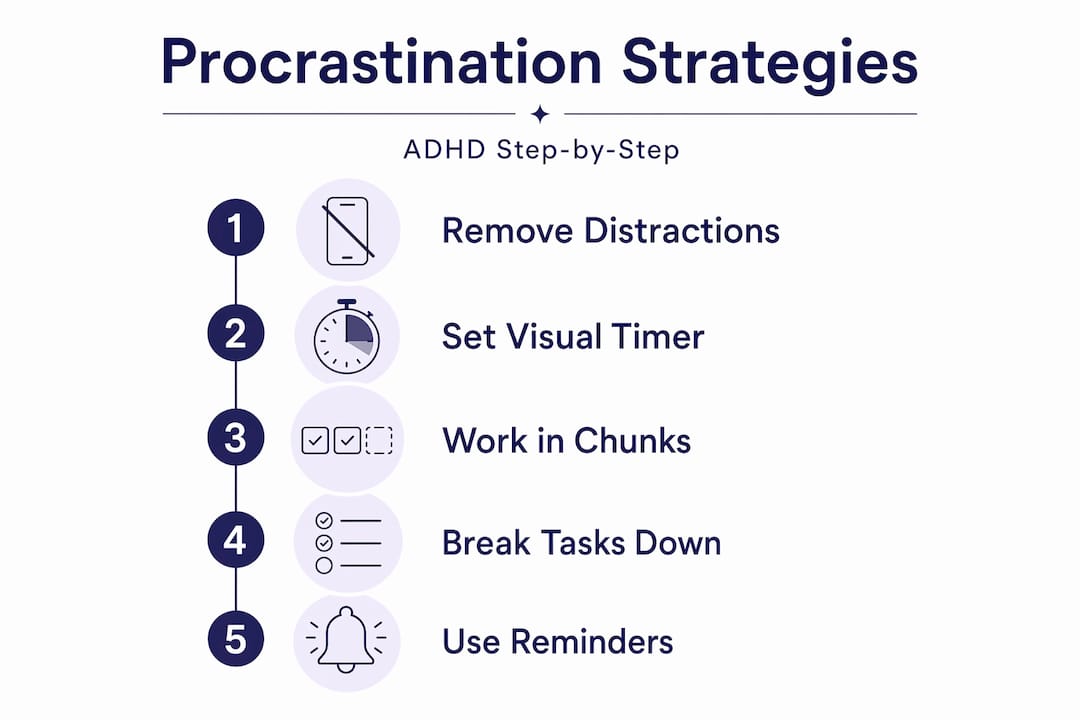
1. Remove distractions before you start. Put your phone in another room, silence notifications, and close browser tabs unrelated to your current task. This sounds basic but it is genuinely one of the most effective changes you can make. Reducing distractions and using external structure consistently ranks among the top strategies recommended by Cleveland Clinic for ADHD focus.
2. Set a visual timer. Use a physical timer, not a phone timer. Place it where you can see it. Visibility matters for ADHD time awareness. The goal is to make time concrete and observable.
3. Use time-limited work chunks. The Pomodoro technique, working for 25 minutes and then taking a 5 minute break, is particularly effective for ADHD adults. It sets a clear start and end point, which reduces the perceived enormity of a task. You can modify the intervals. Some people do better with 15 minute work blocks and 3 minute breaks. The key is a defined chunk with a guaranteed stopping point.
4. Break large tasks into bite-sized steps. A task labeled “write report” is not actionable for an ADHD brain. “Write the first two sentences of the introduction” is. Specificity removes ambiguity and reduces the activation cost of starting. Write your task list in micro-steps, not broad categories.
5. Use activity-based resets between sessions. If you get stuck, do a brief physical reset: walk to the kitchen, do ten jumping jacks, stretch for 90 seconds. Movement activates dopamine pathways and can re-engage task focus more reliably than just staring at the screen.
6. Set up self-reminders and visual cues. Place sticky notes at eye level in your workspace with the single most important task written on them. Use a whiteboard or digital board to display active tasks visually. The ADHD brain responds better to visible prompts than internal memory cues.
7. Build short, frequent feedback loops. At the end of each work chunk, take 30 seconds to note what you completed. This is not journaling, it is a quick check that confirms progress. That confirmation signal is important for maintaining motivation across a longer session.
Pro Tip: You can explore a wide range of practical frameworks in books for ADHD strategies that go deeper on behavioral techniques and working-memory supports specifically designed for adult ADHD.
| Strategy | What it targets | Approximate time investment |
|---|---|---|
| Distraction removal | Environmental control | 2 to 5 minutes setup |
| Visual timer | Time awareness | Immediate |
| Pomodoro technique | Task initiation and stamina | 25 minutes per cycle |
| Micro-task breakdown | Task complexity | 5 to 10 minutes planning |
| Activity reset | Dopamine re-engagement | 90 seconds to 2 minutes |
Many adults find that ADHD coaching approaches help them stay accountable while integrating these strategies into daily routines, particularly in the early weeks after diagnosis.
Common obstacles: Perfectionism, overwhelm, and medication
As you put these strategies into practice, you will likely encounter obstacles. The most common are perfectionism, overwhelm, and confusion about what medication can and cannot do.
Perfectionism is a major procrastination trigger. It works like this: the task feels too important to do imperfectly, so you delay starting until conditions are ideal. Conditions are never ideal, so the task stays undone. Perfectionism creates a specific kind of paralysis where the anticipation of imperfect output triggers avoidance before you even begin.
The practical fix is a deliberate shift from “this must be right” to “this must exist.” A rough draft is better than a perfect blank page. Use visual and action cues to interrupt the perfectionism loop. Set a timer for five minutes and write anything, even if it is messy. Progress, not perfection, is the operational standard.
“Shifting from perfection to progress, combined with visual and action cues, can help break the procrastination cycle driven by perfectionism in ADHD.” Psychology Today, 2026
- Identify your perfectionism triggers (presentations, emails to senior staff, creative work) and pre-plan a “good enough” standard for each.
- Use a “first draft is not final” rule: nothing you write in draft form is a commitment. This removes the emotional weight of starting.
- Set visible word or step counts: “I will write 150 words, not a perfect paragraph” changes the task from qualitative to quantitative.
On the subject of medication: medication for task initiation helps when procrastination is driven by mental fog or distractibility, but it works best alongside behavioral methods, not instead of them. Many newly diagnosed adults expect medication alone to solve procrastination. When it partially helps but does not eliminate the problem, frustration follows. Combining medication with structure and behavioral strategies consistently produces better outcomes than either alone. If you are experiencing persistent task initiation difficulties despite medication, discuss a combined approach with your specialist.
You can use an ADHD workbook to structure your behavioral practice alongside any medical support.
Pro Tip: If you find yourself repeatedly overwhelmed by the volume of tasks, that is a planning problem, not a willpower problem. Reduce your daily task list to a maximum of three priority items. Completing three things reliably beats planning fifteen and finishing none.
For guidance on medication options, ADHD medication guidance provides a clear overview.
Verify and adjust: Tracking progress and making changes
With obstacles addressed, the final step is ensuring your strategies are actually working and adapting them when they are not.
NICE NG87 guidelines in the UK specifically emphasize individualized ADHD management, combining behavioral strategies and carefully monitored medication where appropriate. The key word is individualized. What works consistently for one person with ADHD may not work for another, and your needs will change over time.
Build a simple weekly review into your schedule. Ask three questions:
- Which strategies reduced procrastination this week?
- Which tasks still triggered avoidance, and why?
- What one adjustment could improve next week?
This does not need to be elaborate. Five minutes at the end of the week, written in a notebook or a phone note, is enough to generate useful data about what is working.
Signs that adjustment is needed:
- A strategy that worked for two weeks starts to feel ineffective. Novelty wears off for the ADHD brain faster than average. Rotate your timer types, change your workspace layout, or try a different work block length.
- Procrastination is increasing despite consistent effort. This may signal that lifestyle foundations (sleep, nutrition, exercise) have slipped, or that emotional avoidance around a specific task needs direct attention.
- You are completing tasks but feeling exhausted. Over-structuring can produce compliance at the cost of sustainability. Ease back and prioritize consistency over intensity.
Reading ADHD empowerment stories from other adults navigating the same challenges can also provide perspective and practical ideas that formal guides sometimes miss.
| Check-in question | What to look for | Action if needed |
|---|---|---|
| Are my strategies reducing avoidance? | Less delay, more starts | Continue and refine |
| Are tasks still triggering paralysis? | Specific task types | Adjust task breakdown or timing |
| Am I burning out? | Fatigue despite completion | Reduce session intensity |
| Has a strategy stopped working? | Declining effectiveness | Rotate to a new method |
Self-assessment tools can help you track symptom patterns over time and support more informed conversations with your ADHD specialist.
Our perspective: Why ADHD procrastination strategies must fit real life, not just theory
Most mainstream productivity advice for ADHD does not fail because it is wrong. It fails because it is too rigid to survive contact with actual adult life.
Lists of “10 tips to stop procrastinating” assume consistent conditions: a stable environment, no competing demands, and a steady motivation baseline. Adults with ADHD do not have that. Energy levels shift. Life interrupts. A strategy that worked beautifully for three weeks can stop working almost overnight. That is not failure. That is how the ADHD brain responds to novelty and routine.
The honest reality is that executive function tips and behavioral strategies need to be treated as a flexible toolkit, not a fixed protocol. Experimenting with combinations, dropping what stops working, and reintroducing strategies after a break are all valid and evidence-supported behaviors. Research backs individualization as a core principle of effective ADHD management, not just a workaround for people who cannot stick to a plan.
Sustainable progress in ADHD procrastination management looks like small, repeatable wins over many months. It does not look like a dramatic overnight transformation. Give yourself permission to mix approaches, to adjust without self-judgment, and to measure success in completed steps rather than perfect days. That shift in standard is often the single most practical thing a newly diagnosed adult can do.
Get personalized help for ADHD procrastination
Knowing the strategies is the first step. Applying them consistently in real life is where most adults with ADHD need additional support, and that is entirely normal.

If you are ready to move from understanding to action, working with an ADHD-informed coach or using structured resources built specifically for adults with ADHD can significantly accelerate your progress. Estelle Rose offers executive function strategies, books, and ADHD coaching for adults designed to turn evidence-based knowledge into practical daily habits. These resources are built around real adult life, not idealized conditions. Whether you need a structured workbook, practical guidance, or ongoing coaching support, the tools are here to help you build momentum that actually lasts.
Frequently asked questions
What is the fastest way to handle procrastination with ADHD?
The fastest initial step is to remove distractions and set a visual timer to begin a small part of the task. Timers and visual cues are consistently among the most effective immediate interventions recommended for adult ADHD.
Is procrastination in ADHD just laziness?
No, procrastination in ADHD is primarily the result of executive function difficulties, not a lack of willpower or effort. Task initiation challenges in ADHD are neurological, not motivational.
Can medication alone solve ADHD procrastination?
Medication can lower the activation barrier, but combined behavioral strategies consistently produce better outcomes than medication alone.
How do I stop perfectionism from making my procrastination worse?
Focus on completing a rough, imperfect version rather than the ideal output. Using visual and action cues to prompt progress over perfection is a direct and practical approach.
What if my procrastination strategies stop working?
Adapt by rotating methods, checking whether lifestyle foundations have slipped, or seeking professional support. Individualized ADHD management recognizes that strategy adjustment is expected and supported by evidence.

