
How to Deal with ADHD Criticism and Build Resilience
How to Deal with ADHD Criticism and Build Resilience
TL;DR:
- Rejection Sensitive Dysphoria causes intense emotional pain in adults with ADHD after perceived criticism.
- Managing it involves using strategies like the 24-hour rule, cognitive reframing, and building a positive feedback file.
Rejection Sensitive Dysphoria (RSD) is the intense, often overwhelming emotional pain adults with ADHD experience in response to perceived criticism or rejection. It is not ordinary sensitivity. Nearly one-third of adults with ADHD report RSD as their most difficult symptom, rating it harder to manage than inattentiveness or forgetfulness. That statistic matters because it reframes the problem. Knowing how to deal with ADHD criticism starts with understanding that your nervous system is wired differently, and that proven strategies exist to create space between the trigger and your response.
How to deal with ADHD criticism: what’s really happening in your brain
The ADHD brain processes emotional signals with greater intensity than neurotypical brains. The emotional regulation circuits fire faster and louder, which means a single critical comment can feel like a full-scale attack on your worth as a person. This is not a character flaw. It is a neurological pattern.
Prior experiences of rejection amplify the effect. If you grew up hearing “you’re not trying hard enough” or “why can’t you just focus,” your brain learned to treat criticism as a threat signal. Over time, that association becomes automatic. A raised eyebrow from a colleague can trigger the same fight-or-flight response as a direct confrontation.
The key distinction to hold onto is this: criticism of an action is not the same as criticism of your worth. Your brain, when flooded with emotion, collapses that difference. Rebuilding that distinction is the foundation of every effective coping strategy covered here.
Here is what typically drives heightened sensitivity in adults with ADHD:
- Emotional dysregulation. The ADHD brain struggles to modulate emotional intensity, so feelings arrive at full volume with little warning.
- Hypervigilance to social cues. Years of negative feedback create a pattern of scanning for disapproval, even when none exists.
- Shame accumulation. Repeated criticism over a lifetime builds a backlog of shame that makes new criticism feel heavier than it is.
- Misreading neutral feedback. Ambiguous comments get interpreted as negative because the threat-detection system is on high alert.
Understanding these roots does not make the pain disappear. It makes the pain explainable, and that is the first step toward managing it.
What tools and techniques actually help with criticism sensitivity?
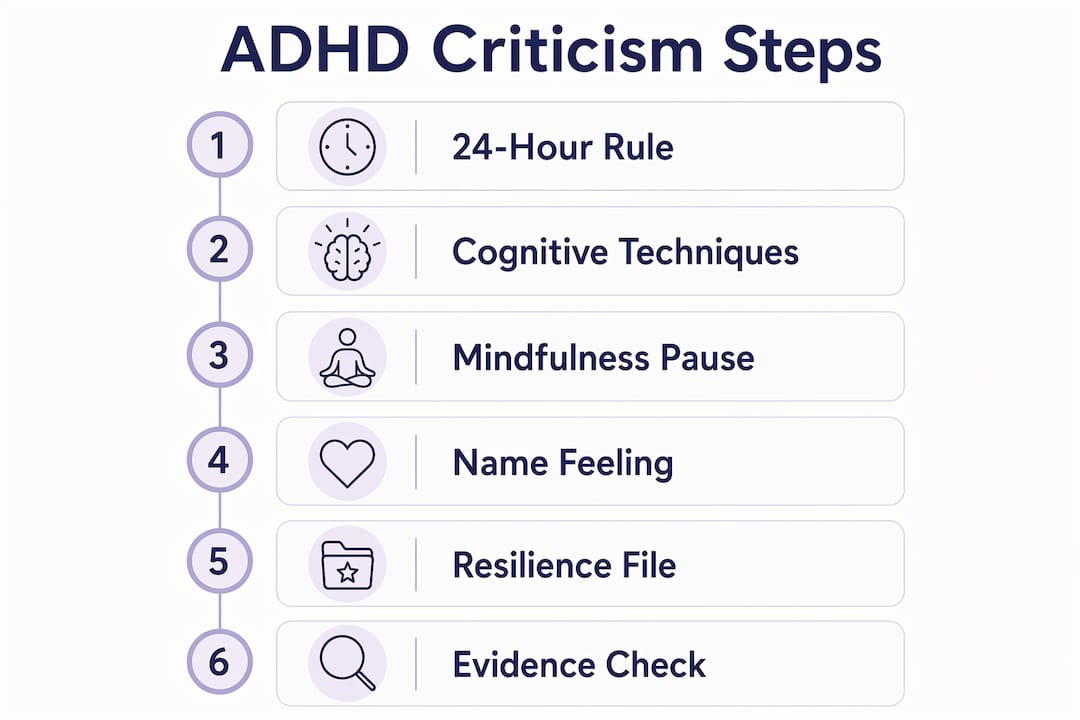
The most effective approach to managing ADHD feedback combines emotional regulation techniques with cognitive reframing. No single tool works for everyone, but the following methods have strong clinical backing.

1. The 24-hour rule
The 24-hour rule is clinically recommended for adults with ADHD who receive criticism. The rule is simple: do not respond to criticism for at least 24 hours. That waiting period shifts your nervous system from fight-or-flight mode into logical thinking mode. What felt like a devastating attack on Monday morning often looks like a minor comment by Tuesday. Text your response into the notes app on your phone, then delete it. Get the words out without sending them.
2. Cognitive Behavioral Therapy (CBT) techniques
CBT and Dialectical Behavior Therapy (DBT) are both effective for managing the catastrophic thinking that criticism triggers in adults with ADHD. CBT teaches you to examine the evidence behind a critical thought. DBT adds distress tolerance skills, which help you survive the emotional spike without acting on it. You do not need to be in formal therapy to use these frameworks. A CBT thought record, where you write down the thought, the evidence for it, and the evidence against it, takes five minutes and interrupts the shame spiral before it gains momentum. Working with a CBT or DBT therapist provides structured guidance if you want professional support.
3. Mindfulness as a pause button
Mindfulness does not stop you from feeling the pain of criticism. Its real value is creating a gap between the feeling and your response. That gap, even two or three seconds wide, is enough to choose a different reaction. A simple breath practice before responding to feedback gives your prefrontal cortex time to come back online.
4. Name the feeling (and maybe give it a silly name)
Naming your emotional response creates cognitive distance from it. Practitioners recommend labeling the trigger to interrupt the immediate reaction pattern. Calling your RSD spike “Dave the Dragon” sounds ridiculous, but it works. When you name it, you are no longer inside the feeling. You are observing it. That shift is the difference between sending a regrettable email and sleeping on it.
5. Build a rejection resilience file
A rejection resilience file is a collection of positive feedback, accomplishments, and kind messages you have received. It acts as a counterweight to shame spirals by providing concrete evidence of your value beyond the criticism moment. Keep it in a folder on your phone. When RSD hits, open the file before you do anything else. The goal is not toxic positivity. The goal is accurate evidence.
6. Evaluate the evidence before reacting
Pausing to examine the evidence behind a critical thought reduces misinterpretation and emotional escalation. Ask yourself: Is this criticism factually accurate? Is it about my behavior or my identity? Is the person qualified to make this judgment? Three questions, thirty seconds, and you have already reduced the emotional charge significantly.
Pro Tip: Set a phone alarm labeled “24 hours” the moment you receive criticism that stings. When it goes off, re-read the comment. You will be surprised how different it looks.
How can communication strategies reduce the impact of criticism?
Handling criticism ADHD-style also means shaping the environment so criticism arrives in a form your brain can actually process. You have more control over this than you think.
Written feedback is easier to process than verbal criticism delivered in real time. Verbal feedback hits your emotional system before your logical brain can engage. Written feedback gives you time to read, re-read, and regulate before responding. Ask your manager, partner, or collaborator to send feedback by email or message when possible. Frame it as a preference, not a limitation.
Additional communication strategies that reduce the sting of criticism:
- Request specific feedback. Vague criticism like “this isn’t quite right” is a breeding ground for RSD. Ask for specifics: “Can you tell me exactly what needs to change?” Specificity removes the ambiguity your brain fills with worst-case interpretations.
- Schedule feedback conversations. Surprise criticism is harder to process than planned feedback. Ask for a set time: “Can we schedule 15 minutes to go over your thoughts?” That preparation window lets your nervous system settle before the conversation starts.
- Set boundaries around tone. You are allowed to say, “I hear your feedback and I want to address it. Can we talk about it when we are both calm?” That is not avoidance. That is self-awareness applied to communication.
- Explain your needs to people who matter. Telling a trusted colleague or partner that you process criticism more intensely is not weakness. It is information. People who care about you will adjust. People who do not adjust are giving you useful information about the relationship.
The ADHD workbook for women by Estelle-rose includes structured exercises for practicing these communication scripts in low-stakes situations before you need them in high-pressure ones.
What challenges come up when applying these strategies?
Progress with coping strategies is not linear. You will have weeks where the 24-hour rule feels automatic, followed by a day where one comment sends you into a full RSD spiral. That is normal. It is not failure.
Emotional relapse is the most common challenge. You apply a strategy successfully for a month, then a particularly sharp piece of criticism bypasses every tool you have. The shame that follows the relapse often feels worse than the original criticism. The antidote is self-compassion, not self-criticism. Beating yourself up for struggling with RSD is RSD eating itself.
Reactive behaviors at work or in relationships are the highest-stakes risk. Sending an angry email, withdrawing completely, or over-explaining defensively are all common ADHD responses to criticism. The 24-hour rule exists specifically for these moments. If you have already reacted impulsively, the repair conversation is still possible. Acknowledging the reaction without excessive self-flagellation is a skill worth practicing.
Support groups and coaching offer ongoing normalization and strategy sharing that reduces the isolation criticism sensitivity creates. Knowing that other adults with ADHD experience the same intensity of reaction removes the layer of shame that says “I am broken.” That normalization is not a small thing. It is often the turning point.
“Progress with ADHD is not about eliminating the feeling. It is about shrinking the gap between the feeling and your next wise choice.”
Pro Tip: Keep a one-sentence log of small wins. “I waited 24 hours before responding to that email.” “I asked for written feedback instead of a verbal review.” Small wins compound. They are the foundation of ADHD coping strategies that actually stick.
Key takeaways
Adults with ADHD can manage criticism more effectively by combining the 24-hour rule, CBT and DBT techniques, written feedback requests, and a rejection resilience file to reduce the emotional impact of RSD.
| Point | Details |
|---|---|
| RSD is neurological, not personal | Nearly one-third of adults with ADHD rate RSD as their hardest symptom, harder than inattentiveness. |
| The 24-hour rule is your first line of defense | Waiting 24 hours before responding shifts your brain from fight-or-flight to logical thinking. |
| Name the feeling to defuse it | Labeling your emotional response creates cognitive distance and interrupts impulsive reactions. |
| Request written and specific feedback | Written feedback gives your brain time to process criticism without real-time emotional flooding. |
| Build a rejection resilience file | Collecting positive evidence counterbalances shame spirals and provides accurate perspective. |
What I have learned about living with RSD
I spent years thinking my reaction to criticism was a personality flaw. Someone would give me perfectly reasonable feedback and I would spend three days replaying it, convinced I was fundamentally incompetent. The turning point was not a therapy breakthrough or a productivity system. It was learning the name “Rejection Sensitive Dysphoria” and realizing my brain had a documented, explainable pattern.
Naming RSD did not fix it. But it gave me something to work with. The 24-hour rule felt patronizing the first time I tried it. I thought, “I am an adult. I do not need to wait to respond to an email.” Then I read the draft I had written in the heat of the moment the next morning and deleted it with genuine relief.
The rejection resilience file is the tool I recommend most to adults I work with, because it is the one that surprises people. We are very good at cataloging evidence against ourselves. We are terrible at cataloging evidence for ourselves. The file fixes that imbalance. It is not about pretending criticism does not hurt. It is about making sure the evidence is complete.
Self-acceptance with ADHD is not a destination. It is a daily practice of choosing accurate thinking over catastrophic thinking, one 24-hour window at a time. You are not too sensitive. You are wired differently, and that wiring comes with real strengths alongside the challenges.
— Estelle
Working with Estelle-rose on emotional regulation and criticism
Adults with ADHD who struggle with criticism sensitivity often need more than strategies on a page. They need a thinking partner who understands how the ADHD brain actually works under pressure.

Estelle-rose offers executive function coaching that addresses emotional regulation directly, including practical work on RSD, feedback processing, and building the kind of self-trust that makes criticism feel less catastrophic. The coaching is designed for adults who are done white-knuckling their way through feedback and ready to build a system that works with their brain. Explore the ADHD books and resources from Estelle-rose for self-paced support, or connect directly for personalized coaching.
FAQ
What is Rejection Sensitive Dysphoria in adults with ADHD?
Rejection Sensitive Dysphoria (RSD) is intense emotional pain triggered by perceived criticism, rejection, or failure. Nearly one-third of adults with ADHD identify it as their most difficult symptom.
How does the 24-hour rule help with ADHD criticism sensitivity?
Waiting 24 hours before responding to criticism allows the nervous system to shift from fight-or-flight mode to logical thinking. It prevents impulsive reactions that often make the situation worse.
Can therapy help adults with ADHD handle criticism better?
CBT and DBT are both effective for managing the catastrophic thinking and emotional dysregulation that criticism triggers in adults with ADHD. CBT reframes negative interpretations; DBT builds distress tolerance.
What is a rejection resilience file and how do I start one?
A rejection resilience file is a saved collection of positive feedback, compliments, and accomplishments. Start by saving three pieces of positive feedback you have received, then add to it whenever criticism hits hard.
How do I ask for feedback in a way that works for my ADHD brain?
Request written feedback instead of verbal, and ask for specific comments rather than general impressions. Scheduling feedback conversations in advance also gives your nervous system time to prepare.

