
Why Written Agendas Help ADHD: A Practical Guide
Why Written Agendas Help ADHD: A Practical Guide
TL;DR:
- Written agendas act as external brains for adults with ADHD, reducing decision fatigue and supporting working memory. They provide structure, help initiate tasks, and lower overwhelm by externalizing priorities, which is essential given ADHD’s executive function deficits. Using simple tools like index cards and following routines such as the 1-3-5 rule can foster consistent organization and alleviate emotional stress linked to forgetfulness.
Written agendas work for many adults with ADHD because they function as an external brain, pulling decisions and priorities out of your head and onto a surface you can actually see. You don’t have to trust your working memory. The agenda does that job for you. Want to test this tonight? Write exactly three tasks on an index card using the 1-3-5 rule (one big task, three medium, five small), set a short timer tomorrow morning, and start the top task the moment it goes off. That’s the whole experiment. Five minutes of setup, and you’ll know whether this works for you.
Table of Contents
- Why do written agendas help ADHD so much?
- How written agendas work with your ADHD brain
- Paper vs. digital agendas: which one actually works for you?
- What makes an agenda actually ADHD-friendly?
- Simple systems that make written agendas stick
- How to use a written agenda in meetings, daily work, and projects
- Ready-to-use templates and a 5-minute start routine
- Common pitfalls with written agendas and how to fix them
- What the research and coaches say about written agendas
- Key Takeaways
- The part nobody talks about enough
- How Estelle-rose can help you make this stick
- Useful sources
Why do written agendas help ADHD so much?
The short answer: they reduce the number of decisions your brain has to make in real time. For adults with ADHD, that matters more than it sounds.
Working memory in ADHD tends to be unreliable. You hold a task in mind, get interrupted, and it’s gone. A written agenda captures tasks immediately before they decay, so you’re not burning mental energy trying to remember what you were supposed to do next. The result is less decision fatigue and a lower barrier to actually starting.
Here’s what that looks like in practice:
- Memory support: A daily task list kept to one to three items means you open your planner and know exactly what to do. No scanning, no deliberating.
- Task initiation: Seeing a concrete next action written down (“write intro paragraph, 20 min”) removes the ambiguity that often causes freeze.
- Reduced overwhelm: Limiting your list to a small number of tasks prevents the mental pile-up that triggers avoidance.
- Meeting engagement: A written meeting agenda gives you anchor points to return to when your attention drifts, so you stay in the conversation instead of losing the thread.
- Lower anxiety: When everything is written down, you stop running a background mental loop of “what am I forgetting?” That loop is exhausting. Closing it frees up real cognitive space.
Research on organizational interventions for ADHD shows moderate-to-large effect sizes for external scaffolding strategies, including visual boards, structured task lists, and environmental triggers. The evidence isn’t just anecdotal.
How written agendas work with your ADHD brain
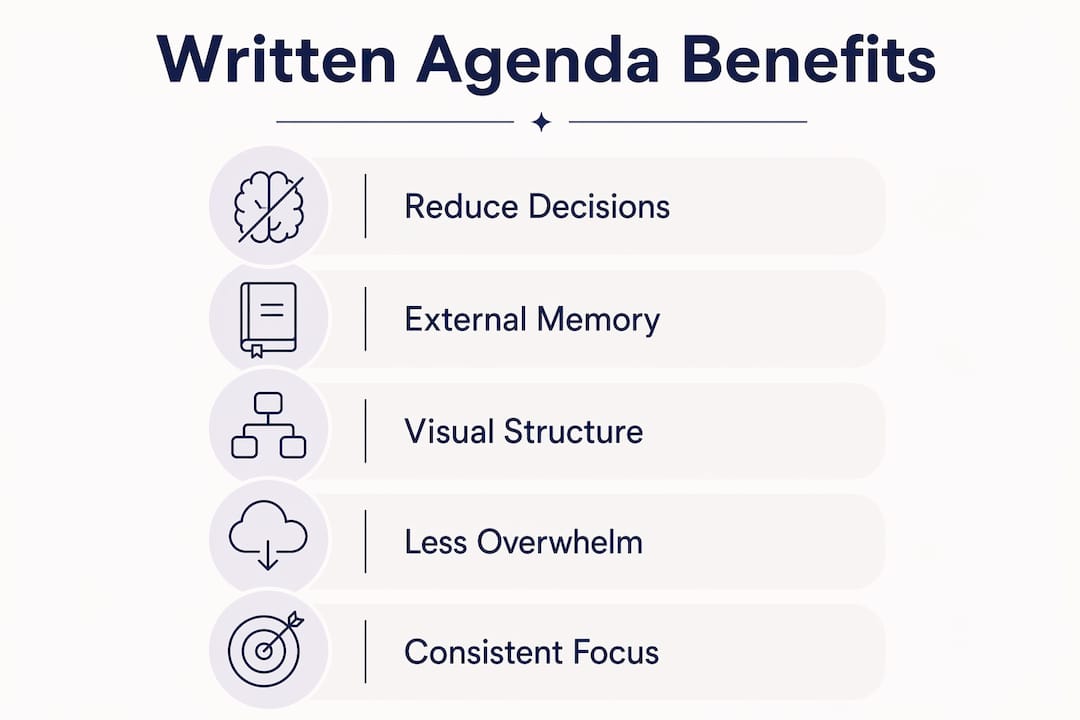
The mechanism is straightforward. ADHD involves deficits in executive function, the set of cognitive skills that handle planning, prioritizing, initiating, and monitoring tasks. When executive function is unreliable, you need external structure to do what a neurotypical brain does automatically.

A written agenda reduces cognitive load by externalizing decisions. Instead of holding your task list, your priorities, and your time estimates all in working memory simultaneously, you offload them onto paper or a screen. Your brain can then focus on doing the work rather than managing the logistics of the work.
Three specific mechanisms are at play:
- Working memory support: ADHD working memory holds less information and loses it faster. Writing tasks down prevents the “I’ll do that later” loop that ends with the task never happening.
- Executive function scaffolding: An agenda provides the structure your prefrontal cortex struggles to generate on its own. It tells you what to do next so you don’t have to figure it out mid-task.
- Time blindness compensation: Adults with ADHD often experience time as “now” or “not now.” Written time estimates and scheduled blocks create an external time structure that makes future tasks feel real and present.
Writing things down isn’t a workaround for a broken brain. It’s the same tool every high-performing professional uses to manage cognitive load. The difference for adults with ADHD is that it shifts from helpful to necessary.
Workplace meetings are consistently rated among the most challenging situations for adults with ADHD, partly because they demand sustained attention without a clear structure to follow. A written agenda changes that dynamic by giving you a visible map of where the conversation is going.
The downstream effects matter too. When you stop white-knuckling your way through the day trying to remember everything, you experience less shame around missed tasks, more momentum between tasks, and a quieter internal environment overall.
Paper vs. digital agendas: which one actually works for you?
Neither format is universally better. The right choice depends on your visibility needs, your distraction risk, and how you naturally capture information. Many adults with ADHD end up using both: digital for capture, physical for execution.
| Feature | Paper agenda | Digital agenda |
|---|---|---|
| Visibility | Always visible; no screen required | Requires opening an app or device |
| Capture speed | Slower; requires a pen | Fast; voice input or quick-add available |
| Distraction risk | Low; no notifications or app switching | Higher; device opens other apps |
| Portability | Portable but can be lost or forgotten | Syncs across devices; always accessible |
| Review habit | Tactile; crossing off tasks feels satisfying | Reminders and recurring tasks are automated |
Physically visible cues like index cards on your desk or a wall Kanban board provide passive exposure that works better for many ADHD adults than push notifications, which are easy to dismiss and forget.
When to choose paper:
- You find screens pull you into distraction
- You want the tactile satisfaction of crossing tasks off
- You work in one physical location most of the day
When to choose digital:
- You move between locations and need your agenda with you
- You want automated reminders for recurring tasks
- You prefer voice capture when ideas arrive fast
When to use both:
- Use a digital inbox (Notes app, voice memo) to capture tasks the moment they occur to you
- Transfer your top three tasks to a physical index card each morning for execution visibility
Pro Tip: Keep a single index card on your desk with today’s top three tasks written in large text. It stays visible without requiring you to open anything. Pair it with one digital reminder set for your start time.
What makes an agenda actually ADHD-friendly?

Most planners are designed for people who don’t have ADHD. They’re full of hourly grids, weekly spreads, and goal-setting pages that look great and create friction immediately. An ADHD-friendly agenda is built around low effort and high visibility.
The features that actually matter:
- Single capture inbox: One place to write everything as it arrives. Not a separate list for work, home, and errands. One list.
- “Next action” phrasing: Tasks written as specific physical actions, not vague categories. “Email Sarah the draft” beats “project follow-up” every time.
- WIP limits: A hard cap on how many tasks are active at once. Three is a good ceiling for most people.
- Visible priorities: Mark your top task clearly. A star, a circle, a number. One marker, not a color-coded system.
- Short time estimates: Write a rough time estimate next to each task. “30 min” next to a task makes it feel schedulable rather than abstract.
- A daily review slot: Two minutes at the end of the day to cross off completed tasks and carry forward anything unfinished. This is the habit that keeps the system alive.
What to avoid:
- Guilt architecture: Don’t design a planner that shows you everything you didn’t do. Carry forward only what still matters; archive or delete the rest.
- Perfectionism traps: A planner that requires neat handwriting, color coding, or elaborate setup will be abandoned. Messy and used beats beautiful and empty.
- Too many categories: The more sections your agenda has, the more decisions you have to make before you can use it.
The ADHD organization principles that work best are the ones with the lowest barrier to entry. If it takes more than 60 seconds to set up your daily agenda, simplify it.
Simple systems that make written agendas stick
A written agenda is a tool. These three rules are how you use it without burning out.
The 1-3-5 rule
Pick one big task, three medium tasks, and five small tasks for the day. Write them on your agenda in that order. The rule forces you to prioritize before you start and prevents the common trap of filling a list with small tasks to feel productive while avoiding the hard work.
How to apply it:
- Open your agenda each morning.
- Write “1:” and name your single most important task.
- Write “3:” and list three medium-effort tasks.
- Write “5:” and list five quick tasks (under 10 minutes each).
- Start with the “1” task immediately.
The 30% rule
When you estimate how long a task will take, add 30% to your first guess. MIT Human Resources guidance on meeting planning recommends increasing projected times by about 33% until you’ve built skill at estimation. The same principle applies to individual tasks. ADHD time blindness makes most people underestimate consistently.
How to apply it:
- Write your task and your first time estimate.
- Multiply by 1.3 and round up to the nearest 5 minutes.
- Schedule that padded estimate into your day.
Time-boxing
Assign each task a fixed time block on your agenda. “Write report intro: 9:00–9:30 AM.” When the block ends, you stop or consciously decide to extend it. Time-boxing creates urgency and prevents tasks from expanding indefinitely.
Quick adoption checklist:
- [ ] Set a physical or digital timer for each time block
- [ ] Write the start time next to each task on your agenda
- [ ] Use a visible timer on your desk (a Time Timer or similar) for extra urgency
- [ ] After each block, take a two-minute break before starting the next
Over-planning is avoidance. Cap your daily planning session at five minutes. Pick three tasks. Start the first one with a timer running.
How to use a written agenda in meetings, daily work, and projects
In meetings
Meetings without agendas are particularly hard for ADHD brains because there’s no visible structure to anchor attention. Before any meeting, write down one or two outcomes you want from it. “Agree on launch date” or “Clarify my role in the project.” That written intention keeps you oriented when the conversation drifts.
Sample meeting agenda template:
Meeting: [Topic]
Date/Time: [Date] at [Time]
Desired outcomes:
  1. [Outcome A]
  2. [Outcome B]
Agenda items:
  - [Item 1] — [Time allocated]
  - [Item 2] — [Time allocated]
Action items (fill during meeting):
  - [Task] — Owner: [Name] — Due: [Date]
Pro Tip: Asking for a written agenda before a meeting is professional practice, not a disclosure. Frame it as: “Could you send an agenda beforehand so I can come prepared?” It helps everyone, and it gives you the structure you need.
Reviewing your notes for five minutes immediately after a meeting preserves context before it fades. Cross off items that were resolved. Transfer action items to your daily agenda before you close your notebook.
In daily work
A filled daily agenda example:
Today — [Date]
1 (big): Finish client proposal draft — 90 min
3 (medium):
  - Review feedback from Tuesday's call — 30 min
  - Update project tracker — 20 min
  - Reply to three pending emails — 25 min
5 (small):
  - File receipts
  - Schedule dentist appointment
  - Text back Jordan
  - Print shipping label
  - Water the plant
In multi-step projects
Break the project into the smallest possible next actions and schedule each one as a separate agenda item across multiple days. Never write “work on project” as a task. Write “draft the first paragraph of the introduction” instead. When a task doesn’t get done, carry it forward to the next day’s agenda with a small arrow symbol. That carry-forward notation signals that the task still matters without triggering shame about the missed day.
Ready-to-use templates and a 5-minute start routine
Template 1: Daily 1-3-5 card
DATE: ___________
1 (big task): _________________________________ [___ min]
3 (medium tasks):
  a. _________________________________________ [___ min]
  b. _________________________________________ [___ min]
  c. _________________________________________ [___ min]
5 (small tasks):
  1. _________________ 2. _________________ 3. _________________
  4. _________________ 5. _________________
REVIEW (end of day): ✓ done  → carry forward  ✗ drop
Filled example:
DATE: Monday
1: Write first draft of newsletter — 45 min
3a: Respond to client brief — 20 min
3b: Update invoice tracker — 15 min
3c: Prep tomorrow's agenda — 5 min
5: Reply to Slack, buy stamps, book call, send file, check calendar
Template 2: Meeting agenda card
MEETING: ___________________  DATE: ________  TIME: ______
Desired outcomes: 1. _________________ 2. _________________
Items:
  □ _________________________________ [___ min]
  □ _________________________________ [___ min]
  □ _________________________________ [___ min]
Action items:
  → Task: _________________ Owner: ________ Due: ________
  → Task: _________________ Owner: ________ Due: ________
Post-meeting review (5 min): ✓ resolved  → transferred to daily agenda
Template 3: Project micro-step card
PROJECT: ___________________
Next action: _________________________________ [___ min]
Step after that: _____________________________ [___ min]
Blocked by: _________________________________
Carry-forward date: _________________________
The 5-minute start routine
- Open a blank card or page.
- Brain dump: write every task in your head in 90 seconds. Don’t filter.
- Pick your top three tasks from the dump.
- Write the top task as a specific next action with a time estimate.
- Set a timer for 25 minutes and start.
That’s it. Five minutes of planning, then you’re working.
Common pitfalls with written agendas and how to fix them
Problem: Overcomplication. You spend 30 minutes designing your planner system and never actually use it. Fix: Use a plain index card. One card, one day, three tasks. Add complexity only after the basic habit is solid.
Problem: Too many tasks. Your list has 20 items and you complete two. Fix: Apply the 1-3-5 rule strictly. Anything beyond nine tasks goes on a separate “someday” list, not today’s agenda.
Problem: Failing to review. Tasks pile up, the agenda becomes a guilt document, and you stop looking at it. Fix: Build a two-minute end-of-day review into your agenda. Cross off completed tasks. Carry forward only what still matters. Archive or delete the rest.
Problem: Perfectionism. You skip a day, feel bad about it, and abandon the system entirely. Fix: A missed day is just a missed day. Recovery is simple: open a new card, write three tasks, start the timer. The system resets in under five minutes.
Problem: App switching. You try a new productivity app every two weeks and never build a habit. Fix: Choose one format and commit to it for 30 days. Limiting tool-hopping is one of the most consistent recommendations in ADHD task management guidance. The tool matters less than the consistency.
Recovering after a week off: Don’t try to reconstruct what you missed. Open a fresh card. Write today’s three tasks. Start the timer. The system doesn’t require continuity to work; it just requires you to start again.
Managing ADHD overwhelm often comes down to this: lower the barrier to re-entry so that starting again feels smaller than staying stuck.
What the research and coaches say about written agendas
The evidence base for external scaffolding in ADHD is solid. Research supports structured organizational interventions as one of the most practical and accessible tools available to adults with ADHD.
Key findings:
- External scaffolding works. Meta-analytic evidence supports structured organizational strategies, including visual boards, written task lists, and environmental triggers, showing moderate-to-large effect sizes for organizational outcomes in ADHD.
- Immediate capture prevents memory loss. CHADD’s organizational guidance identifies writing things down immediately as a foundational strategy, because information decays faster in ADHD working memory than in neurotypical working memory.
- Meetings are a high-difficulty context. Practitioner resources citing a 2018 study identify workplace meetings as one of the top three most challenging situations for adults with ADHD, and written agendas directly address the anchor-point deficit that makes meetings hard.
- Lifestyle-based interventions complement written systems. ADHD lifestyle treatment approaches that combine structured planning with sleep, movement, and nutrition show stronger outcomes than planning alone.
The adults with ADHD who make the most consistent progress aren’t the ones with the most sophisticated systems. They’re the ones who use the simplest system every single day. A three-task index card, used daily, outperforms a beautifully designed planner used twice a month.
The ADD Resource Center’s guidance on ADHD planners reinforces this: the goal of any planner is to reduce friction, not add it. If your system requires effort to maintain, it will be abandoned.
For a deeper look at how executive function deficits shape the way ADHD adults experience planning and organization, the ADHD books available through Estelle-rose cover these mechanisms in practical, accessible detail.
Key Takeaways
Written agendas help adults with ADHD because they externalize working memory, reduce decision fatigue, and provide visible structure that executive function alone cannot reliably generate.
| Point | Details |
|---|---|
| External brain principle | Writing tasks down immediately prevents memory decay and removes the need to hold priorities in working memory. |
| 1-3-5 rule for daily planning | Limit each day to one big task, three medium tasks, and five small tasks to prevent overwhelm and force prioritization. |
| Visibility beats notifications | Physically visible cues like index cards and wall boards provide passive reminders that work better for many ADHD adults than push alerts. |
| Recovery is always available | A missed day requires only a fresh card and three tasks; the system resets in under five minutes with no continuity required. |
| Estelle-rose coaching and resources | Estelle-rose offers ADHD coaching and workbooks that help adults build and maintain agenda habits tailored to their specific profile. |
The part nobody talks about enough
Most articles about written agendas for ADHD focus on the productivity angle. Get more done. Miss fewer deadlines. Stay organized. All of that is real. But the part that tends to go unmentioned is the emotional one.
When you’re running on working memory alone, every missed task feels like a character flaw. You forgot the meeting, you didn’t send the email, you lost the note. And because it keeps happening, you start to believe the story that you’re unreliable, careless, or just not trying hard enough. That story is exhausting and it’s not accurate.
A written agenda doesn’t just help you get things done. It removes the conditions that generate that story in the first place. When tasks are written down and visible, forgetting them becomes a system failure, not a personal one. That’s a meaningful shift. It moves the problem from inside you to outside you, where it can actually be fixed.
The permission statement worth keeping: you don’t need a perfect system. You need a system you’ll actually use. Start with one index card. Use it badly. Use it inconsistently. Keep using it. The habit builds from repetition, not from getting it right.
If you’re a creative, a freelancer, or someone running a business with ADHD, the stakes of staying organized feel higher because they are. A coaching relationship can help you design a system that fits your actual life rather than the life a productivity book assumes you have.
How Estelle-rose can help you make this stick
Knowing why written agendas work is one thing. Building the habit when your brain actively resists routine is another. That’s where personalized ADHD coaching makes a concrete difference: a coach helps you design a system that fits your specific work style, holds you accountable between sessions, and troubleshoots the exact points where your current approach breaks down.

Estelle-rose works with adults with ADHD, including creatives, entrepreneurs, and self-employed professionals, to build practical organizational habits grounded in how ADHD actually works. Sessions focus on real-world application: which agenda format fits your day, how to build the review habit, and how to recover quickly when the system slips. The ADHD workbook for women offers a structured, self-paced alternative with templates and exercises you can start using today.
If you’re ready to move from understanding the system to actually using it, book a discovery call with Estelle-rose and build your first working agenda in the first session.
Useful sources
These are the primary sources used in this article. Each one is worth reading if you want more evidence or ready-to-use templates.
-
CHADD: Organizing an ADHD Brain — A clinical summary from one of the most authoritative ADHD organizations in the US. Covers working memory, immediate capture, and foundational organizational strategies for adults.
-
ADD Resource Center: ADHD Planners for Adults — Practical guidance on choosing and using planners designed for ADHD adults, with a focus on reducing friction and building review habits.
-
MIT Human Resources: How and Why to Use a Meeting Agenda — Clear, evidence-informed guidance on agenda structure, time estimation, and desired outcomes. Directly applicable to the meeting templates in this article.
-
Journey Mental Health: ADHD Lifestyle Treatment Approach — A practical overview of lifestyle-based interventions that complement written planning systems, including sleep, movement, and structured routines.
-
Estelle-rose: Adult ADHD Executive Function — Explains how executive function deficits shape planning and organization for adults with ADHD, and how structured tools compensate. Useful for readers who want to understand the cognitive basis of the strategies in this article.
-
Estelle-rose: ADHD Books and Workbooks — Self-help books and downloadable workbooks covering executive function, organization, and emotional regulation for adults with ADHD. A practical next step for readers who prefer self-directed learning.

