
Women With ADHD: UK Coaching and ADHD’s 1.7–1.9× Entrepreneurship Link
Women With ADHD: UK Coaching and ADHD’s 1.7–1.9× Entrepreneurship Link
A practical approach is straightforward: lean into creativity and risk tolerance, then build executive-function support around the gaps. A good first step is to take the ASRS screening checklist or book a short coaching intro to see what structure actually fits.
TL;DR:
- A study of 9,869 university students found clinical ADHD linked to 1.7 to 1.9 times higher odds of starting ventures, though its sample limits generalization.
- Impulsivity and hyperactivity correlate with faster venture creation, while unsupported inattention can hinder operations; use checklists or shared boards to externalize memory.
- Track energy for a week before scheduling; then reserve 25 to 45 minute creative sprints and a weekly focus block around your highest energy periods.
- UK applicants who are self employed can seek Access to Work funding for coaching, equipment, or support workers, but typically must show business viability.
Table of Contents
- What the evidence and UK data say about ADHD and entrepreneurship
- ADHD-linked strengths and how to channel them into business wins
- Managing masking, executive dysfunction, and social or funding barriers
- Systems and scheduling that actually work for ADHD brains
- Where to find community, coaching, and workplace support
- A note on late diagnosis and building a founder identity that fits
- Ready for coaching built around how your brain actually works?
- FAQ
- Sources
What the evidence and UK data say about ADHD and entrepreneurship
A large-scale study found that people with a clinical ADHD diagnosis were about 1.7 to 1.9 times more likely to initiate entrepreneurial action than those without ADHD, drawn from a sample of roughly 9,869 university-enrolled adults. That’s a meaningful signal, though the sample skews toward a specific age group and education level, so it doesn’t capture every founder’s path.
Diagnosis patterns matter here too. The NHS Adult Psychiatric Morbidity Survey found more women than men screen positive for ADHD, reflecting a pattern of later recognition in women.
The ASRS-v1.1 is the screening checklist clinicians and researchers commonly use to flag adults who may benefit from a formal assessment. Peer-reviewed work also shows that symptom type shapes outcomes:
- Impulsivity and hyperactivity tend to correlate with faster venture creation.
- Inattention alone, without support systems, tends to correlate with more operational struggle.
More women than men screen positive for ADHD in the latest NHS survey, which tracks with the pattern of women getting diagnosed later in life, often after years of misattributed symptoms.
ADHD-linked strengths and how to channel them into business wins
Peer-reviewed literature connects ADHD-related behaviors like impulsivity and high energy with entrepreneurial tendencies, while noting that outcomes vary by individual symptom profile. Translated into daily business life, that research points to a few repeatable strengths.
- Creativity: use it for product naming, content angles, or solving a client problem nobody else thought to address.
- Calculated risk-taking: use it to test a new offer or price point before competitors move.
- Rapid ideation: use it in brainstorming sessions, then hand the list to a system (not your memory) for follow-up.
- Hyperfocus: use it for deep creative or technical work, scheduled during your highest-energy window.
To amplify these without burning out, try time-boxed creative sprints of 25 to 45 minutes, a single “capture everything” inbox for ideas so nothing competes for mental bandwidth, and a weekly block reserved specifically for hyperfocus work rather than hoping it shows up on schedule.
Pro Tip: Track your energy for one week before building any schedule. Build the plan around your real patterns, not the one you wish you had.

Managing masking, executive dysfunction, and social or funding barriers
Masking, the effort of suppressing ADHD traits to appear more conventionally organized, is a real and often invisible cost. Practitioner accounts and lived-experience podcasts describe it as a drain on cognitive resources that could otherwise go toward the business. One low-effort fix: pick one meeting style (camera on or off, live or async) and stick with it instead of renegotiating every time.
For executive function gaps, four tactics hold up well:
- Chunk tasks into steps small enough to finish in one sitting.
- Apply the two-minute rule: if it takes under two minutes, do it immediately instead of queuing it.
- Externalize memory with checklists, voice notes, or a shared board instead of relying on recall.
- Use visual timers so time stays visible instead of abstract.
On funding and networking, structural barriers like funding bias and extra scrutiny show up more often for women. Countering that means preparing a one-minute traction script, leading with concrete evidence of customer interest, and asking a trusted introducer to open investor conversations rather than cold-pitching alone.
Pro Tip: If masking, overwhelm, or money stress start affecting daily function, that’s the signal to bring in a clinician, an ADHD coach, or to look into a formal support scheme rather than pushing through alone, including how to get a valid ESA letter for ADHD as part of emotional support options.
Systems and scheduling that actually work for ADHD brains
A workable weekly rhythm beats a rigid to-do list for most ADHD founders. Try this shape: a Monday planning ritual, tasks assigned to your actual energy levels rather than the clock, one dedicated admin day, and a short Friday review.
- Visual project boards keep work visible instead of buried in a notebook.
- Simple automations (recurring invoices, scheduled social posts) remove repetitive decisions.
- Calendar blockers protect focus time from getting eaten by meetings.
- Basic financial tracking (even a simple spreadsheet) prevents money anxiety from derailing focus.
Accountability works best in a format you’ll actually show up for: a weekly peer check-in, a scheduled coaching session, or a single accountability partner you message daily. To cut decision fatigue, keep a short checklist of defaults (what time you start work, what you eat for lunch, how you triage email) so those choices stop costing you energy.
Where to find community, coaching, and workplace support
Peer communities help most when they’re moderated, focused on practical tactics rather than only venting, and sized small enough that you’re not shouting into a void. Look for Facebook groups, podcasts, or local meetups built specifically around ADHD and business, not general entrepreneurship spaces where ADHD gets treated as a footnote.
Coaching adds structure a community can’t: a dedicated session to break down a stuck project, build accountability into your week, and develop skills like task initiation or time estimation. A first session usually starts with mapping where things are breaking down, not a generic pep talk.
For self-employed readers in the UK, the government’s Access to Work scheme can fund coaching, equipment, or support workers to remove barriers tied to a disability or health condition, including ADHD. Self-employed applicants typically need to show evidence of business viability as part of the application.
- Free starting points: NHS ASRS information, local library resources, and ADHD-focused webinars.
A note on late diagnosis and building a founder identity that fits
Getting diagnosed later in life often brings relief and grief at once: relief at finally having an explanation, grief over years spent masking and overcompensating. Both are normal, and neither means you’re behind.
Instead of chasing a perfect system, test one small change for two weeks: a single planning ritual, one capture tool, one accountability check-in. See what sticks before adding the next piece. Share what you learn with a community that gets it; you’ll move faster with people who’ve already solved the same problem.
— Estelle
Ready for coaching built around how your brain actually works?
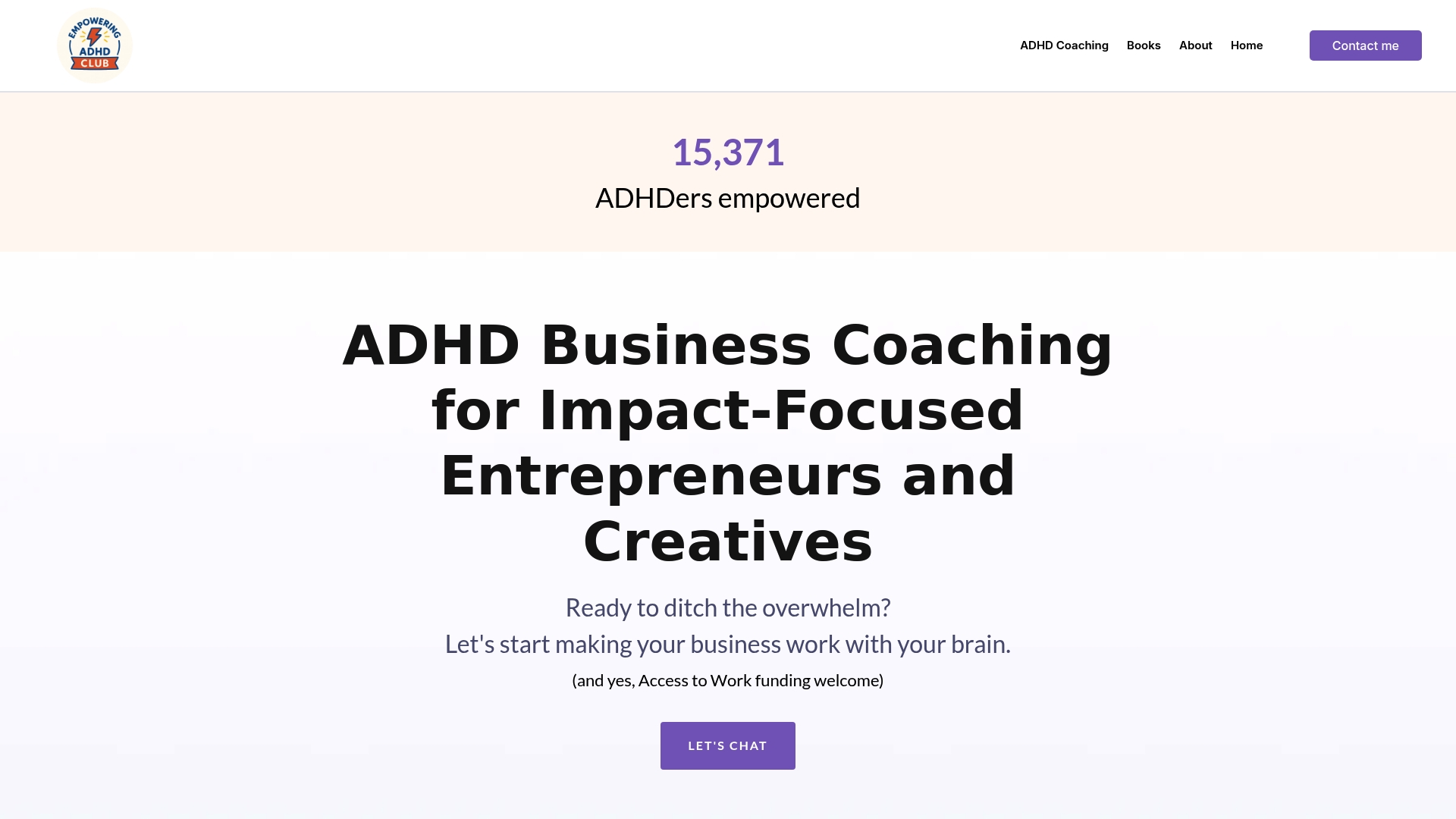
We run ADHD Business Coaching for Impact-Focused Entrepreneurs and Creative Freelancers, along with training and consulting for organizations that want to support ADHD team members well. For readers who want self-guided tools first, our workbook collection includes The Empowering ADHD Workbook for Women and the Adult ADHD Executive Function 7-Week Power-Up.
This combination of one-to-one coaching and structured workbooks works well if you recognize yourself in the masking, funding stress, or executive-function gaps covered above and want a direct, personalized way through them rather than piecing it together solo.
- Founders who need accountability built into their week.
- Creatives who want executive-function support without losing their creative edge.
- Anyone newly diagnosed who wants a clear starting structure.
Book an intro coaching session or explore our full range of ADHD books and workbooks to start with the tool that fits where you are right now.
FAQ
Do people with ADHD do well as entrepreneurs?
Many do, particularly when they build systems around executive-function gaps instead of relying on willpower alone. A large-scale study found people with clinical ADHD were roughly 1.7 to 1.9 times more likely to initiate entrepreneurial action, though outcomes vary by symptom profile and available support.
What are the characteristics of quiet ADHD in women?
What’s sometimes called quiet or inattentive-type ADHD in women often looks like daydreaming, trouble finishing tasks, chronic lateness, or quietly overworking to compensate rather than visible hyperactivity. Because these traits are less disruptive to others, they’re frequently missed or misread as anxiety or disorganization rather than ADHD.
Why are so many women getting ADHD diagnoses in midlife?
Diagnostic criteria were built around how ADHD shows up in boys, so many women masked symptoms for years before being recognized. The NHS Adult Psychiatric Morbidity Survey found 14.9% of women screened positive for ADHD compared with 12.4% of men, a gap consistent with later identification in women.
What is the best job for ADHD women?
There’s no single best job, but ADHD entrepreneurs and creatives often do well in roles with variety, autonomy, and room for hyperfocus, such as running their own business, consulting, or creative freelancing. The right fit usually comes down to building the surrounding structure, not the job title itself.
Sources
- Entrepreneurship and attention deficit/hyperactivity disorder: a large-scale study involving the clinical condition of ADHD
- Adult Psychiatric Morbidity Survey (APMS) — Attention-deficit/hyperactivity disorder
- Access to Work
- Exploring the association between attention-deficit/hyperactivity disorder and entrepreneurship (PMC article)

